
Search results will appear as highlighted text.
Quick Navigation
PREFACEINTRODUCTIONTHE SEVENTY WEEKS REACH THEIR FULFILMENTTO FINISH THE TRANSGRESSION AND MAKE AN END OF SINSTO MAKE RECONCILIATION AND BRING IN EVERLASTING RIGHTEOUSNESSTO SEAL UP THE VISION AND PROPHECYTO ANOINT THE MOST HOLYHE SHALL CONFIRM THE COVENANTSACRIFICE AND OBLATION CEASE IN JESUS CHRISTTHE FINAL THREE AND A HALF YEARSWHEN DID THE SEVENTIETH WEEK END? A.D. 34ONE NEW COVENANT PEOPLE IN JESUS CHRISTCONCLUSION: THE PROPHECY IS FULFILLED IN JESUS CHRISTMODULE CONCLUSION: DANIEL'S SEVENTY WEEKS FULFILLED IN JESUS CHRISTSUBMISSION TO COGMA FOR APPRAISAL
INSTRUCTIONS FOR THE STUDENT
My Study Plan
Preparing a Study Plan before starting this Study Guide will assist you in completing it within a designated timeframe. It also helps in developing the discipline required for studying God’s Word effectively.
Proverbs 16:3:
Commit thy works unto the LORD, and thy thoughts shall be established.
My Study Guide Journal
Keep a record as you progress through your Study Guide, including the Personal Responses for each section, for future reference and goal setting.
Content
- PREFACE
- INTRODUCTION
- THE SEVENTY WEEKS REACH THEIR FULFILMENT
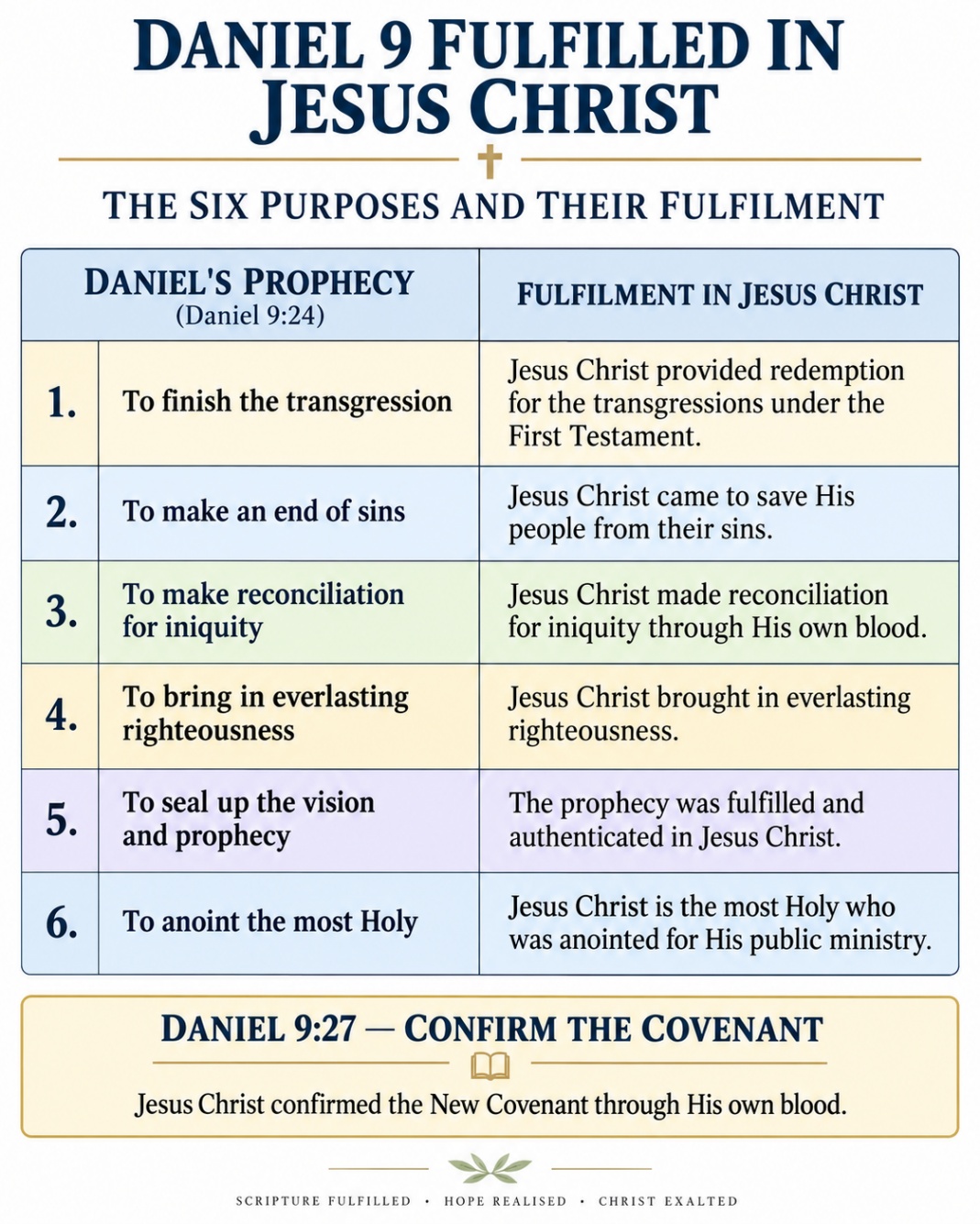
- TO FINISH THE TRANSGRESSION AND MAKE AN END OF SINS
- TO MAKE RECONCILIATION AND BRING IN EVERLASTING RIGHTEOUSNESS
- TO SEAL UP THE VISION AND PROPHECY
- TO ANOINT THE MOST HOLY
- HE SHALL CONFIRM THE COVENANT
- SACRIFICE AND OBLATION CEASE IN JESUS CHRIST
- THE FINAL THREE AND A HALF YEARS
- WHEN DID THE SEVENTIETH WEEK END? A.D. 34
- ONE NEW COVENANT PEOPLE IN JESUS CHRIST
- CONCLUSION: THE PROPHECY IS FULFILLED IN JESUS CHRIST
- MODULE CONCLUSION: DANIEL'S SEVENTY WEEKS FULFILLED IN JESUS CHRIST
Important Points
- COGMA does not claim to be infallible or the authority.
- Infallibility and authority belong only to God and His Word.
COGMA therefore strongly advises that you prayerfully study the content of each Study Guide with the heart of a Berean (Acts 17:10–12).
Contact and Links
Website: cogma.com.au
Email: admin@cogma.org.au
Radio COGMA: radiocogma.com
YouTube: youtube.com/@COGMAChannel
PREFACE
This final Study Guide in the Daniel's Seventy Weeks module brings the prophecy to its fulfilment in Jesus Christ. The first Study Guide established what the prophecy means. The second followed the prophetic timeline from the command to restore Jerusalem through the appearance of Messiah the Prince and His being cut off in the midst of the seventieth week.
We now come to the purpose towards which the entire prophecy has been moving.
Daniel's seventy weeks were not given simply so that dates could be calculated correctly. The chronology matters because it leads to Jesus Christ and identifies the work He would accomplish.
The prophecy declares that transgression would be finished, sins would be dealt with, reconciliation would be made, everlasting righteousness would be brought in, the vision and prophecy would be sealed, and the most Holy would be anointed. It also declares that Messiah would confirm the covenant and cause sacrifice and oblation to cease in their divine purpose.
These are not disconnected prophetic statements. They belong together. And they are fulfilled in Jesus Christ.
The chronology has already brought us to the central events. Messiah the Prince was revealed in A.D. 27. Jesus Christ was crucified on the 14th of Nisan, A.D. 31, in the midst of the seventieth week. Three and a half years then remained before the full seventy-week period reached its conclusion in A.D. 34.
This Study Guide will examine what was accomplished through Jesus Christ within that determined period and how the seventieth week reached its completion. It will also carefully distinguish between the establishment of the New Covenant and the completion of Daniel's seventy weeks.
The Church did not begin in A.D. 34.
The Gospel Day began at Pentecost in A.D. 31, when Jesus Christ came to His people as the Holy Spirit. A.D. 34 marks the completion of Daniel's determined period and an important transition in the outward direction of the Gospel mission.
Throughout this study, Jesus Christ must remain the centre.
The prophecy does not finish with Israel. It does not finish with Stephen. It does not finish with Saul. It does not finish with chronology.
All of those events must be understood in relation to the One to whom the prophecy points. The final question is therefore not simply when the seventy weeks ended. The final question is what their fulfilment reveals about Jesus Christ.
That is the purpose of this Study Guide.
Daniel's seventy weeks were fulfilled in Jesus Christ.
Personal Response
Key Truth
Why does completing the seventy weeks lead us to Christ's work rather than dates alone?
Personal Reflection
What do you hope to understand more clearly about what Jesus has accomplished?
Action Step
Which purpose in Daniel 9:24 will you keep in view as you begin?
INTRODUCTION
Daniel's seventy weeks prophecy reaches far beyond the calculation of dates. The chronology identifies when Messiah the Prince would appear and when He would be cut off, but the prophecy also declares what would be accomplished within the determined period. This final Study Guide in the module will examine that fulfilment.
The central question is no longer simply: When did the events occur? The question is: What was accomplished through Jesus Christ?
Daniel identifies specific purposes connected with the seventy weeks. Transgression would be finished. An end would be made of sins. Reconciliation would be made for iniquity.
Everlasting righteousness would be brought in. The vision and prophecy would be sealed. The most Holy would be anointed.
Daniel also declares that the covenant would be confirmed and that sacrifice and oblation would cease in their divine purpose. These statements must be examined from Scripture. Each one leads us to Jesus Christ.
This Study Guide will therefore move carefully through the purposes of the prophecy and establish how they were fulfilled. Particular attention will be given to the saving work of Jesus Christ, the New Covenant, the fulfilment of the Old Covenant sacrificial system, and the completion of the seventieth week.
The final three and a half years of the prophecy must also be considered. The crucifixion occurred in the midst of the seventieth week, so the determined period continued beyond A.D. 31. The question of how the remaining years reached their conclusion in A.D. 34 will be examined later in this Study Guide.
That conclusion must be understood within the historical and covenant setting of Daniel's prophecy. The seventy weeks had been determined upon Daniel's people and Daniel's holy city. Yet the fulfilment of the prophecy leads beyond the former Old Covenant order into the New Covenant reality established through Jesus Christ.
The focus throughout must remain upon Him.
This is not a study of prophecy for the sake of prophecy. It is not an attempt to construct another prophetic system. It is not an exercise in chronology detached from the Gospel.
The purpose is to see how God's Word was fulfilled and how that fulfilment reveals Jesus Christ. The prophecy foretold Messiah. The timeline identified Messiah. The work of Messiah fulfilled the purposes of the prophecy.
The completion of the seventy weeks confirms the faithfulness of God's Word. This final Study Guide will therefore bring the module to its proper conclusion: Daniel's seventy weeks were fulfilled in Jesus Christ.
Personal Response
Key Truth
How do the purposes of the prophecy and its chronology belong together in Jesus Christ?
Personal Reflection
Why does asking what Christ accomplished matter to your faith?
Action Step
Which saving purpose will you examine through its supporting verses?
THE SEVENTY WEEKS REACH THEIR FULFILMENT
Daniel's seventy weeks form one complete prophetic period. They begin with the command to restore and build Jerusalem, move through the appearance of Messiah the Prince, include His being cut off in the midst of the seventieth week, and continue until the full 490 years are complete.
The chronology has already been established:
- 457 B.C.: The command to restore and build Jerusalem;
- A.D. 27: Messiah the Prince revealed;
- A.D. 31: Messiah cut off in the midst of the seventieth week;
- A.D. 34: Completion of the full seventy-week period.
The prophecy therefore has a beginning, a middle and an end.
The Full 490 Years Must Be Completed
Daniel did not say that sixty-nine weeks would be fulfilled and the final week would be separated from the prophecy. He said: “Seventy weeks are determined.” The Hebrew word CHATHAK means “to cut off.” A complete prophetic period of seventy SHABUA was cut off upon Daniel's people and Daniel's holy city.
Seventy SHABUA equal 490 years. Therefore, all 490 years belong to the same prophecy. The final week is not optional, detached or postponed. It completes the determined period.
The Prophecy Reaches Messiah
The first sixty-nine weeks lead to Messiah the Prince, and that point is reached in A.D. 27. The final week then begins with Jesus Christ already at the centre. This is important because the seventieth week must be interpreted through Messiah.
Daniel does not move away from Jesus Christ once the sixty-nine weeks are complete. He moves more deeply into the work of Christ. Messiah is revealed. Messiah is cut off.
Messiah confirms the covenant. Messiah causes sacrifice and oblation to cease in their divine purpose. The final week belongs to Jesus Christ.
The Midpoint Does Not End the Prophecy
The crucifixion occurred in the midst of the seventieth week. That means the prophecy did not end at the cross. Three and a half years still remained. This is a simple but important point.
A seven-year week divided in half gives:
3½ years + 3½ years = 7 years.
The first half reaches from A.D. 27 to A.D. 31. The second half continues from A.D. 31 to A.D. 34. The prophetic period therefore continues after the crucifixion.
Personal Response
Key Truth
Why does the crucifixion at the midpoint leave part of the final week to be fulfilled?
Personal Reflection
How does distinguishing the midpoint from the end help you read the prophecy carefully?
Action Step
When will you trace the final week from A.D. 27 through A.D. 31 to A.D. 34?
The Purposes Were Being Fulfilled Through Jesus Christ
The continuing prophetic period does not mean that the work of Christ was incomplete. Jesus Christ had already accomplished the redemptive work that established the New Covenant. He had already made the perfect sacrifice, and the Old Covenant sacrificial system had already reached its divine fulfilment. The New Covenant was already in force.
The remaining three and a half years belong to the completion of the determined prophetic period, not to the completion of Christ's salvation. This distinction must remain clear.
Salvation was complete in Jesus Christ.
Paul wrote in Colossians 2:10:
“And ye are complete in him, which is the head of all principality and power:”
The word connected with “complete” is PLEROO, which carries the meaning of being made full or complete. The believer is complete in Jesus Christ. Salvation is not partly received now and then completed by a future physical return of Jesus Christ.
The writer of Hebrews wrote in Hebrews 9:28:
“So Christ was once offered to bear the sins of many; and unto them that look for him shall he appear the second time without sin unto salvation.”
The Greek word translated “appear” is OPTANOMAI, which means “to appear” or “to be seen.” The verse contrasts Christ's once-for-all offering for sin with His appearing “without sin unto salvation.” It does not say that another sacrifice is required or that salvation remains spiritually incomplete until a future physical return.
Jesus Christ first came in genuine humanity and was offered to bear the sins of many. He also promised His disciples:
“I will come to you.”
That promised coming was fulfilled at Pentecost in A.D. 31, when Jesus Christ came to His people as the Holy Spirit to dwell within His born-again people. The One who had come in genuine humanity came to dwell within His people as Spirit.
The Person has come.
The believer therefore does not wait for a future physical Second Coming in order for salvation to become complete. The believer is already complete in Jesus Christ.
Complete means complete.
The prophecy itself, however, still had to reach the end of the full seventy weeks.
The Prophecy Remained Connected with Daniel's People
Daniel's seventy weeks were determined upon Daniel's people and Daniel's holy city. The final years of the prophecy therefore remained especially connected with the Jewish setting in which Messiah had been revealed.
The Gospel was being proclaimed. Jesus Christ had been crucified and risen, and the Church had begun at Pentecost in A.D. 31. Yet the prophetic period determined upon Daniel's people had not yet reached its end. The remaining years therefore continue to show the response of natural Israel to Messiah the Prince.
A.D. 34 Completes the Determined Period
The chronology identifies A.D. 34 as the completion of the seventy weeks. It connects the end of the period with the rejection surrounding Stephen's message in Acts 7 and with the conversion of Saul.
These events do not create the New Covenant. They do not begin the Church. They do not complete salvation. Those realities had already been established in Jesus Christ.
What these events mark is the end of the determined 490-year period and a decisive change in the outward direction of the Gospel mission.
The Prophecy Moves from Israel to the Nations
The Gospel had first been proclaimed within the Jewish setting, but God's saving purpose was never limited permanently to natural Israel. The New Covenant brings Jew and Gentile into one body through Jesus Christ. The end of the seventy weeks therefore prepares us to see the Gospel move outward beyond its earlier concentration within natural Israel.
The prophetic period closes. The Gospel does not. The seventy weeks end. The New Covenant continues.
The former national privilege reaches its appointed conclusion. The one Gospel of Jesus Christ goes to all people.
The Fulfilment Is Christ-Centred
The completion of Daniel's seventy weeks must not therefore be reduced to A.D. 34 as a date by itself. The date matters because it completes the period, but the meaning of the prophecy remains centred upon Jesus Christ.
The whole seventy-week span leads to Him. Its saving purposes are fulfilled through Him. Its covenant is confirmed through Him. Its sacrifices find their fulfilment in Him.
Its conclusion confirms that God's purpose has moved beyond the Old Covenant order into the New Covenant reality established in Jesus Christ. The seventy weeks therefore reach their fulfilment exactly where the prophecy has been pointing from the beginning: in Jesus Christ.
Personal Response
Key Truth
Why does the continuing prophetic period not mean Christ's salvation was incomplete?
Personal Reflection
What does completeness in Christ now strengthen in your confidence in Him?
Action Step
Which words in Colossians 2:10 will you prayerfully consider this week?
TO FINISH THE TRANSGRESSION AND MAKE AN END OF SINS
Daniel's prophecy declares that two of the purposes to be accomplished within the seventy weeks were “to finish the transgression” and “to make an end of sins.” These statements lead directly to the saving work of Jesus Christ.
Daniel wrote in Daniel 9:24:
“Seventy weeks are determined upon thy people and upon thy holy city, to finish the transgression, and to make an end of sins, and to make reconciliation for iniquity, and to bring in everlasting righteousness, and to seal up the vision and prophecy, and to anoint the most Holy.”
The prophecy does not leave transgression and sin unresolved. It points forward to the One who would deal with them.
To Finish the Transgression
Daniel's people lived under the First Testament. The Law revealed God's righteousness, exposed transgression and showed the seriousness of sin, but the sacrifices of that covenant could not themselves provide the final redemption to which they pointed.
The writer of Hebrews explains what Jesus Christ accomplished. Hebrews states in Hebrews 9:15:
“And for this cause he is the mediator of the new testament, that by means of death, for the redemption of the transgressions that were under the first testament, they which are called might receive the promise of eternal inheritance.”
This verse connects the death of Jesus Christ directly with “the redemption of the transgressions that were under the first testament.” Those transgressions were not ignored. They were not left unresolved. Jesus Christ dealt with them through His death.
The New Covenant therefore does not stand apart from God's dealings with His people under the former covenant. The faithful who trusted God before Christ were also dependent upon the saving work that would ultimately be accomplished through Jesus Christ. His death provided the redemption necessary for the promised eternal inheritance.
Isaiah Foretold the Work of Messiah
Isaiah had already spoken prophetically of the One who would bear transgression and iniquity. Isaiah wrote in Isaiah 53:5:
“But he was wounded for our transgressions, he was bruised for our iniquities: the chastisement of our peace was upon him; and with his stripes we are healed.”
Isaiah then wrote in Isaiah 53:8:
“He was taken from prison and from judgment: and who shall declare his generation? for he was cut off out of the land of the living: for the transgression of my people was he stricken.”
The language agrees directly with Daniel's prophecy. Daniel foretold that Messiah would be “cut off.” Isaiah declared that the suffering One would be “cut off out of the land of the living” and that He would be stricken “for the transgression of my people.”
Jesus Christ fulfilled both prophecies. The transgression was dealt with through the death of Messiah.
Personal Response
Key Truth
How does Christ's death provide redemption for transgressions under the First Testament?
Personal Reflection
What does the agreement between Isaiah and Daniel help you recognise about His sacrifice?
Action Step
Which words in Isaiah 53 and Hebrews 9:15 will you read together?
The New Testament Was Established Through His Death
The writer of Hebrews continues by explaining why the death of Jesus Christ was necessary. Hebrews states in Hebrews 9:15-17:
“And for this cause he is the mediator of the new testament, that by means of death, for the redemption of the transgressions that were under the first testament, they which are called might receive the promise of eternal inheritance. For where a testament is, there must also of necessity be the death of the testator. For a testament is of force after men are dead: otherwise it is of no strength at all while the testator liveth.”
The New Testament was therefore established through the death of Jesus Christ. His death brought the former covenant order to its fulfilment and established the New Covenant reality.
This is why the cry of Jesus from the cross is so significant. John recorded in John 19:30:
“When Jesus therefore had received the vinegar, he said, It is finished: and he bowed his head, and gave up the ghost.”
The words “It is finished” declare completion. The work of redemption was not awaiting another sacrifice. Jesus Christ had given Himself.
To Make an End of Sins
Daniel's second stated purpose was “to make an end of sins.” Jesus Christ did not come simply to reduce the consequences of sin while leaving His people permanently under its dominion. He came to save from sin.
Matthew recorded in Matthew 1:21:
“And she shall bring forth a son, and thou shalt call his name JESUS: for he shall save his people from their sins.”
The purpose is stated plainly:
Jesus Christ saves His people from their sins.
Salvation is not a promise that the believer will remain spiritually incomplete until some future event. The born-again believer receives complete salvation in Jesus Christ.
Complete means complete.
His Earthly Ministry Was First Directed to Israel
During His earthly ministry, Jesus Christ worked within the covenant setting of Israel. Jesus said in Matthew 15:24:
“But he answered and said, I am not sent but unto the lost sheep of the house of Israel.”
This does not mean that salvation was intended to remain confined to natural Israel. It shows the order in which the Gospel was revealed. Paul later expressed that order clearly.
Paul wrote in Romans 1:16:
“For I am not ashamed of the gospel of Christ: for it is the power of God unto salvation to every one that believeth; to the Jew first, and also to the Greek.”
The Gospel came “to the Jew first, and also to the Greek.” Jesus Christ fulfilled the promises given within Israel's covenant history, and through Him salvation was opened to all who believe.
The End of Sin Is Found in Jesus Christ
Daniel's words “to make an end of sins” therefore point to the saving power of Jesus Christ. They do not mean that sin ceased to exist in the world. They mean that Jesus Christ accomplished the work by which sin is forgiven, removed and no longer rules those who are saved.
The answer to sin is not a future prophetic programme. The answer is Jesus Christ. He dealt with transgression. He bore sin.
He established the New Covenant. He saves His people from their sins. The prophecy therefore reaches fulfilment in Him.
Jesus Christ finished the work required to deal with transgression and to save His people from their sins.
Personal Response
Key Truth
What does Christ saving His people from their sins mean, while sin still exists in the world?
Personal Reflection
How does His completed saving work affect your confidence in freedom from sin?
Action Step
Which words in Matthew 1:21 will guide a prayer of thanks for His salvation?
TO MAKE RECONCILIATION AND BRING IN EVERLASTING RIGHTEOUSNESS
Daniel's third and fourth stated purposes are closely connected. The prophecy declares that reconciliation would be made for iniquity and everlasting righteousness would be brought in. Both are fulfilled through Jesus Christ.
Daniel wrote in Daniel 9:24:
“Seventy weeks are determined upon thy people and upon thy holy city, to finish the transgression, and to make an end of sins, and to make reconciliation for iniquity, and to bring in everlasting righteousness, and to seal up the vision and prophecy, and to anoint the most Holy.”
Reconciliation deals with the separation caused by sin and iniquity. Everlasting righteousness describes the New Covenant reality found in Jesus Christ.
To Make Reconciliation for Iniquity
The word reconciliation speaks of restoring what sin has separated. Humanity could not reconcile itself to God through the works of the Law, religious performance or outward ordinances. Reconciliation required the saving work of Jesus Christ.
John wrote in 1 John 2:2:
“And he is the propitiation for our sins: and not for ours only, but also for the sins of the whole world.”
Jesus Christ is the propitiation for sin. The reconciliation Daniel foretold therefore does not wait for another prophetic age or another sacrifice.
The writer of Hebrews states this even more directly in Hebrews 2:17:
“Wherefore in all things it behoved him to be made like unto his brethren, that he might be a merciful and faithful high priest in things pertaining to God, to make reconciliation for the sins of the people.”
The words are explicit: “to make reconciliation for the sins of the people.” Jesus Christ accomplished that work.
Iniquity Is Personal, Not Inherited
The reconciliation made through Jesus Christ must be understood together with personal responsibility for sin. Scripture does not teach that a person's guilt or sinful nature is inherited from a parent or from Adam.
Ezekiel wrote in Ezekiel 18:20:
“The soul that sinneth, it shall die. The son shall not bear the iniquity of the father, neither shall the father bear the iniquity of the son: the righteousness of the righteous shall be upon him, and the wickedness of the wicked shall be upon him.”
Each person is accountable before God for their own sin. Iniquity is not transferred biologically from one generation to another. Yet all people who choose their own way need the reconciliation found in Jesus Christ.
Isaiah wrote in Isaiah 53:6:
“All we like sheep have gone astray; we have turned every one to his own way; and the LORD hath laid on him the iniquity of us all.”
The problem is not that every person is born guilty for another person's sin. The problem is that humanity has turned from God's way, and reconciliation is necessary. Jesus Christ provided that reconciliation.
Personal Response
Key Truth
How does personal responsibility for iniquity agree with our need for Christ's reconciliation?
Personal Reflection
What does Ezekiel 18:20 correct or strengthen in your understanding of guilt?
Action Step
How will you read Ezekiel 18:20 with Isaiah 53:6 before explaining personal responsibility?
Christ Redeems from Iniquity
Paul wrote in Titus 2:14:
“Who gave himself for us, that he might redeem us from all iniquity, and purify unto himself a peculiar people, zealous of good works.”
Jesus Christ gave Himself to “redeem us from all iniquity.” This is not partial redemption. It is not redemption from some iniquity while leaving the believer spiritually bound to the rest.
Jesus Christ redeems from all iniquity.
The reconciliation foretold by Daniel was accomplished through the sacrifice of Jesus Christ in the midst of the seventieth week.
To Bring in Everlasting Righteousness
Daniel then declares that everlasting righteousness would be brought in. This righteousness is not another temporary covenant arrangement. It is not righteousness produced by ceremonies.
It is not righteousness established by outward observance. It is the righteousness of God found in Jesus Christ.
Paul wrote in 2 Corinthians 5:21:
“For he hath made him to be sin for us, who knew no sin; that we might be made the righteousness of God in him.”
Notice where righteousness is found: “in him.” The believer's righteousness is found in Jesus Christ.
Jesus Christ does not stand outside the believer as an example they must attempt to copy in their own strength. At the new birth, Christ comes to dwell within, and His life becomes the source of the believer's righteous living. Everlasting righteousness is therefore not an external religious standard imposed upon the believer. It is the righteousness of God received in Jesus Christ.
Righteousness Is Present at the New Birth
John wrote in 1 John 2:29:
“If ye know that he is righteous, ye know that every one that doeth righteousness is born of him.”
Righteousness is connected with being “born of him.” The new birth brings the believer into Jesus Christ. The righteousness of the New Covenant is therefore inward and spiritual, flowing from the indwelling life of Christ.
This does not mean that conduct is unimportant. It means that righteous conduct is the fruit of the life received within. The believer does not become righteous by performing works in order to earn acceptance with God. The believer is made righteous in Christ, and His life within produces righteous living.
Righteousness in This Present World
Paul also makes clear that righteousness is a present New Covenant reality. Paul wrote in Titus 2:11-12:
“For the grace of God that bringeth salvation hath appeared to all men, Teaching us that, denying ungodliness and worldly lusts, we should live soberly, righteously, and godly, in this present world;”
The believer is called to live “righteously, and godly, in this present world.” Everlasting righteousness is therefore not postponed until some future age. It has already been brought in through Jesus Christ.
The believer can live righteously now because Jesus Christ is present within.
Jesus Christ Is Our Righteousness
The New Covenant does not direct us back to the outward righteousness of the former covenant. It directs us to Jesus Christ Himself.
He made reconciliation for iniquity. He redeemed from all iniquity. He brought in everlasting righteousness.
The righteousness Daniel foretold is therefore not a temporary system and not a future programme. It is the everlasting righteousness of God found in Jesus Christ.
Reconciliation has been made, and everlasting righteousness has been brought in through Him.
Personal Response
Key Truth
How does righteous conduct flow from Christ's inward life at the new birth?
Personal Reflection
What does righteousness in Christ change in your view of trying to earn acceptance?
Action Step
Which everyday choice will you consider in the light of Titus 2:11-12?
TO SEAL UP THE VISION AND PROPHECY
Daniel's fifth stated purpose was “to seal up the vision and prophecy.” This does not mean that the prophecy was hidden so that it could not be understood. The meaning is that the prophecy would be brought to its conclusion and authenticated through fulfilment.
Daniel wrote in Daniel 9:24:
“Seventy weeks are determined upon thy people and upon thy holy city, to finish the transgression, and to make an end of sins, and to make reconciliation for iniquity, and to bring in everlasting righteousness, and to seal up the vision and prophecy, and to anoint the most Holy.”
The Hebrew word translated “seal up” is CHATHAM. The word means “to seal” or “to seal up.” A seal can close a document and confirm its authenticity. In the same way, fulfilled prophecy confirms the truthfulness of what God declared beforehand.
The Prophecy Authenticates Jesus Christ
The purpose of prophecy is not simply to predict future events. Its fulfilment authenticates Jesus Christ.
Jesus said in John 5:39:
“Search the scriptures; for in them ye think ye have eternal life: and they are they which testify of me.”
The Scriptures testify of Jesus Christ. The Law, the prophets, the promises and the prophetic timelines all move towards Him. Daniel's seventy weeks therefore do not stand apart from the wider testimony of Scripture. They form part of the same Christ-centred witness.
The command to restore Jerusalem leads to Messiah the Prince. The measured period identifies His public manifestation. The final week contains His being cut off.
The covenant is confirmed through Him. The sacrificial system reaches its fulfilment through Him. The prophecy is sealed through fulfilment in Him.
“In the Volume of the Book”
The writer of Hebrews shows that the Old Testament Scriptures were pointing towards Jesus Christ and the work He would accomplish. Hebrews states in Hebrews 10:7-8:
“Then said I, Lo, I come (in the volume of the book it is written of me,) to do thy will, O God. Above when he said, Sacrifice and offering and burnt offerings and offering for sin thou wouldest not, neither hadst pleasure therein; which are offered by the law;”
The statement is significant: “in the volume of the book it is written of me.” Jesus Christ is the One towards whom the written Word points.
The sacrifices and offerings of the Old Covenant were never the final reality. They pointed forward to the One who would fulfil their purpose.
Hebrews continues in Hebrews 10:9:
“Then said he, Lo, I come to do thy will, O God. He taketh away the first, that he may establish the second.”
The first covenant order was not intended to continue permanently. Jesus Christ fulfilled it. He took away the first and established the second.
The Prophecy Reaches Its Conclusion in Christ
Daniel's prophecy therefore cannot remain open and unfinished for thousands of years. The seventy weeks were determined as a complete period. The prophecy declared what would be accomplished within that period. Jesus Christ fulfilled the saving work towards which those purposes pointed.
The writer of Hebrews states in Hebrews 10:10:
“By the which will we are sanctified through the offering of the body of Jesus Christ once for all.”
The words “once for all” declare completion. The sacrifice of Jesus Christ does not need to be repeated. The Old Covenant shadows do not need to be restored.
A future sacrificial system is not required to complete Daniel's prophecy. The reality has already come in Jesus Christ.
Fulfilment Confirms the Word of God
The sealing of the vision also confirms the reliability of God's Word. God declared the prophecy before the events occurred. The command went forth, and the years passed. Messiah appeared and Messiah was cut off.
The covenant was confirmed. The former sacrifices reached the end of their divine covenant purpose through the perfect offering of Jesus Christ. The fulfilment therefore authenticates both the prophecy and the One to whom it points.
This is why fulfilled prophecy strengthens faith. It shows that God did what He said He would do.
The Prophecy Does Not Point Beyond Christ for Its Completion
Any interpretation that leaves Daniel's seventy weeks unfinished must eventually look beyond Jesus Christ for their completion. It must search for another covenant, another seven-year period, another sacrificial system and another central figure.
But Daniel's prophecy does not require any of these. Its centre is already established. Its covenant is already identified. Its sacrifice has already been offered.
Its Messiah has already come. Its purposes have been fulfilled in Jesus Christ. The prophecy is therefore sealed through fulfilment.
The word CHATHAM means “to seal” or “to seal up.” Daniel's vision is sealed and authenticated because what God foretold came to pass.
And the One whom the prophecy authenticates is Jesus Christ.
Personal Response
Key Truth
How does fulfilment seal the prophecy and confirm God's Word?
Personal Reflection
What does Christ's once-for-all work strengthen in your trust that the prophecy is complete?
Action Step
Which fulfilled purpose will you compare with Hebrews 10:10 this week?
TO ANOINT THE MOST HOLY
Daniel's sixth stated purpose was “to anoint the most Holy.” Within the Christ-centred sequence of the prophecy, this purpose reaches its fulfilment in Jesus Christ.
Daniel wrote in Daniel 9:24:
“Seventy weeks are determined upon thy people and upon thy holy city, to finish the transgression, and to make an end of sins, and to make reconciliation for iniquity, and to bring in everlasting righteousness, and to seal up the vision and prophecy, and to anoint the most Holy.”
The KJV speaks of “the most Holy.” As the prophecy moves towards Messiah the Prince, Scripture identifies Jesus Christ as holy and records that He was anointed for His public ministry. The fulfilment therefore does not require the future anointing of a rebuilt physical temple in Jerusalem.
Jesus Christ Was Already Holy
The anointing did not make Jesus Christ holy. He was already holy.
Samuel wrote in 1 Samuel 2:2:
“There is none holy as the LORD: for there is none beside thee: neither is there any rock like our God.”
Holiness belongs inherently to God. Isaiah identifies the promised Son as God revealed in genuine humanity.
Isaiah wrote in Isaiah 9:6:
“For unto us a child is born, unto us a son is given: and the government shall be upon his shoulder: and his name shall be called Wonderful, Counsellor, The mighty God, The everlasting Father, The Prince of Peace.”
The Child who would be born is identified as “The mighty God” and “The everlasting Father.” Jesus Christ is not a lesser divine being who later became holy through anointing. He is God revealed through genuine humanity.
“That Holy Thing”
The holiness of Jesus Christ was declared before His birth. Luke recorded in Luke 1:35:
“And the angel answered and said unto her, The Holy Ghost shall come upon thee, and the power of the Highest shall overshadow thee: therefore also that holy thing which shall be born of thee shall be called the Son of God.”
Jesus Christ was already described as “that holy thing” before He entered His public ministry. His anointing at the beginning of that ministry therefore did not add holiness or deity to Him. It did not make Him the Son of God. He was already holy because God Himself was revealed in Him.
The Holy Child Was Anointed
The book of Acts confirms both truths together: Jesus was holy, and Jesus was anointed. The believers prayed in Acts 4:27:
“For of a truth against thy holy child Jesus, whom thou hast anointed, both Herod, and Pontius Pilate, with the Gentiles, and the people of Israel, were gathered together,”
Notice the order. He is called “thy holy child Jesus” and then described as the One “whom thou hast anointed.” His holiness existed before the anointing.
The anointing marked His being set apart for the public work He was beginning.
Personal Response
Key Truth
Why was Jesus holy before He was anointed for His public work?
Personal Reflection
What does this distinction clarify in your understanding of who Jesus is?
Action Step
Which words in Luke 1:35 and Acts 4:27 will you read together?
The Meaning of Anointing
The Hebrew word connected with anointing is MASHACH, which means “to anoint.” The corresponding Greek word CHRIO also means “to anoint.” In Scripture, anointing is associated with being set apart or appointed for a particular work.
Under the Old Covenant, kings and others were anointed with oil when they were appointed to their work. The outward anointing represented divine appointment. Jesus Christ fulfilled the greater reality.
He was not being made holy. He was being publicly set apart for the Messianic ministry Daniel had foretold.
God Anointed Jesus of Nazareth
Peter later described this anointing. Peter said in Acts 10:38:
“How God anointed Jesus of Nazareth with the Holy Ghost and with power: who went about doing good, and healing all that were oppressed of the devil; for God was with him.”
This anointing is directly connected with the public ministry of Jesus Christ. He went about preaching, healing and delivering. The prophetic timeline had reached Messiah the Prince, and Jesus Christ had been anointed for the work He would accomplish during the seventieth week.
Jesus Declared His Anointing
Jesus Himself declared the purpose of His anointing. Jesus said in Luke 4:18-19:
“The Spirit of the Lord is upon me, because he hath anointed me to preach the gospel to the poor; he hath sent me to heal the brokenhearted, to preach deliverance to the captives, and recovering of sight to the blind, to set at liberty them that are bruised, To preach the acceptable year of the Lord.”
His anointing was connected with His mission. He was anointed:
- To preach the Gospel;
- To heal the brokenhearted;
- To proclaim deliverance;
- To give sight;
- To set the bruised at liberty;
- To proclaim the acceptable year of the Lord.
This is the work of Messiah the Prince.
The Anointing Belongs with the Prophetic Timeline
The anointing of Jesus Christ belongs at the beginning of His public ministry in A.D. 27. That is the same point at which the sixty-nine SHABUA reach Messiah the Prince. Daniel's chronology and the Gospel record therefore come together.
The prophetic period leads to Messiah. Messiah is publicly revealed. Jesus Christ is anointed, and His ministry begins.
The seventieth week opens with Jesus Christ at its centre.
Not a Future Temple
Some interpretations apply Daniel's words “to anoint the most Holy” to a future physical sanctuary in Jerusalem. However, Daniel's prophecy has already led directly to Messiah the Prince, and Scripture identifies Jesus Christ as holy and records that He was anointed.
Scripture also connects His anointing with the beginning of His public ministry. The fulfilment is therefore already present within the prophetic sequence. There is no need to move this purpose into a future temple programme when the prophecy is being fulfilled through Jesus Christ.
The Most Holy Is Jesus Christ
Daniel's sixth purpose therefore strengthens the Christ-centred nature of the entire prophecy. Jesus Christ was already holy. He was already the visible revelation of the invisible God.
His anointing did not make Him holy or divine. It marked His appointment for the public work of Messiah. In the Christ-centred fulfilment established throughout Daniel's seventy weeks, this purpose is fulfilled in Him.
Jesus Christ is the most Holy who was anointed.
Personal Response
Key Truth
How does Jesus' anointing fulfil the purpose stated in Daniel 9:24?
Personal Reflection
Why does its fulfilment in Messiah strengthen your confidence in Him?
Action Step
How will you compare Acts 10:38 and Luke 4:18-19 with Daniel's stated purpose?
HE SHALL CONFIRM THE COVENANT
Daniel's prophecy does not end with the anointing of Messiah. It continues into the seventieth week and declares what would be accomplished within that final seven-year period.
Daniel wrote in Daniel 9:27:
“And he shall confirm the covenant with many for one week: and in the midst of the week he shall cause the sacrifice and the oblation to cease, and for the overspreading of abominations he shall make it desolate, even until the consummation, and that determined shall be poured upon the desolate.”
The central statement is: “he shall confirm the covenant with many for one week.” The identity of the One who confirms the covenant must be determined from the prophecy and the wider testimony of Scripture.
The One Who Confirms the Covenant Is Messiah
Daniel 9:25 identifies “Messiah the Prince.” Daniel 9:26 then declares that Messiah would be cut off. Daniel 9:27 continues into the seventieth week and speaks of the One who confirms the covenant and causes sacrifice and oblation to cease.
The flow of the prophecy remains centred upon Messiah and His work. Messiah appears. Messiah is cut off. The covenant is confirmed through Him, and sacrifice and oblation cease in their divine purpose through His perfect sacrifice.
The prophecy does not require us to remove the seventieth week from Jesus Christ and transfer its central covenant work to a future Antichrist. The whole prophetic sequence has been moving towards Messiah the Prince.
The seventieth week belongs to Jesus Christ.
He Shall Confirm the Covenant
The KJV states that “he shall confirm the covenant.” This covenant was not an unknown agreement appearing without any previous promise. God had already declared that a New Covenant would come.
Jeremiah wrote in Jeremiah 31:31-34:
“Behold, the days come, saith the LORD, that I will make a new covenant with the house of Israel, and with the house of Judah: Not according to the covenant that I made with their fathers in the day that I took them by the hand to bring them out of the land of Egypt; which my covenant they brake, although I was an husband unto them, saith the LORD: But this shall be the covenant that I will make with the house of Israel; After those days, saith the LORD, I will put my law in their inward parts, and write it in their hearts; and will be their God, and they shall be my people. And they shall teach no more every man his neighbour, and every man his brother, saying, Know the LORD: for they shall all know me, from the least of them unto the greatest of them, saith the LORD: for I will forgive their iniquity, and I will remember their sin no more.”
The covenant Daniel speaks of therefore belongs within God's already revealed covenant purpose. Jeremiah had plainly promised a New Covenant, and Jesus Christ would establish that covenant through His own blood.
Personal Response
Key Truth
How does the covenant promise in Jeremiah help identify the covenant confirmed by Messiah?
Personal Reflection
What does keeping the covenant centred on Christ correct in your expectations?
Action Step
Which words in Jeremiah 31:31-34 will you compare with Daniel 9:27?
The New Covenant Is Inward
The New Covenant differs fundamentally from the former covenant. The Law would no longer remain only as an outward code written upon stone. God said: “I will put my law in their inward parts, and write it in their hearts.”
The New Covenant is inward and spiritual. Its reality is found in Jesus Christ dwelling within the born-again believer.
The writer of Hebrews repeats Jeremiah's promise in Hebrews 8:10:
“For this is the covenant that I will make with the house of Israel after those days, saith the Lord; I will put my laws into their mind, and write them in their hearts: and I will be to them a God, and they shall be to me a people:”
The covenant confirmed through Jesus Christ is therefore not the restoration of the former outward order. It is the New Covenant reality.
The First Covenant Was Made Old
Hebrews makes the distinction clear. Hebrews states in Hebrews 8:9:
“Not according to the covenant that I made with their fathers in the day when I took them by the hand to lead them out of the land of Egypt; because they continued not in my covenant, and I regarded them not, saith the Lord.”
The New Covenant is “not according to” the former covenant. It is not simply the Law of Moses renewed, nor is it a restoration of the former national covenant arrangement.
Hebrews continues in Hebrews 8:13:
“In that he saith, A new covenant, he hath made the first old. Now that which decayeth and waxeth old is ready to vanish away.”
The first covenant had been made old. The New Covenant had come.
Jesus Identified the Covenant with His Own Blood
Jesus Christ directly identified the New Covenant with His own sacrificial death. Jesus said in Luke 22:20:
“Likewise also the cup after supper, saying, This cup is the new testament in my blood, which is shed for you.”
The covenant is therefore inseparable from the blood of Jesus Christ. It was not established through a political treaty. It was established through His own sacrificial work.
The covenant is the New Testament. The blood is His blood. The One through whom it is established is Jesus Christ.
The Covenant Was Established Through His Death
The writer of Hebrews explains the relationship between the testament and the death of the testator. Hebrews states in Hebrews 9:16-17:
“For where a testament is, there must also of necessity be the death of the testator. For a testament is of force after men are dead: otherwise it is of no strength at all while the testator liveth.”
The New Testament came into force through the death of Jesus Christ. This is why the crucifixion stands at the centre of Daniel's seventieth week.
Messiah was cut off. The covenant was confirmed through His sacrificial death. The Old Covenant sacrificial order reached its fulfilment, and the New Covenant was established through Jesus Christ.
The Covenant Is Not a Future Antichrist Agreement
Some interpretations remove Daniel 9:27 from Jesus Christ and apply it to a future Antichrist who is expected to enter into a seven-year agreement with natural Israel. This interpretation moves the central covenant statement away from Messiah and places the seventieth week into a future prophetic programme.
The KJV does not describe the covenant as a political treaty. It says: “he shall confirm the covenant.” Scripture had already promised the New Covenant, Jesus identified the New Testament with His own blood, and Hebrews explains that the former covenant was made old and the New Covenant established.
There is therefore no need to introduce a future Antichrist covenant to complete Daniel 9:27. The covenant fulfilment is found in Jesus Christ.
The Covenant Was Confirmed with Many
Daniel says that the covenant would be confirmed “with many.” Jesus Christ did not establish the New Covenant for one ethnic nation alone. The Gospel would extend beyond natural Israel, and the promise would reach all who believe.
The covenant established through His blood is the basis of one New Covenant people. Jew and Gentile are brought into one body through Jesus Christ.
This truth becomes increasingly important as the seventieth week reaches its completion and the Gospel mission widens beyond its earlier concentration within the Jewish setting.
The Covenant Was Confirmed Through Messiah's Ministry
The confirmation of the covenant belongs to the whole Christ-centred seventieth week. From the beginning of His public ministry in A.D. 27, Jesus Christ proclaimed the Gospel, announced the kingdom of God and demonstrated the New Covenant work He had come to accomplish.
Jesus said in Luke 4:18-21:
“The Spirit of the Lord is upon me, because he hath anointed me to preach the gospel to the poor; he hath sent me to heal the brokenhearted, to preach deliverance to the captives, and recovering of sight to the blind, to set at liberty them that are bruised, To preach the acceptable year of the Lord. And he closed the book, and he gave it again to the minister, and sat down. And the eyes of all them that were in the synagogue were fastened on him. And he began to say unto them, This day is this scripture fulfilled in your ears.”
During the first half of the seventieth week, Jesus Christ proclaimed and demonstrated the covenant work foretold in Scripture. His ministry revealed that the promised time of fulfilment had come.
In the midst of that week, on the 14th of Nisan, A.D. 31, the New Covenant was established through His blood. His sacrificial death brought the former covenant order to its fulfilment and established the New Covenant reality.
The Gospel testimony then continued during the remaining half of the seventieth week as the full period determined upon Daniel's people moved towards its conclusion.
The entire seventieth week therefore remains centred upon the covenant work of Jesus Christ.
The Final Week Remains Christ-Centred
Daniel's seventieth week cannot be understood correctly when Jesus Christ is removed from its centre. He is Messiah the Prince. He is the One who is cut off. The New Covenant is established through His blood.
He is also the One through whom the former covenant order reaches its fulfilment. The covenant and the ending of sacrifice therefore belong together in the saving work accomplished through Jesus Christ.
The words of Daniel 9:27 find their fulfilment in Him.
Jesus Christ confirmed the New Covenant through His own blood.
Personal Response
Key Truth
How does Christ's blood establish the New Covenant as an inward reality?
Personal Reflection
What does God's law written within mean for your own response to Him?
Action Step
Which words in Luke 22:20 and Hebrews 8:10 will you consider together?
SACRIFICE AND OBLATION CEASE IN JESUS CHRIST
Daniel declared that something decisive would occur in the midst of the seventieth week.
Daniel wrote in Daniel 9:27:
“And he shall confirm the covenant with many for one week: and in the midst of the week he shall cause the sacrifice and the oblation to cease, and for the overspreading of abominations he shall make it desolate, even until the consummation, and that determined shall be poured upon the desolate.”
Jesus Christ was cut off in the midst of the seventieth week. Through His own perfect sacrifice, He caused the former sacrifices and offerings to cease in their divine covenant purpose.
The First Was Taken Away
The writer of Hebrews explains the change clearly. Hebrews states in Hebrews 10:9-10:
“Then said he, Lo, I come to do thy will, O God. He taketh away the first, that he may establish the second. By the which will we are sanctified through the offering of the body of Jesus Christ once for all.”
Jesus Christ “taketh away the first” and “establish[eth] the second.” The first covenant was not repaired or continued alongside the New Covenant as another valid way to God.
Its appointed purpose was fulfilled, and the second covenant was established through Jesus Christ. The sacrifice that accomplished this was offered “once for all.”
The Outward Sacrifices Did Not Physically Stop That Day
Daniel's words do not mean that every animal sacrifice in Jerusalem physically stopped at the moment Jesus Christ died. The Temple continued standing, priests continued serving, and animal sacrifices continued to be offered for a period.
But their divine covenant purpose had ended. The former sacrifices had pointed forward to the perfect sacrifice of Jesus Christ. Once the reality came, the shadows no longer possessed the covenant standing they had previously held.
The outward system remained visible, but its spiritual purpose had been fulfilled.
Christ Put Away Sin by the Sacrifice of Himself
The writer of Hebrews states in Hebrews 9:26:
“For then must he often have suffered since the foundation of the world: but now once in the end of the world hath he appeared to put away sin by the sacrifice of himself.”
Two important Greek words occur behind the English word “world” in this verse. In the expression “foundation of the world,” the Greek word is KOSMOS, which means the world or created order.
In the expression “the end of the world,” the Greek wording uses the plural form of AION. AION refers to an age, and the expression in Hebrews 9:26 speaks of the consummation or conclusion of the ages.
The verse therefore does not teach that the physical earth ended when Jesus Christ died. Within the wider argument of Hebrews, His appearance and sacrifice belong to the fulfilment of the former covenant order and the arrival of the New Covenant reality.
The Old Covenant age reached its fulfilment in Jesus Christ, and the New Covenant age had arrived.
Personal Response
Key Truth
Why did sacrifices cease in divine purpose although offerings continued outwardly?
Personal Reflection
What does Christ's perfect sacrifice help you recognise about the difference between shadow and reality?
Action Step
How will you compare Daniel 9:27 with Hebrews 10:9-10?
The Time of Reformation Had Come
Hebrews had already explained that the former system was temporary. The writer of Hebrews wrote in Hebrews 9:8-10:
“The Holy Ghost this signifying, that the way into the holiest of all was not yet made manifest, while as the first tabernacle was yet standing: Which was a figure for the time then present, in which were offered both gifts and sacrifices, that could not make him that did the service perfect, as pertaining to the conscience; Which stood only in meats and drinks, and divers washings, and carnal ordinances, imposed on them until the time of reformation.”
The gifts, sacrifices, washings and carnal ordinances were “imposed on them until the time of reformation.” They had an appointed limit. The next verses identify when that greater reality came.
Hebrews states in Hebrews 9:11-12:
“But Christ being come an high priest of good things to come, by a greater and more perfect tabernacle, not made with hands, that is to say, not of this building; Neither by the blood of goats and calves, but by his own blood he entered in once into the holy place, having obtained eternal redemption for us.”
The words “But Christ being come” identify the turning point. The former system was the figure. Jesus Christ is the reality.
One Sacrifice for Sins for Ever
The Old Covenant required repeated sacrifices. Jesus Christ offered one perfect sacrifice.
Hebrews states in Hebrews 10:11-12:
“And every priest standeth daily ministering and offering oftentimes the same sacrifices, which can never take away sins: But this man, after he had offered one sacrifice for sins for ever, sat down on the right hand of God;”
The contrast is unmistakable. The former sacrifices were repeated, but Jesus Christ offered “one sacrifice for sins for ever.”
No further sacrifice is required. No future Temple sacrifice can add anything to what Jesus Christ has already accomplished.
Christ Our Passover
Paul also connects Jesus Christ directly with Passover fulfilment. Paul wrote in 1 Corinthians 5:7:
“Purge out therefore the old leaven, that ye may be a new lump, as ye are unleavened. For even Christ our passover is sacrificed for us:”
Christ is our Passover. The former Passover sacrifice pointed forward to Him. The shadow gave way to the reality.
Jesus Christ Himself is the fulfilment.
The Gospel Day Is the New Covenant Age
The sacrifice of Jesus Christ occurred in A.D. 31, in the midst of Daniel's seventieth week. Through that sacrifice, the Old Covenant order reached its divine fulfilment. The Gospel Day began in A.D. 31 and continues as the New Covenant age.
The Temple could remain standing. Animal sacrifices could continue outwardly. The former system could remain visible.
But none of those things could reverse what Jesus Christ had accomplished. The reality had come.
Daniel's Prophecy Was Fulfilled in Christ
Daniel said that sacrifice and oblation would cease. Within the Christ-centred fulfilment of the seventieth week, Jesus Christ accomplished this through the sacrifice of Himself.
He did not cause the sacrifices to cease by physically preventing priests from offering them that afternoon. He fulfilled the divine purpose those sacrifices had served. The former sacrifices pointed to Him, and His one perfect sacrifice fulfilled what the repeated offerings could never accomplish.
The Old Covenant shadow had reached its fulfilment. The New Covenant reality had come.
Jesus Christ caused sacrifice and oblation to cease in their divine purpose through His once-for-all sacrifice.
Personal Response
Key Truth
Why can no later sacrifice add to Christ's one offering for sins?
Personal Reflection
What does Christ as our Passover strengthen in your confidence in His completed work?
Action Step
Which words in Hebrews 10:11-12 will you use in thanking Christ for His sacrifice?
THE FINAL THREE AND A HALF YEARS
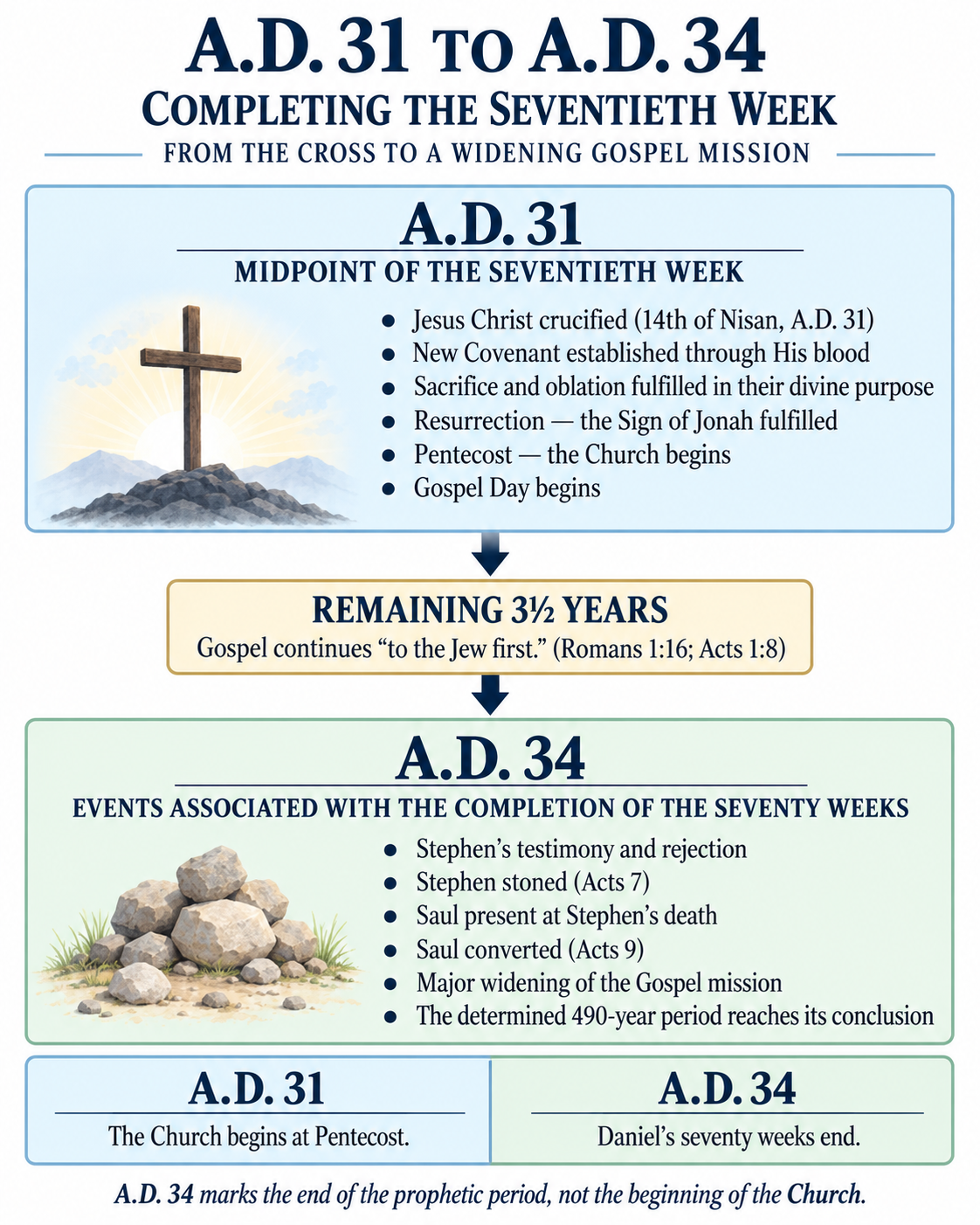
The crucifixion of Jesus Christ occurred in the midst of Daniel's seventieth week. That means the seventieth week did not end at Calvary.
One SHABUA is seven years, and the midst of seven years is three and a half years. Jesus Christ began His public ministry in A.D. 27 and was crucified three and a half years later, in the spring of A.D. 31. Therefore, another three and a half years remained before the full seventy-week period was complete.
The chronology is straightforward:
- A.D. 27: Beginning of the seventieth week;
- A.D. 31: Messiah cut off in the midst of the week;
- A.D. 34: Completion of the seventieth week.
The second half of the final week therefore extends from A.D. 31 to A.D. 34.
Calvary Did Not End the Seventieth Week
Daniel wrote in Daniel 9:27:
“And he shall confirm the covenant with many for one week: and in the midst of the week he shall cause the sacrifice and the oblation to cease, and for the overspreading of abominations he shall make it desolate, even until the consummation, and that determined shall be poured upon the desolate.”
The words “in the midst of the week” are important because they place the crucifixion at the midpoint rather than at the end. The sacrificial death of Jesus Christ therefore divides the seventieth week into two equal halves.
The first three and a half years contain His public ministry. The second three and a half years continue after His death, resurrection and the beginning of the Gospel Day at Pentecost.
The Saving Work of Christ Was Already Complete
The continuation of Daniel's prophetic period after the crucifixion must not be misunderstood. Jesus Christ did not need another three and a half years to complete salvation. His sacrifice was complete, and the New Covenant had been established through His blood.
Sacrifice and oblation had ceased in their divine covenant purpose. Reconciliation had been made, and everlasting righteousness had been brought in. The prophetic period continued because the full seventy weeks had not yet expired.
There is therefore an important distinction between the completion of Christ's saving work and the completion of Daniel's seventy-week period. The work of salvation was complete in Jesus Christ. The remaining time belonged to the completion of the prophecy determined upon Daniel's people and Daniel's holy city.
The Final Week Remained Connected with Daniel's People
Daniel wrote in Daniel 9:24:
“Seventy weeks are determined upon thy people and upon thy holy city, to finish the transgression, and to make an end of sins, and to make reconciliation for iniquity, and to bring in everlasting righteousness, and to seal up the vision and prophecy, and to anoint the most Holy.”
The seventy weeks were specifically determined upon Daniel's people and Daniel's holy city. This remains important during the final three and a half years.
The Gospel had come through the Jewish covenant setting. Jesus Christ had ministered among Israel, and Messiah the Prince had been revealed to Israel. He had then been rejected and crucified.
Yet the determined prophetic period still had three and a half years remaining.
Personal Response
Key Truth
Why did the final three and a half years remain connected with Daniel's people?
Personal Reflection
How does the order 'to the Jew first' help you understand the Gospel's setting?
Action Step
Which words in Romans 1:16 will you read alongside Daniel 9:24?
The Gospel Was “to the Jew First”
Paul later described the Gospel order in Romans 1:16:
“For I am not ashamed of the gospel of Christ: for it is the power of God unto salvation to every one that believeth; to the Jew first, and also to the Greek.”
The Gospel is the power of God unto salvation “to every one that believeth.” Yet Paul also states the historical order: “to the Jew first, and also to the Greek.”
This order helps us understand the setting of the remaining years. The final three and a half years continued within the period Daniel had been told was determined upon his people. The Gospel was not limited permanently to natural Israel, but the prophetic period had not yet reached its end.
The Prophecy Was Moving Towards A.D. 34
From the spring of A.D. 31, the prophetic clock continued for another three and a half years. The seventieth week could not simply disappear at the crucifixion, nor could its remaining half be moved thousands of years into the future.
The same week that began in A.D. 27 continued without interruption. The first half was fulfilled. The midpoint was fulfilled. The second half also had to be fulfilled.
That brings the chronology to A.D. 34.
Israel's Response to Messiah Remained Central
The final three and a half years bring the question of Israel's response to Messiah into sharp focus. Messiah the Prince had come and had been publicly revealed. He had been cut off, and through His sacrificial death the New Covenant had been confirmed and the sacrificial system had reached its fulfilment.
The central issue was no longer whether Messiah would come. He had come. The issue was whether Daniel's people would receive the Messiah whom God had sent.
The events surrounding Stephen become especially important at the conclusion of this period. Acts chapters 6 and 7 record a powerful confrontation between the testimony of Jesus Christ and those who continued to resist that testimony.
The precise significance of those events belongs to the next section.
The Second Half Completes the Same Prophecy
There is no new prophecy beginning in A.D. 31. There is no second seventieth week. There is no future seven-year period waiting to be inserted.
There is one seventieth week. It begins in A.D. 27, its midpoint is A.D. 31, and its conclusion is A.D. 34.
The final three and a half years therefore complete the same continuous prophetic period that began with Messiah the Prince. The chronology remains unbroken, and the prophecy continues to bear witness to Jesus Christ.
The final three and a half years bring Daniel's seventy weeks to their appointed conclusion in A.D. 34.
Personal Response
Key Truth
How does the second half complete the same seventieth week?
Personal Reflection
What does the difference between salvation completed and time completed clarify for you?
Action Step
How will you record that distinction while tracing A.D. 31 to A.D. 34?
WHEN DID THE SEVENTIETH WEEK END? A.D. 34
The final question of Daniel's seventy weeks is not where the prophecy began or where its midpoint fell. Those points have already been established.
The remaining question is:
When did the seventieth week end?
Daniel wrote in Daniel 9:24:
“Seventy weeks are determined upon thy people and upon thy holy city, to finish the transgression, and to make an end of sins, and to make reconciliation for iniquity, and to bring in everlasting righteousness, and to seal up the vision and prophecy, and to anoint the most Holy.”
The full period was seventy SHABUA, or 490 years. The prophetic clock began in 457 B.C., and sixty-nine SHABUA brought the chronology to A.D. 27. The midpoint of the seventieth week came three and a half years later in A.D. 31.
Another three and a half years remained. The full seventy-week period therefore concludes in A.D. 34.
The End Must Still Relate to Daniel's People
The seventy weeks were determined upon Daniel's people and Daniel's holy city. The conclusion of the final week must therefore still be understood in relation to Israel's response to Messiah the Prince.
Jesus Christ had already come and had been publicly revealed. He had been cut off, and through His sacrificial death He had confirmed the New Covenant and fulfilled the sacrificial system through His own perfect offering.
The issue was no longer whether Messiah would appear. The issue was Israel's response to the Messiah whom God had sent.
Stephen's Message Brought the Issue to a Climax
Acts chapters 6 and 7 record the ministry of Stephen and the opposition that arose against his testimony. Stephen's final message reviewed Israel's history and exposed a continuing pattern of resisting those whom God sent.
His message culminated in a direct accusation. Stephen said in Acts 7:51-53:
“Ye stiffnecked and uncircumcised in heart and ears, ye do always resist the Holy Ghost: as your fathers did, so do ye. Which of the prophets have not your fathers persecuted? and they have slain them which shewed before of the coming of the Just One; of whom ye have been now the betrayers and murderers: Who have received the law by the disposition of angels, and have not kept it.”
Stephen brought the issue directly to Jesus Christ. He identified the people before him with those who had resisted God's messengers before them and declared that they had become the betrayers and murderers of “the Just One.”
The rejection of Messiah was therefore being openly confronted.
Personal Response
Key Truth
How did Stephen's message confront the rejection of Messiah?
Personal Reflection
What does the response to his testimony teach you about listening when truth challenges you?
Action Step
Which words in Acts 7:51-53 will you consider before responding to a challenging truth?
The Stoning of Stephen
Luke records the response in Acts 7:54-60:
“When they heard these things, they were cut to the heart, and they gnashed on him with their teeth. But he, being full of the Holy Ghost, looked up stedfastly into heaven, and saw the glory of God, and Jesus standing on the right hand of God, And said, Behold, I see the heavens opened, and the Son of man standing on the right hand of God. Then they cried out with a loud voice, and stopped their ears, and ran upon him with one accord, And cast him out of the city, and stoned him: and the witnesses laid down their clothes at a young man's feet, whose name was Saul. And they stoned Stephen, calling upon God, and saying, Lord Jesus, receive my spirit. And he kneeled down, and cried with a loud voice, Lord, lay not this sin to their charge. And when he had said this, he fell asleep.”
The reaction is striking. They were “cut to the heart” and “stopped their ears.” They ran upon Stephen, cast him out of the city and stoned him.
Stephen's testimony concerning Jesus Christ was rejected violently.
The Seventy-Week Chronology Reaches A.D. 34
Acts itself does not state the calendar year of Stephen's death. The date must therefore not be claimed from Acts alone.
The first sixty-nine weeks reach A.D. 27. The crucifixion occurs three and a half years later in A.D. 31, and the remaining three and a half years bring the seventy-week chronology to A.D. 34.
Within the chronology established throughout this module, the rejection and death of Stephen are identified with the conclusion of the period determined upon Daniel's people. His message brings Israel's rejection of Messiah into sharp focus at the point where the seventy weeks reach their appointed end.
The seventy weeks therefore conclude in A.D. 34.
Saul Stood at the Scene
Luke records an important detail. The witnesses who stoned Stephen “laid down their clothes at a young man's feet, whose name was Saul.”
Acts continues in Acts 8:1:
“And Saul was consenting unto his death. And at that time there was a great persecution against the church which was at Jerusalem; and they were all scattered abroad throughout the regions of Judaea and Samaria, except the apostles.”
Saul was not yet the preacher of Jesus Christ he would later become. At this point he was consenting to Stephen's death and participating in the persecution of the Church.
Yet this same Saul would soon be confronted by Jesus Christ and radically changed.
Saul's Conversion Marks a Major Transition
Saul's conversion belongs to the widening Gospel mission associated with this period of transition. He would become a major messenger of the Gospel among the Gentiles.
Jesus said concerning him in Acts 9:15:
“But the Lord said unto him, Go thy way: for he is a chosen vessel unto me, to bear my name before the Gentiles, and kings, and the children of Israel:”
Saul would bear the name of Jesus Christ:
- Before the Gentiles;
- Before kings;
- Before the children of Israel.
The Gospel was moving outward beyond its earlier concentration within the Jewish setting. The message of Jesus Christ was going to the nations.
This Did Not Begin the Church
The significance of A.D. 34 must be stated carefully. The Church did not begin at the stoning of Stephen.
The Church had already begun at Pentecost in A.D. 31, when Jesus Christ came to His people as the Holy Spirit. The New Covenant was already in force, and born-again believers were already part of the body of Christ.
A.D. 34 marks the completion of Daniel's seventy-week period, not the beginning of the Church.
It also marks a decisive transition in the outward direction of the Gospel mission.
The Period Determined Upon Daniel's People Ends
The completion of the seventy weeks brings the period specifically determined upon Daniel's people and Daniel's holy city to its appointed conclusion. This does not mean that the Old Covenant remained spiritually valid until A.D. 34. Its divine purpose had already been fulfilled in Jesus Christ, and the New Covenant had already been established through His blood.
Natural descent does not establish a person's place in the New Covenant people of God. That identity is found in Jesus Christ. Jew and Gentile come to God through the same Gospel, the same new birth and the same Spirit.
The completion of the seventy weeks therefore marks the end of the determined prophetic period connected especially with Daniel's people. The Gospel continues without national restriction to all who believe.
The prophetic period ends. The Gospel continues.
The Seventy Weeks Are Complete
The seventy weeks can now be followed from beginning to end:
- 457 B.C.: The command to restore and build Jerusalem;
- A.D. 27: Messiah the Prince revealed;
- A.D. 31: Messiah cut off in the midst of the seventieth week;
- A.D. 34: The full 490-year period completed.
Nothing remains to be added. There is no suspended seventieth week and no future seven-year period waiting to complete Daniel's prophecy.
The seventy weeks have reached their end. Their fulfilment confirms again that the prophecy is centred upon Jesus Christ.
Personal Response
Key Truth
Why does A.D. 34 mark the prophetic period's end rather than the Church's beginning?
Personal Reflection
What does the Gospel continuing beyond the determined period strengthen in your understanding?
Action Step
How will you distinguish the chronology's conclusion from what Acts directly states about Stephen?
ONE NEW COVENANT PEOPLE IN JESUS CHRIST
The completion of Daniel's seventy weeks brings an important covenant truth into clear view. God does not preserve natural Israel and the Church as two separate covenant peoples with two different ways of salvation.
Under the New Covenant, Jew and Gentile must both come into Jesus Christ.
Natural Birth Does Not Determine Covenant Identity
Jesus made this clear when He spoke to Nicodemus. Nicodemus was a Jew, a Pharisee and a ruler of the Jews, yet his natural descent did not give him entrance into the kingdom of God.
Jesus said in John 3:3:
“Jesus answered and said unto him, Verily, verily, I say unto thee, Except a man be born again, he cannot see the kingdom of God.”
Jesus repeated the requirement in John 3:7:
“Marvel not that I said unto thee, Ye must be born again.”
Natural descent cannot replace the new birth. Every person must be born again.
There Is No Difference in the Way of Salvation
Paul states this plainly in Romans 10:11-13:
“For the scripture saith, Whosoever believeth on him shall not be ashamed. For there is no difference between the Jew and the Greek: for the same Lord over all is rich unto all that call upon him. For whosoever shall call upon the name of the Lord shall be saved.”
There is no separate saving programme for the Jew and another for the Gentile. There is one Lord, one Gospel, one salvation and one New Covenant.
There is one people in Jesus Christ.
One Spirit into One Body
Paul wrote in 1 Corinthians 12:13:
“For by one Spirit are we all baptized into one body, whether we be Jews or Gentiles, whether we be bond or free; and have been all made to drink into one Spirit.”
Both Jew and Gentile are brought by one Spirit into one body. That body is the Church.
Paul wrote in Colossians 1:18:
“And he is the head of the body, the church: who is the beginning, the firstborn from the dead; that in all things he might have the preeminence.”
There are not two covenant peoples. There is one body in Jesus Christ, and Jesus Christ is its Head.
One New Man
Paul explains this unity further in Ephesians 2:13-16:
“But now in Christ Jesus ye who sometimes were far off are made nigh by the blood of Christ. For he is our peace, who hath made both one, and hath broken down the middle wall of partition between us; Having abolished in his flesh the enmity, even the law of commandments contained in ordinances; for to make in himself of twain one new man, so making peace; And that he might reconcile both unto God in one body by the cross, having slain the enmity thereby:”
The Greek word translated “one” in “one new man” is HEIS, which means “one.” Jesus Christ made Jew and Gentile one. He did not preserve them as two covenant peoples.
Paul says Christ made “of twain one new man” and reconciled “both unto God in one body.” The place where Jew and Gentile become one is Jesus Christ.
The Jew does not remain under the Old Covenant while accepting Jesus alongside it. The Gentile does not become part of natural Israel. Both come into Jesus Christ.
Personal Response
Key Truth
How are Jew and Gentile made one new man in Jesus Christ?
Personal Reflection
What does belonging to one body mean for your attitude towards another believer?
Action Step
Which words in Ephesians 2:13-16 will guide a conversation about Christian fellowship?
The True Jew Is Inward
Paul makes the change in covenant identity explicit. Paul wrote in Romans 2:28-29:
“For he is not a Jew, which is one outwardly; neither is that circumcision, which is outward in the flesh: But he is a Jew, which is one inwardly; and circumcision is that of the heart, in the spirit, and not in the letter; whose praise is not of men, but of God.”
The contrast is direct. Under the New Covenant, identity moves:
- From outward to inward;
- From flesh to Spirit;
- From physical circumcision to circumcision of the heart;
- From natural ancestry to the spiritual work of God.
The true Jew is identified inwardly. Covenant identity is no longer determined by an outward mark in the flesh but by the inward work of God.
Not All Israel Is Israel
Paul also distinguishes between natural Israel and the spiritual people of God. Paul wrote in Romans 9:6-8:
“Not as though the word of God hath taken none effect. For they are not all Israel, which are of Israel: Neither, because they are the seed of Abraham, are they all children: but, In Isaac shall thy seed be called. That is, They which are the children of the flesh, these are not the children of God: but the children of the promise are counted for the seed.”
Natural descent alone does not determine God's spiritual people. Paul distinguishes between “the children of the flesh” and “the children of the promise.”
The New Covenant therefore cannot be understood simply as the continuation of natural Israel's former outward identity.
Those Who Belong to Christ Are Abraham's Seed
Paul wrote in Galatians 3:28-29:
“There is neither Jew nor Greek, there is neither bond nor free, there is neither male nor female: for ye are all one in Christ Jesus. And if ye be Christ's, then are ye Abraham's seed, and heirs according to the promise.”
The determining words are: “if ye be Christ's.” Those who belong to Jesus Christ are Abraham's seed.
Natural ancestry does not determine the seed. Belonging to Christ does.
The Israel of God
Paul makes the same truth clear in Galatians 6:15-16:
“For in Christ Jesus neither circumcision availeth any thing, nor uncircumcision, but a new creature. And as many as walk according to this rule, peace be on them, and mercy, and upon the Israel of God.”
Under the New Covenant, the controlling reality is not circumcision or uncircumcision. It is “a new creature.”
The Israel of God is the spiritual people of God in Jesus Christ: those who are born again and made part of His body, the Church. New Covenant identity is therefore found in new creation, not in natural descent.
Daniel's Prophecy Does Not Create Two Future Peoples
Daniel's seventy weeks were determined upon literal Israel and literal Jerusalem. That prophetic period has now reached its completion.
Its completion does not create a future second covenant programme in which natural Israel becomes God's spiritual people apart from Jesus Christ. The New Covenant has already been established, and the one body already exists.
Jew and Gentile must come through the same Gospel, the same new birth and the same Spirit into the same body. There is no second way, no parallel covenant and no future saving programme apart from Jesus Christ.
One Saviour, One People
The conclusion is clear. There is one Saviour, one Gospel, one Spirit, one body and one New Covenant.
There is one New Covenant people in Jesus Christ.
Jew and Gentile who are born again are brought together into the one body, the Church. The completion of Daniel's seventy weeks does not create two covenant programmes. It brings to an end the prophetic period determined upon Daniel's people while the New Covenant reality already established through Jesus Christ continues for all who believe.
God's New Covenant people are one in Jesus Christ.
Personal Response
Key Truth
Why does belonging to Christ rather than natural ancestry identify Abraham's seed?
Personal Reflection
What does the new birth clarify about your basis for belonging to God's people?
Action Step
How will you compare Galatians 3:28-29 with Jesus' words about being born again?
CONCLUSION: THE PROPHECY IS FULFILLED IN JESUS CHRIST
Daniel's seventy weeks were given for definite purposes, and those purposes were fulfilled in Jesus Christ. The prophecy declared that transgression would be finished, sins would be dealt with, reconciliation would be made for iniquity, everlasting righteousness would be brought in, the vision and prophecy would be sealed, and the most Holy would be anointed.
Jesus Christ fulfilled these purposes. He provided redemption for the transgressions under the First Testament and came to save His people from their sins. He made reconciliation for iniquity and brought in everlasting righteousness.
He authenticated the prophetic Word through fulfilment. He is the most Holy who was anointed for His public ministry.
Daniel also declared that the covenant would be confirmed. Jesus Christ confirmed the New Covenant through His own blood. The prophecy declared that sacrifice and oblation would cease in their divine purpose, and Jesus Christ accomplished this through His once-for-all sacrifice.
The former sacrifices could continue outwardly for a time, but the reality to which they had pointed had come.
That reality is Jesus Christ.
The crucifixion occurred in the midst of the seventieth week in A.D. 31. The remaining three and a half years brought the determined seventy-week period to its conclusion in A.D. 34.
Within the chronology established throughout this module, the rejection surrounding Stephen stands at the conclusion of that prophetic period. Saul's conversion belongs to the important widening of the Gospel mission associated with this time of transition.
These events did not establish the New Covenant or begin the Church. Those realities had already come through Jesus Christ.
The completion of the seventy weeks also confirms that natural Israel does not continue as a separate covenant people alongside the Church. Under the New Covenant, Jew and Gentile come to God in the same way. Both must be born again, both are brought by one Spirit into one body, and both belong to Jesus Christ.
There is one Saviour. One Gospel. One Spirit. One body.
One New Covenant people in Jesus Christ.
Daniel's prophecy therefore does not leave us waiting for another fulfilment. The covenant has been confirmed. The sacrifice has been offered. Reconciliation has been made.
Everlasting righteousness has been brought in. The determined period has reached its conclusion. Every part of that fulfilment leads to the same Person.
Jesus Christ is the fulfilment of Daniel's seventy weeks.
Personal Response
Key Truth
How do the fulfilled purposes, confirmed covenant and completed period bear witness to Jesus Christ?
Personal Reflection
Which part of His completed work has become clearer to you?
Action Step
How will that truth guide your response to Him this week?
MODULE CONCLUSION: DANIEL'S SEVENTY WEEKS FULFILLED IN JESUS CHRIST
Daniel's seventy weeks form one complete prophetic testimony centred upon Jesus Christ. Across this module, the prophecy has been defined, its timeline has been established, and its fulfilment has been traced to its conclusion. The result is one continuous prophetic line that begins with the command to restore and build Jerusalem and ends with the completion of the seventy weeks in A.D. 34.
The prophecy is not incomplete or suspended. It does not contain a 2,000-year gap or require a future seven-year tribulation period.
It was fulfilled in Jesus Christ.
The Prophecy Was Defined
Daniel's seventy weeks were determined upon Daniel's people and Daniel's holy city. The Hebrew word SHABUA identifies a period of seven, so seventy SHABUA equal 490 years. The prophecy therefore establishes a fixed period.
The Hebrew word CHATHAK means “to cut off.” A defined period of 490 years was cut off upon Daniel's people and Daniel's holy city for the accomplishment of God's stated purposes.
The seventy weeks form one continuous prophetic period. The final week belongs to the same prophecy as the first sixty-nine. There is no Scriptural basis for removing the seventieth week from the first century and placing it thousands of years into the future.
The Timeline Was Established
Daniel identified the event that would begin the prophetic clock: “the going forth of the commandment to restore and to build Jerusalem.” The command associated with Artaxerxes in his seventh year provides the correct starting point in 457 B.C.
From that point, sixty-nine SHABUA equal 483 years. Allowing for the absence of a year zero, the chronology reaches A.D. 27. That is where Messiah the Prince is publicly revealed.
The Hebrew word MASHIACH means “Anointed One.” Jesus Christ is that Messiah.
Daniel then declared that Messiah would be “cut off.” The Hebrew word KARATH means “to cut off,” and in Daniel's prophecy this describes the death of Messiah. Three and a half years after A.D. 27 brings the timeline to the spring of A.D. 31.
Jesus Christ was crucified on the 14th of Nisan, A.D. 31, in the midst of the seventieth week. The chronology agrees with the sign Jesus Himself gave. Three nights and three days are fulfilled from His burial before sunset on Wednesday through His resurrection before sunset on Saturday.
The tomb was already empty when Mary arrived while it was yet dark on the first day of the week. The Sign of Jonah was fulfilled.
Personal Response
Key Truth
How do the defined prophecy and its measured timeline lead to Messiah?
Personal Reflection
What does their agreement strengthen in your confidence in God's Word?
Action Step
How will you explain the continuous line from the command to Messiah's death?
The Purposes Were Fulfilled in Jesus Christ
Daniel declared that specific purposes would be accomplished within the seventy weeks. Transgression would be finished, an end would be made of sins, reconciliation would be made for iniquity, and everlasting righteousness would be brought in. The vision and prophecy would be sealed, and the most Holy would be anointed.
Each purpose leads to Jesus Christ. He provided redemption for the transgressions under the First Testament. He came to save His people from their sins. He made reconciliation for iniquity and brought in everlasting righteousness.
The Hebrew word CHATHAM means “to seal” or “to seal up.” The prophecy was sealed through fulfilment, and that fulfilment authenticates the prophetic Word and bears witness to Jesus Christ as Messiah.
Jesus Christ is the most Holy who was anointed for His public ministry. His anointing did not make Him holy or divine because He was already holy. The anointing marked His appointment for the public work of Messiah.
The Covenant Was Confirmed
Daniel also declared: “he shall confirm the covenant with many for one week.” Within the Christ-centred sequence of the seventy weeks and the wider testimony of Scripture, the One who confirms the covenant is Jesus Christ.
The prophecy does not require us to move from Messiah to a future Antichrist and make a political agreement with natural Israel the central covenant of the seventieth week. Jesus Christ confirmed the New Covenant and identified that covenant with His own blood.
The former covenant reached its fulfilment, and the New Covenant was established. The covenant of Daniel 9:27 finds its fulfilment in the New Covenant established through Jesus Christ.
Sacrifice and Oblation Ceased in Their Divine Purpose
Daniel declared that in the midst of the week sacrifice and oblation would cease. Jesus Christ fulfilled this through His own perfect sacrifice.
The Temple sacrifices could continue outwardly for a time, but their divine covenant purpose had ended. Jesus Christ offered one sacrifice for sins for ever. The shadow had reached its fulfilment because the reality had come.
The reality is Jesus Christ.
The Full Seventy Weeks Reached A.D. 34
The crucifixion occurred in the midst of the seventieth week. Three and a half years therefore remained, and the final half of the week continued from A.D. 31 to A.D. 34.
Within the chronology established throughout this module, the events surrounding Stephen and Saul stand at the conclusion of the determined period. Stephen's message exposed Israel's continuing rejection of Messiah, and his death brought that rejection of the testimony concerning Jesus Christ to a climax.
Saul stood at Stephen's death and was soon afterwards confronted by Jesus Christ. He became a major messenger of the Gospel among the Gentiles. These events belong to the important widening of the Gospel mission associated with this period of transition.
The completion of the seventy weeks therefore marks the end of the period determined upon Daniel's people and Daniel's holy city. It does not mark the beginning of the New Covenant or the Church, because those realities had already come through Jesus Christ.
The prophetic period ends. The Gospel continues.
One New Covenant People
The fulfilment of Daniel's prophecy does not establish two continuing covenant peoples. Natural Israel and the Church are not two parallel saving programmes. Under the New Covenant, natural ancestry does not determine spiritual identity.
Every person must be born again. Jew and Gentile are brought by one Spirit into one body. There is one way of salvation in Jesus Christ.
The Greek word HEIS means “one.” Jesus Christ made “of twain one new man.” Those who belong to Christ are Abraham's seed, and the true Jew is inward. The Israel of God is identified by new creation.
There is one Saviour, one Gospel, one Spirit and one body.
There is one New Covenant people in Jesus Christ.
The Whole Prophecy Leads to Jesus Christ
Daniel's seventy weeks are not ultimately about chronology. They are about Jesus Christ.
The dates lead to Him. The prophecy leads to Him. The covenant leads to Him. The sacrifice leads to Him.
The righteousness leads to Him, and the new people of God belong to Him. The fulfilment of the seventy weeks bears witness to Jesus Christ as Messiah the Prince and confirms the faithfulness of God's Word.
The prophecy has reached its fulfilment. The timeline is complete. The covenant has been confirmed.
The sacrifice has been offered. The New Covenant has been established. The determined period has ended.
And the conclusion of the entire module is clear:
Daniel's seventy weeks were fulfilled completely in Jesus Christ.
Personal Response
Key Truth
Why do the whole prophecy and its fulfilment end with one New Covenant people in Christ?
Personal Reflection
What has been corrected or strengthened in your understanding of His completed work?
Action Step
How will you continue to live by that truth as part of Christ's one body?
SUBMISSION TO COGMA FOR APPRAISAL
Instructions
Complete this section after you have finished the Study Guide. It must be completed online. The link to the online form that you must complete and submit is located at the bottom of this Study Guide.
Your answers should reflect your understanding, your personal response, and how you intend to live by the truth you have studied.
Answer honestly and be specific.
1. Main Truth
Explain how Jesus Christ fulfils the purposes of Daniel 9:24 rather than leaving them for a later prophetic age. How do His work concerning sin and iniquity, everlasting righteousness, the sealed prophecy and the anointing of the most Holy belong together?
2. Understanding
Why did the prophetic period continue for three and a half years after Christ's saving work was complete? Explain the distinction between His death, the Church's beginning at Pentecost in A.D. 31 and the seventy weeks ending in A.D. 34.
3. Personal Reflection
What has the teaching about personal responsibility for iniquity and reconciliation through Jesus Christ corrected or strengthened in your understanding? Use a verse to explain how His inward life relates to righteous conduct now.
4. Response to Truth
How does Jesus Christ confirming the New Covenant through His blood call you to respond to God's inward work? Explain why returning to outward ordinances cannot add to His completed sacrifice and what this means for your own trust.
5. Action Step
This week, compare Hebrews 10:9-12 with Daniel 9:27 and explain in your own words how Christ's sacrifice ended the former sacrifices' divine purpose. What will you look for, and when will you begin?
6. Early Response
Have you already compared Hebrews 10:9-12 with Daniel 9:27 and explained in your own words how Christ's sacrifice ended the former sacrifices' divine purpose? If yes, briefly explain what you did or what became clear. If not, explain what has made it difficult to begin.
7. Ongoing Practice
How will you continue to live from the righteousness received in Jesus Christ rather than treat it as a future promise or something earned by ceremonies? Explain how a verse about the new birth or righteous living will guide one continuing practice.
8. Doctrinal Clarity
Why do sealing the prophecy and anointing the most Holy find their fulfilment in Jesus Christ? Use verses to explain why His anointing did not give Him holiness or deity, and why neither purpose requires a future Temple programme.
9. Living the Truth
A person treats natural ancestry as a separate way of belonging to God's covenant people. How would you explain the new birth and the one body in Christ, and how should that truth govern your fellowship with believers of another background?
10. Final Response
Bring together Messiah's completed saving work, the New Covenant, the end of the seventy weeks and the widening Gospel mission associated with Stephen and Saul. What has become clearer or been corrected for you, and how will you live as part of the one New Covenant people in Jesus Christ?
You must submit your answers to the above 10 questions ONLINE.
Use the link below for your final submission after finishing this Study Guide. Answer honestly and be specific.
Would you prefer a printable copy?