
Search results will appear as highlighted text.
Quick Navigation
PREFACEINTRODUCTIONTHE PROPHETIC CLOCK BEGINS WITH A COMMANDWHICH COMMAND RESTORED AND BUILT JERUSALEM?ARTAXERXES' DECREE: 457 B.C.FROM 457 B.C. TO MESSIAH THE PRINCEMESSIAH THE PRINCE REVEALED: A.D. 27MESSIAH SHALL BE CUT OFFIN THE MIDST OF THE SEVENTIETH WEEK: A.D. 31CALCULATING DATES IN BIBLICAL CONTEXTTHE SIGN OF JONAHCONCLUSION: THE TIMELINE LEADS TO JESUS CHRISTSUBMISSION TO COGMA FOR APPRAISAL
INSTRUCTIONS FOR THE STUDENT
My Study Plan
Preparing a Study Plan before starting this Study Guide will assist you in completing it within a designated timeframe. It also helps in developing the discipline required for studying God’s Word effectively.
Proverbs 16:3:
Commit thy works unto the LORD, and thy thoughts shall be established.
My Study Guide Journal
Keep a record as you progress through your Study Guide, including the Personal Responses for each section, for future reference and goal setting.
Content
- PREFACE
- INTRODUCTION
- THE PROPHETIC CLOCK BEGINS WITH A COMMAND
- WHICH COMMAND RESTORED AND BUILT JERUSALEM?
- ARTAXERXES' DECREE: 457 B.C.
- FROM 457 B.C. TO MESSIAH THE PRINCE
- MESSIAH THE PRINCE REVEALED: A.D. 27
- MESSIAH SHALL BE CUT OFF
- IN THE MIDST OF THE SEVENTIETH WEEK: A.D. 31
- CALCULATING DATES IN BIBLICAL CONTEXT
- THE SIGN OF JONAH
- CONCLUSION: THE TIMELINE LEADS TO JESUS CHRIST
Important Points
- COGMA does not claim to be infallible or the authority.
- Infallibility and authority belong only to God and His Word.
COGMA therefore strongly advises that you prayerfully study the content of each Study Guide with the heart of a Berean (Acts 17:10–12).
Contact and Links
Website: cogma.com.au
Email: admin@cogma.org.au
Radio COGMA: radiocogma.com
YouTube: youtube.com/@COGMAChannel
PREFACE
Daniel's seventy weeks prophecy does more than establish that a period of 490 years was determined. It also provides a precise chronological line that begins with a command to restore and build Jerusalem, reaches Messiah the Prince, and places the cutting off of Messiah within the final seventieth week.
Daniel wrote in Daniel 9:25-27:
“Know therefore and understand, that from the going forth of the commandment to restore and to build Jerusalem unto the Messiah the Prince shall be seven weeks, and threescore and two weeks: the street shall be built again, and the wall, even in troublous times. And after threescore and two weeks shall Messiah be cut off, but not for himself: and the people of the prince that shall come shall destroy the city and the sanctuary; and the end thereof shall be with a flood, and unto the end of the war desolations are determined. And he shall confirm the covenant with many for one week: and in the midst of the week he shall cause the sacrifice and the oblation to cease, and for the overspreading of abominations he shall make it desolate, even until the consummation, and that determined shall be poured upon the desolate.”
These verses contain a measurable prophecy. God identifies the event that begins the timeline, the period leading to Messiah, the cutting off of Messiah and the events occurring within the final week. The chronology therefore does not depend upon speculation or upon choosing dates first and then attempting to make Scripture fit them.
The starting point must satisfy Daniel's own words: “the going forth of the commandment to restore and to build Jerusalem.” The prophecy then measures seven weeks and threescore and two weeks from that command to Messiah the Prince. These sixty-nine prophetic weeks equal 483 years, and when the correct starting command is identified, the chronology leads directly to Jesus Christ.
The Hebrew word SHABUA means a period of seven. Sixty-nine SHABUA therefore equal 483 years, and the complete seventy SHABUA equal 490 years. The timeline is exact and continuous.
This Study Guide will examine the Persian commands connected with Jerusalem and determine which one fulfils the requirement given in Daniel 9:25. Particular attention will be given to the decree associated with Artaxerxes and Ezra, the seventh year of Artaxerxes, and the year 457 B.C.
From that point, the prophetic calculation moves forward 483 years to A.D. 27, when Jesus Christ was revealed publicly as Messiah the Prince. The chronology then continues into the seventieth week.
Daniel states that Messiah would be “cut off.” The Hebrew word KARATH means “to be put to death.” The prophecy therefore foretells not only the appearance of Messiah but also His death.
The final week is seven years, and the midst of that week is three and a half years. From the beginning of Jesus Christ's public ministry in A.D. 27, three and a half years bring the chronology to A.D. 31, when Messiah was cut off.
Daniel also states, “in the midst of the week he shall cause the sacrifice and the oblation to cease.” Jesus Christ fulfilled the Old Covenant sacrificial system through His own perfect sacrifice. The sacrifices could continue outwardly for a time, but their divine covenant purpose had been fulfilled in Him.
The chronology therefore leads directly to Jesus Christ. The decree matters because it establishes the starting point, the 483 years matter because they lead to Messiah the Prince, A.D. 27 matters because it identifies the beginning of His public ministry, and A.D. 31 matters because it places the crucifixion in the exact position foretold by Daniel.
The Sign of Jonah will also be examined because Jesus Himself gave three days and three nights as the sign connected with His death and resurrection. The chronology of His burial and resurrection must therefore agree with the sign He gave.
Throughout this Study Guide, Scripture will govern the timeline. Dates, decrees, calendars and historical evidence must be tested against the conditions God placed in the prophecy. The purpose is not simply to construct a chronological chart, but to see how precisely the timeline leads to Jesus Christ.
Daniel's prophetic clock begins with the command to restore Jerusalem and moves forward without interruption. It reaches exactly where God said it would reach: Messiah the Prince: Jesus Christ.
Personal Response
Key Truth
Why does the measured timeline matter as a testimony to Jesus Christ?
Personal Reflection
How does its focus on Messiah affect your reason for studying prophetic dates?
Action Step
Which words in Daniel 9:25-27 will you read before working through the chronology?
INTRODUCTION
Daniel's seventy weeks prophecy establishes a precise prophetic timeline that leads directly to Jesus Christ. The prophecy does not simply identify a period of 490 years. It also identifies the event that begins the countdown, the period leading to Messiah the Prince, the cutting off of Messiah and what occurs in the midst of the final week.
Daniel wrote in Daniel 9:24-27:
“Seventy weeks are determined upon thy people and upon thy holy city, to finish the transgression, and to make an end of sins, and to make reconciliation for iniquity, and to bring in everlasting righteousness, and to seal up the vision and prophecy, and to anoint the most Holy. Know therefore and understand, that from the going forth of the commandment to restore and to build Jerusalem unto the Messiah the Prince shall be seven weeks, and threescore and two weeks: the street shall be built again, and the wall, even in troublous times. And after threescore and two weeks shall Messiah be cut off, but not for himself: and the people of the prince that shall come shall destroy the city and the sanctuary; and the end thereof shall be with a flood, and unto the end of the war desolations are determined. And he shall confirm the covenant with many for one week: and in the midst of the week he shall cause the sacrifice and the oblation to cease, and for the overspreading of abominations he shall make it desolate, even until the consummation, and that determined shall be poured upon the desolate.”
The prophecy gives a sequence that can be followed. It begins with “the going forth of the commandment to restore and to build Jerusalem,” moves “unto the Messiah the Prince,” and then states that after the sixty-nine weeks Messiah would be cut off. In the final week, “in the midst of the week he shall cause the sacrifice and the oblation to cease.”
These statements establish the chronological framework. Our task is to identify the historical events that fulfil each part of the prophecy and to test them carefully against Scripture and history.
The starting point cannot be chosen simply because it produces a convenient result. It must satisfy the words Daniel used. The appearance of Messiah must agree with the prophetic period God established, the crucifixion must fall where Daniel places it, and the final week must remain part of the same continuous seventy-week period.
The Hebrew word SHABUA means a period of seven. Sixty-nine SHABUA equal 483 years, and seventy SHABUA equal 490 years. The calculation is straightforward, but the important question is where the 483 years begin.
Daniel answers that question with the words “from the going forth of the commandment to restore and to build Jerusalem.” Several Persian decrees are connected with Jerusalem and the Temple, so they must be examined carefully to determine which one fulfils Daniel's exact requirement.
The correct command must lead directly to Messiah the Prince. The chronology followed in this Study Guide identifies the decree associated with Artaxerxes in the seventh year of his reign as the correct starting point and places that decree in 457 B.C. From that point, the first sixty-nine weeks, or 483 years, lead to A.D. 27, the beginning of Jesus Christ's public ministry.
This is where the prophecy reaches “Messiah the Prince.” The Hebrew word MASHIACH means “Anointed One,” and Jesus Christ is the Anointed One to whom the prophecy points.
Daniel then states that after the sixty-nine weeks Messiah would be cut off. The Hebrew word KARATH means “to be put to death.” The prophecy therefore moves directly from the revelation of Messiah to His death.
The final week is one SHABUA, or seven years. The midst of that week is three and a half years. From the beginning of Jesus Christ's public ministry in A.D. 27, three and a half years lead to A.D. 31, when Messiah was cut off.
The chronology therefore places the crucifixion exactly where Daniel said it would occur: in the midst of the seventieth week. Daniel also states that Messiah would “cause the sacrifice and the oblation to cease.” This does not mean that every animal sacrifice physically stopped at the moment Jesus died, but that the Old Covenant sacrificial system had reached its divine fulfilment in Jesus Christ.
His sacrifice was the reality to which the former sacrifices pointed. The prophetic timeline therefore does more than establish a sequence of dates: it authenticates the Messiah, confirms the accuracy of God's Word, places the crucifixion inside the seventieth week and keeps the prophecy centred upon Jesus Christ.
The Sign of Jonah also forms an important part of the chronology. Jesus gave three days and three nights as the sign connected with His death and resurrection. The chronology of His burial and resurrection must therefore agree with the sign He gave.
This Study Guide will follow the timeline step by step:
- The command that begins the prophetic clock;
- The Persian decrees connected with Jerusalem;
- The identification of 457 B.C.;
- The 483 years leading to A.D. 27;
- The revelation of Messiah the Prince;
- The cutting off of Messiah;
- The midst of the seventieth week in A.D. 31;
- The Sign of Jonah;
- The biblical calculation of the dates.
The purpose throughout is not simply chronological accuracy. The purpose is authentication. When the prophetic timeline is followed correctly, it leads directly to one Person: Jesus Christ, Messiah the Prince.
Personal Response
Key Truth
Why must the starting command satisfy Daniel's words rather than a preferred date?
Personal Reflection
What does this requirement teach you about examining an inherited interpretation?
Action Step
Which condition in Daniel 9:25 will you keep in view as you examine the Persian commands?
THE PROPHETIC CLOCK BEGINS WITH A COMMAND
Daniel's prophecy identifies a precise event that begins the seventy-week timeline. The prophetic clock does not begin with Daniel's prayer, the end of the Babylonian captivity, the rebuilding of the Temple or the appearance of Messiah. It begins with a command concerning Jerusalem.
Daniel wrote in Daniel 9:25:
“Know therefore and understand, that from the going forth of the commandment to restore and to build Jerusalem unto the Messiah the Prince shall be seven weeks, and threescore and two weeks: the street shall be built again, and the wall, even in troublous times.”
The words are exact: “from the going forth of the commandment to restore and to build Jerusalem.” That statement establishes the starting condition of the prophecy. The seventy weeks cannot begin until a command fulfilling those words goes forth.
The Starting Point Is Given by Scripture
The beginning of a prophetic period must be determined by the conditions God gives in the prophecy itself. Daniel does not simply say, “from a decree.” He identifies what the command must accomplish: the restoration and rebuilding of Jerusalem.
This means that every proposed starting point must be tested against Daniel 9:25. A decree may concern the Jewish people, the Temple or permission to return to Jerusalem, but unless it satisfies the condition Daniel gives, it cannot be used as the starting point of the seventy weeks.
Scripture determines the requirement, and history identifies the event that fulfils it. The interpreter must not reverse that order.
The Command Must Lead to Messiah the Prince
Daniel also tells us where the sixty-nine-week period must end. It begins with the command and extends “unto the Messiah the Prince.”
The first seven weeks and the following sixty-two weeks equal sixty-nine SHABUA. One SHABUA is a period of seven years. Therefore, sixty-nine SHABUA equal 483 years.
The correct starting command must produce a 483-year timeline ending at the manifestation of Messiah the Prince. This gives us a clear test. If a proposed decree does not lead to Messiah at the end of 483 years, it cannot be the beginning Daniel identified.
The prophecy itself therefore provides both ends of the calculation. The beginning is the command to restore and build Jerusalem, and the destination is Messiah the Prince.
The Prophecy Requires More Than the Temple
Jerusalem and the Temple were closely connected, but they are not identical. Daniel did not write, “from the commandment to rebuild the Temple.” He wrote, “to restore and to build Jerusalem.”
This distinction is important. A command dealing specifically with the Temple cannot automatically be treated as the command of Daniel 9:25. The question must always be whether the command fulfils exactly what Daniel said.
We must therefore ask whether Jerusalem itself was being restored, whether authority connected with the city was being restored, whether the rebuilding of Jerusalem was included, and whether the resulting chronology leads to Messiah the Prince. These questions must govern the examination of the Persian commands.
Personal Response
Key Truth
Why is a command concerning the Temple not automatically the command to restore Jerusalem?
Personal Reflection
How does attending to Daniel's exact wording help you avoid a careless conclusion?
Action Step
Which words describing the command will you note before comparing the decrees?
“Restore” and “Build” Both Matter
Daniel uses two actions: restore and build. The command must therefore involve more than construction alone.
Jerusalem was not simply a collection of damaged buildings. It had once functioned as the centre of national, judicial and religious life under the Old Covenant. To restore Jerusalem involved restoring its functioning order, while to build Jerusalem involved the physical rebuilding associated with the city.
Daniel's wording therefore requires a command broad enough to satisfy both elements. The command must restore and build Jerusalem. This is why the commands must be examined carefully rather than treated as though they were all identical.
The “Going Forth” of the Command
Daniel does not simply identify the existence of a command. He speaks of “the going forth of the commandment.” The chronology therefore begins when the command goes forth in fulfilment of the prophecy.
This point becomes especially important when examining the command associated with Artaxerxes and Ezra. The chronology followed in this module connects the going forth of the command with Ezra's arrival in Jerusalem during the seventh year of Artaxerxes. The details of that event will be examined carefully in the sections that follow.
For now, the important point is that Daniel gives a definite starting event. The seventy-week clock does not begin at an undefined moment. It begins when the command goes forth.
The Starting Date Must Be Proved
The year assigned to the beginning of the seventy weeks must be established, not assumed. The calculation cannot begin with Jesus Christ and work backwards until a convenient date is found. Neither can a traditional date be accepted simply because it has been repeated by prophetic teachers.
The starting point must be proved from the conditions of Daniel 9:25. We must first identify the commands recorded in Scripture that concern Jerusalem and the Temple, then examine exactly what each command authorised. We must determine which command fulfils Daniel's words “to restore and to build Jerusalem,” establish the historical year in which that command went forth, calculate forward the 483 years and test whether the chronology reaches Messiah the Prince.
The correct starting point must satisfy every part of the prophecy.
The Prophecy Is Designed to Be Tested
Daniel's prophecy is not built upon hidden information. Its words provide the test because God gives the beginning, the length and the destination. The chronology can therefore be examined.
This is one reason Daniel's seventy weeks so powerfully authenticate Jesus Christ. The timeline is not simply a broad prediction that Messiah would appear someday. It gives a measured route to Him.
Daniel's prophecy tells us where to begin, how long to count and where the prophetic period must lead. It must arrive at Messiah the Prince.
The Command Opens the Timeline to Christ
The command to restore and build Jerusalem is not important simply because it concerns an ancient city. It is important because it starts the prophetic clock that leads directly to Jesus Christ.
From the correct command, seven weeks begin and sixty-two more weeks follow. Together, the sixty-nine weeks total 483 years and lead to Messiah the Prince. The command is therefore the doorway into the prophetic timeline.
If the starting point is wrong, the chronology will be wrong. If the starting point is correct, the timeline will lead exactly where Daniel said it would lead.
The next task is therefore clear. We must examine the commands connected with Jerusalem and determine which one truly fulfilled the words: “to restore and to build Jerusalem.”
Personal Response
Key Truth
How do the required beginning and destination allow Daniel's timeline to be tested?
Personal Reflection
What does a measured route to Messiah strengthen in your confidence in Scripture?
Action Step
How will you compare a proposed starting point with both ends of Daniel's calculation?
WHICH COMMAND RESTORED AND BUILT JERUSALEM?
Daniel does not simply tell us that the seventy-week prophecy begins with a Persian decree. He tells us what the command must accomplish. The command must fulfil the exact requirement God gave in the prophecy.
Daniel wrote in Daniel 9:25:
“Know therefore and understand, that from the going forth of the commandment to restore and to build Jerusalem unto the Messiah the Prince shall be seven weeks, and threescore and two weeks: the street shall be built again, and the wall, even in troublous times.”
The requirement is definite: the command must be “to restore and to build Jerusalem.” Several Persian commands are connected with the return of the Jewish people, the Temple and Jerusalem, but they cannot all be the starting point of Daniel's prophetic clock. Each must therefore be examined according to the words God gave Daniel.
The three principal commands connected with this restoration period are associated with Cyrus, Darius and Artaxerxes. Only one fulfils the complete requirement of Daniel 9:25 and produces the prophetic timeline leading directly to Messiah the Prince.
Cyrus: The Command to Rebuild the Temple
At the conclusion of the Babylonian captivity, Cyrus issued a proclamation allowing the Jewish people to return and rebuild the house of God in Jerusalem.
Ezra wrote in Ezra 1:1-3:
“Now in the first year of Cyrus king of Persia, that the word of the LORD by the mouth of Jeremiah might be fulfilled, the LORD stirred up the spirit of Cyrus king of Persia, that he made a proclamation throughout all his kingdom, and put it also in writing, saying, Thus saith Cyrus king of Persia, The LORD God of heaven hath given me all the kingdoms of the earth; and he hath charged me to build him an house at Jerusalem, which is in Judah. Who is there among you of all his people? his God be with him, and let him go up to Jerusalem, which is in Judah, and build the house of the LORD God of Israel, (he is the God,) which is in Jerusalem.”
The purpose of Cyrus' proclamation is stated clearly. He authorised the people to “build the house of the LORD God of Israel.” The command was directed principally towards rebuilding the Temple.
This decree was important in the restoration of the Jewish people after the captivity, but Daniel's prophecy requires more than permission to rebuild the Temple. Daniel said that the prophetic clock would begin with the command “to restore and to build Jerusalem.” The Temple was in Jerusalem, but rebuilding the Temple and restoring Jerusalem are not identical acts.
Personal Response
Key Truth
What did Cyrus' proclamation authorise concerning the house of God?
Personal Reflection
Why should an important event still be tested against the prophecy's full requirement?
Action Step
Which words in Ezra 1 will you compare with the requirement in Daniel 9:25?
Isaiah Foretold Cyrus
The work of Cyrus had itself been foretold by Isaiah.
Isaiah wrote in Isaiah 44:28:
“That saith of Cyrus, He is my shepherd, and shall perform all my pleasure: even saying to Jerusalem, Thou shalt be built; and to the temple, Thy foundation shall be laid.”
Cyrus clearly had an important place in God's purpose. Jerusalem would be rebuilt, the Temple foundation would be laid, the captivity would end and the people would be permitted to return.
However, the actual proclamation recorded in Ezra 1 concentrates upon rebuilding “the house of the LORD God of Israel.” The restoration of Jerusalem as a functioning city, with civil and judicial authority, had not yet been fully established. For that reason, Cyrus' decree does not fulfil the complete requirement of Daniel 9:25.
The Work Was Interrupted
The restoration did not proceed without opposition. Ezra records that the enemies of Judah resisted the rebuilding work and attempted to frustrate it.
Ezra wrote in Ezra 4:4-5:
“Then the people of the land weakened the hands of the people of Judah, and troubled them in building, And hired counsellors against them, to frustrate their purpose, all the days of Cyrus king of Persia, even until the reign of Darius king of Persia.”
The work was opposed and interrupted. This historical setting helps explain why another royal action became necessary during the reign of Darius.
Darius Confirmed the Earlier Decree
During the reign of Darius, a search was made for the earlier decree of Cyrus.
Ezra wrote in Ezra 6:1-3:
“Then Darius the king made a decree, and search was made in the house of the rolls, where the treasures were laid up in Babylon. And there was found at Achmetha, in the palace that is in the province of the Medes, a roll, and therein was a record thus written: In the first year of Cyrus the king the same Cyrus the king made a decree concerning the house of God at Jerusalem, Let the house be builded, the place where they offered sacrifices, and let the foundations thereof be strongly laid; the height thereof threescore cubits, and the breadth thereof threescore cubits;”
Again, the subject is unmistakable: “the house of God at Jerusalem.” Darius did not issue the command of Daniel 9:25 to restore Jerusalem as a functioning city. He confirmed and enforced the earlier command concerning the Temple, which was subsequently completed.
Ezra wrote in Ezra 6:15:
“And this house was finished on the third day of the month Adar, which was in the sixth year of the reign of Darius the king.”
The work accomplished under Darius was significant, but its central object remained the house of God. Therefore, the decree of Darius does not fulfil the complete requirement “to restore and to build Jerusalem.”
The Prophecy Requires the Restoration of the City
The distinction between the Temple and the city must remain clear. Daniel does not say, “from the commandment to rebuild the Temple.” He says, “from the going forth of the commandment to restore and to build Jerusalem.”
The city itself must therefore be restored. This involves more than stones, walls and buildings. Jerusalem had functioned as the centre of Israel's civil, judicial and religious life, so restoration required the re-establishment of functioning authority as well as physical rebuilding.
The command that begins Daniel's seventy weeks must meet that broader requirement. This is why the Persian commands must be examined carefully rather than treated as though they were all identical.
Artaxerxes Gave the Required Authority
The command associated with Artaxerxes goes beyond the rebuilding of the Temple. Ezra was given authority to return to Jerusalem, establish the Law of God and appoint those who would administer judgement.
Artaxerxes declared in Ezra 7:25-26:
“And thou, Ezra, after the wisdom of thy God, that is in thine hand, set magistrates and judges, which may judge all the people that are beyond the river, all such as know the laws of thy God; and teach ye them that know them not. And whosoever will not do the law of thy God, and the law of the king, let judgment be executed speedily upon him, whether it be unto death, or to banishment, or to confiscation of goods, or to imprisonment.”
This decree restored civil and judicial authority. Ezra was empowered to appoint “magistrates and judges,” administer the Law and execute judgement. Jerusalem was therefore being restored as a functioning centre of government and worship.
This is fundamentally different from a decree dealing only with the Temple. The command under Artaxerxes satisfies the word “restore” in Daniel 9:25 because Jerusalem's functioning order was being re-established.
Restoration Means Functioning Authority
Jerusalem was not simply being repaired physically. The Jewish people were again given recognised authority to administer their law within the framework permitted by the Persian king.
This is why the decree recorded in Ezra 7 is the decisive command. Cyrus authorised the rebuilding of the Temple, Darius confirmed that Temple decree, and Artaxerxes gave the authority required for the restoration and functioning of Jerusalem itself.
Daniel's prophecy requires Jerusalem.
The Correct Command Must Also Fit the Timeline
There is another decisive test. Daniel says that from the going forth of the correct command “unto the Messiah the Prince” would be seven weeks and sixty-two weeks.
That is sixty-nine SHABUA, or 483 years. The correct command must therefore not only fulfil the wording concerning Jerusalem. It must also produce the chronology leading to Jesus Christ.
The decree associated with Artaxerxes does both. It satisfies the requirement to restore Jerusalem, and its date provides the starting point from which the 483 years lead directly to Messiah the Prince. The detailed calculation will follow, but the identity of the correct command is already established by the prophetic conditions.
Scripture Identifies the Correct Command
The three commands can therefore be distinguished clearly. Cyrus authorised the rebuilding of the Temple, Darius confirmed and enforced the earlier Temple decree, and Artaxerxes gave Ezra the authority required for the restoration and functioning of Jerusalem.
Only the command associated with Artaxerxes fulfils Daniel's complete requirement “to restore and to build Jerusalem.” The prophetic clock therefore does not begin with Cyrus or Darius. It begins with the command given under Artaxerxes.
The next question is now precise: When did that command go forth? The answer establishes the fixed starting date of Daniel's seventy-week prophecy: 457 B.C.
Personal Response
Key Truth
Why does Artaxerxes' grant of civil and judicial authority fulfil the restoration requirement?
Personal Reflection
How does the distinction between restoring a city and rebuilding its Temple clarify your understanding?
Action Step
How will you compare Ezra 7:25-26 with the earlier Temple decrees?
ARTAXERXES' DECREE: 457 B.C.
Daniel's prophetic clock begins with “the going forth of the commandment to restore and to build Jerusalem.” The command that satisfies this requirement is the decree given under Artaxerxes in the seventh year of his reign. The book of Ezra records the historical setting.
Ezra wrote in Ezra 7:8-9:
“And he came to Jerusalem in the fifth month, which was in the seventh year of the king. For upon the first day of the first month began he to go up from Babylon, and on the first day of the fifth month came he to Jerusalem, according to the good hand of his God upon him.”
The crucial statement is “in the seventh year of the king.” That seventh year establishes the historical setting in which Daniel's prophetic timeline begins.
The Seventh Year of Artaxerxes
The chronology followed in this study places the beginning of Artaxerxes' reign in late 465 B.C. or early 464 B.C. The regnal years are then reckoned according to the Jewish civil year beginning with the first of Tishri.
Using that reckoning, the regnal years are counted as follows:
- First year ending in September/October 463 B.C.;
- Second year ending in September/October 462 B.C.;
- Third year ending in September/October 461 B.C.;
- Fourth year ending in September/October 460 B.C.;
- Fifth year ending in September/October 459 B.C.;
- Sixth year ending in September/October 458 B.C.;
- Seventh year ending in September/October 457 B.C.
The seventh year therefore places Ezra's mission and the command connected with the restoration of Jerusalem in 457 B.C. This becomes the fixed starting year of Daniel's seventy-week prophecy.
i.Josephus' Account of Artaxerxes and Esther
The Jewish historian Flavius Josephus, writing in the first century A.D., also connects this Persian king with the events recorded in the book of Esther. In Antiquities of the Jews, Book XI, Chapter 6, Josephus states that after the death of Xerxes the kingdom passed to “his son Cyrus, whom the Greeks called Artaxerxes.”
Josephus then identifies this same Artaxerxes as the king involved in the events concerning Mordecai, Haman and Esther. He records that the king married Esther and describes her as a Jewish woman through whom her people were delivered from the destruction planned against them.
This testimony is significant because Josephus understood the events recorded in Esther to have taken place during the reign of the Artaxerxes he describes. His account also records the king's favourable relationship with Esther and the Jewish people.
Josephus' identification should be understood as historical testimony rather than as the basis of Daniel's prophetic calculation. The starting date of the seventy weeks rests upon the biblical record in Ezra and the chronological identification of Artaxerxes' seventh year.
Nevertheless, Josephus provides valuable ancient historical testimony connecting Artaxerxes, Esther and the Jewish people within this period.
Personal Response
Key Truth
How does Artaxerxes' seventh year establish the chronology's starting year?
Personal Reflection
Why is it helpful to distinguish Ezra's biblical evidence from Josephus' historical testimony?
Action Step
Which statement in Ezra 7:8-9 will you use to review the regnal-year calculation?
Ezra Was Given Authority to Restore Order
Artaxerxes did not simply give Ezra permission to return. He gave him authority to restore functioning order among the people.
Ezra wrote in Ezra 7:25-26:
“And thou, Ezra, after the wisdom of thy God, that is in thine hand, set magistrates and judges, which may judge all the people that are beyond the river, all such as know the laws of thy God; and teach ye them that know them not. And whosoever will not do the law of thy God, and the law of the king, let judgment be executed speedily upon him, whether it be unto death, or to banishment, or to confiscation of goods, or to imprisonment.”
This goes beyond Temple construction. Ezra was instructed to “set magistrates and judges,” he was given authority to administer law, and judgement could be executed. The civil and judicial functioning of the people was being restored.
This is why Artaxerxes' decree fulfils Daniel's requirement to restore Jerusalem.
The Restoration Was More Than Physical Rebuilding
Jerusalem had once been the functioning centre of Old Covenant Israel. Its restoration therefore involved more than rebuilding walls and structures. A city is not fully restored simply because buildings stand again.
Jerusalem also required:
- Recognised authority;
- Judges;
- Law;
- Administration;
- Worship;
- Social order.
Artaxerxes' decree gave Ezra authority to restore that functioning order. The decree therefore satisfies both parts of Daniel's wording: restore and build Jerusalem.
Ezra's Arrival Fixes the Historical Moment
Ezra gives a precise date for his arrival. He states that “on the first day of the fifth month came he to Jerusalem.” The fifth month in the Hebrew calendar is Av.
Using the chronology followed in this study, Ezra's arrival in Jerusalem on the first day of Av falls in 457 B.C. This becomes the point associated with the “going forth” of the command in the prophetic calculation.
Daniel's wording is important. He does not simply say that a decree existed somewhere in the Persian Empire. He speaks of “the going forth of the commandment.”
The command had to reach Jerusalem and take effect. Ezra carried the royal authority with him, and when he arrived in Jerusalem, the command was brought into operation.
The Jewish Calendar Matters
The chronology must be understood according to the calendar framework in which the biblical events occurred. A Hebrew day runs from sunset to sunset, and the months are lunar. The calendar keeps those months aligned with the seasons by adding a leap month when necessary.
These principles become especially important later when examining dates connected with the crucifixion, Nisan and the Sign of Jonah. For the present calculation, the important point is that the fifth month, Av, falls later in the year than the beginning of the regnal year used in this calculation.
Ezra's arrival in the fifth month of Artaxerxes' seventh year therefore places the beginning of the prophetic countdown in 457 B.C.
457 B.C. Is the Anchor Date
The starting date is essential because every later calculation depends upon it. When the correct starting point is established, the prophecy begins to unfold with remarkable precision.
From 457 B.C., Daniel gives seven weeks and sixty-two weeks to Messiah the Prince. That equals sixty-nine SHABUA, or 483 years.
The prophetic clock therefore begins at 457 B.C. and moves forward 483 years. Its destination is not an arbitrary historical event. Its destination is Jesus Christ.
The Command Goes Forth Towards Messiah
The importance of Artaxerxes' decree lies not simply in Persian history. Its significance is prophetic because the decree begins a countdown that God had revealed centuries beforehand.
From that point:
- Seven SHABUA begin;
- Sixty-two more SHABUA follow;
- The total reaches sixty-nine SHABUA;
- The 483 years arrive at Messiah the Prince.
The decree therefore serves as the historical anchor for a prophecy centred upon Jesus Christ. The moment the command goes forth, the prophetic clock begins.
The Timeline Now Has a Fixed Beginning
The seventy-week prophecy can now be placed on a definite chronological line. Its starting point is not Cyrus or Darius. It is the decree under Artaxerxes in his seventh year.
The year is 457 B.C. The command is to restore and to build Jerusalem. The prophetic period that follows is 483 years to Messiah the Prince.
The next step is therefore clear. We now move forward from 457 B.C. through the sixty-nine prophetic weeks and determine where Daniel's timeline reaches.
It reaches Jesus Christ.
Personal Response
Key Truth
How does Ezra's arrival bring the command into operation at Jerusalem?
Personal Reflection
Why does establishing a sound beginning matter to your confidence in the later dates?
Action Step
When will you review how the seventh year and the fifth month place the beginning in 457 B.C.?
FROM 457 B.C. TO MESSIAH THE PRINCE
Once the starting point of Daniel's prophecy is fixed at 457 B.C., the next part of the calculation is straightforward. Daniel gives a measured period from the command to restore and build Jerusalem to the appearance of Messiah the Prince.
Daniel wrote in Daniel 9:25:
“Know therefore and understand, that from the going forth of the commandment to restore and to build Jerusalem unto the Messiah the Prince shall be seven weeks, and threescore and two weeks: the street shall be built again, and the wall, even in troublous times.”
The prophecy gives two divisions before Messiah appears: seven weeks and threescore and two weeks. Together these equal sixty-nine prophetic weeks.
Sixty-Nine SHABUA
The Hebrew word SHABUA means a period of seven years. Therefore, sixty-nine SHABUA equal 483 years.
69 × 7 = 483 years.
Daniel's prophecy therefore gives a period of 483 years from the command to restore and build Jerusalem to Messiah the Prince. The starting point is 457 B.C., the prophetic period is 483 years, and the destination is Messiah the Prince.
The Importance of the Starting Date
A prophetic timeline can only be as accurate as its starting point. If the wrong command is chosen, the final date will not reach Messiah the Prince.
This is why the earlier examination of Cyrus, Darius and Artaxerxes was necessary. The command under Artaxerxes fulfils the requirement of Daniel 9:25 and provides the correct historical starting point.
The chronology therefore begins in 457 B.C. From there, the sixty-nine SHABUA are counted forward. The prophecy itself tells us where the count must finish: “unto the Messiah the Prince.”
Calculating the 483 Years
The arithmetic is straightforward. If 483 years are counted forward from 457 B.C., the calculation first appears to produce A.D. 26.
483 – 457 = 26.
However, there is no year zero between B.C. and A.D. The calendar moves directly from 1 B.C. to A.D. 1. One year must therefore be allowed for when the calculation crosses from B.C. into A.D.
The complete calculation is:
457 B.C. + 483 years = A.D. 27.
The sixty-nine prophetic weeks therefore reach A.D. 27.
The Prophecy Reaches Its Appointed Destination
Daniel did not simply say that 483 years would pass. He identified what would be reached at the end of those years: “Messiah the Prince.”
The year A.D. 27 therefore becomes extremely important. In the chronology followed in this module, this is the year in which Jesus Christ entered His public ministry and was openly revealed as Messiah.
The prophetic timeline does not lead to an unknown ruler, a future Antichrist or an unspecified age. It leads directly to Jesus Christ.
Personal Response
Key Truth
Why do 483 years from 457 B.C. reach A.D. 27 rather than A.D. 26?
Personal Reflection
What does the absence of a year zero teach you about checking the assumptions in a calculation?
Action Step
When will you work through the calculation across 1 B.C. and A.D. 1?
Messiah Is the Anointed One
The Hebrew word MASHIACH means “Anointed One.” This is the word translated Messiah.
Daniel therefore tells us that the prophetic period leads to the Anointed One, the Prince. Jesus Christ is that Messiah, and the 483 years function as prophetic authentication.
God declared the period beforehand. The period began with the command to restore Jerusalem, the years moved forward, and the chronology arrived at the appearance of Messiah the Prince.
Jesus Christ Was Openly Revealed
The public ministry of Jesus Christ began at the Jordan. John the Baptist was preparing the way and directing attention towards the One who would come after him.
John wrote in John 1:29:
“The next day John seeth Jesus coming unto him, and saith, Behold the Lamb of God, which taketh away the sin of the world.”
Jesus Christ was publicly identified. He was the One to whom the prophetic clock had been moving, and the seventy-week prophecy does not require us to search for another Messiah.
The chronology reaches Jesus Christ.
The First Sixty-Nine Weeks Are Complete
The importance of A.D. 27 is that it marks the completion of the first sixty-nine weeks. The prophecy can now be followed step by step:
- 457 B.C.: The command goes forth to restore and build Jerusalem;
- 69 SHABUA: Sixty-nine periods of seven years;
- 483 years: The total period from the command to Messiah;
- A.D. 27: Messiah the Prince is revealed.
The calculation is precise. Daniel's words have reached their appointed point.
The Prophecy Does Not End at the Sixty-Ninth Week
The arrival of Messiah the Prince does not end the seventy-week prophecy. There is still one final SHABUA remaining.
The complete prophecy contains seventy weeks. Sixty-nine have now passed, and one remains. That final SHABUA is seven years.
The chronology therefore continues directly into the seventieth week. There is no gap, no pause and no suspended prophetic clock.
The Final Week Begins With Messiah
This is important because the seventieth week begins with Jesus Christ already at the centre. The prophecy has reached Messiah the Prince, so the final week cannot properly be separated from Him.
Everything that follows must be understood in relation to Jesus Christ. Daniel's prophecy now moves from the appearance of Messiah to what happens to Messiah.
Daniel wrote in Daniel 9:26:
“And after threescore and two weeks shall Messiah be cut off, but not for himself: and the people of the prince that shall come shall destroy the city and the sanctuary; and the end thereof shall be with a flood, and unto the end of the war desolations are determined.”
The prophecy therefore moves directly from Messiah revealed to Messiah cut off. The chronology remains continuous and Christ-centred.
The Timeline Authenticates Jesus Christ
The significance of the 483 years is not simply that the calculation works. The significance is where the calculation ends.
God declared beforehand, “unto the Messiah the Prince.” The chronology was then fulfilled in Jesus Christ. The prophetic period therefore identifies and authenticates Him as Messiah.
This strengthens confidence in the accuracy of God's Word. The timeline was not written after the event to fit Jesus Christ. It was given beforehand and leads to Him.
From 457 B.C. to A.D. 27
The calculation can now be stated clearly:
- Starting point: 457 B.C.;
- Prophetic period: 69 SHABUA;
- Length: 483 years;
- Calendar adjustment: No year zero;
- End point: A.D. 27;
- Prophetic destination: Messiah the Prince.
Daniel's chronology reaches Jesus Christ exactly where the prophecy says it will. The first sixty-nine weeks are complete, the seventieth week now begins, and the prophecy is about to reveal what would happen to Messiah during that final seven-year period.
The 483 years lead directly to Jesus Christ, Messiah the Prince.
Personal Response
Key Truth
How does the end of the sixty-nine weeks identify Messiah the Prince?
Personal Reflection
Why does reaching Jesus Christ matter more than producing a correct calculation alone?
Action Step
How will you explain the 483 years together with their destination in Christ?
MESSIAH THE PRINCE REVEALED: A.D. 27
Daniel's prophecy does not simply predict that Messiah would come. It identifies the measured period that leads to His public manifestation. The prophetic timeline reaches its appointed destination in Jesus Christ.
Daniel wrote in Daniel 9:25:
“Know therefore and understand, that from the going forth of the commandment to restore and to build Jerusalem unto the Messiah the Prince shall be seven weeks, and threescore and two weeks: the street shall be built again, and the wall, even in troublous times.”
From the command in 457 B.C., sixty-nine SHABUA equal 483 years. Allowing for the absence of a year zero, those 483 years reach A.D. 27. That is the year in which Jesus Christ entered His public ministry.
Messiah Means the Anointed One
The Hebrew word MASHIACH means “Anointed One.” Daniel therefore identifies the destination of the sixty-nine weeks as Messiah the Prince, the Anointed One. The prophecy points directly to Jesus Christ, not to an unidentified ruler or a future political figure.
Everything before this point in the chronology has been moving towards Him. The command went forth, the prophetic years passed and the sixty-nine weeks were completed. Then Messiah the Prince appeared.
Jesus Christ Was Revealed at the Jordan
The chronology followed in this study places the beginning of Jesus Christ's public ministry in A.D. 27. At the Jordan, Jesus was openly revealed to Israel as the One to whom the prophecy pointed.
John wrote in John 1:29:
“The next day John seeth Jesus coming unto him, and saith, Behold the Lamb of God, which taketh away the sin of the world.”
John did not direct the people towards another future Messiah. He identified Jesus Christ and declared, “Behold the Lamb of God.” The One to whom Daniel's timeline had been moving was now present, and the 483 years had reached their appointed destination in Him.
Jesus Was Anointed for His Public Ministry
The anointing of Jesus Christ is connected with the beginning of His public ministry. Peter later described that anointing.
Peter said in Acts 10:38:
“How God anointed Jesus of Nazareth with the Holy Ghost and with power: who went about doing good, and healing all that were oppressed of the devil; for God was with him.”
Jesus Christ did not become holy through this anointing. He was already holy. The anointing marked His being set apart for the public ministry He was beginning.
This distinction is important because the anointing did not add holiness or deity to Jesus Christ. He was already the Holy One in whom God was revealed through genuine humanity. The anointing marked the beginning of the work He now publicly undertook.
Personal Response
Key Truth
Why did Jesus' anointing mark His public work rather than make Him holy?
Personal Reflection
How does His holiness before His ministry clarify your understanding of Messiah?
Action Step
Which words in Luke 1:35 and Acts 10:38 will you consider together?
Jesus Christ Was Already the Most Holy
Scripture identifies Jesus Christ as holy from His birth.
Luke recorded in Luke 1:35:
“And the angel answered and said unto her, The Holy Ghost shall come upon thee, and the power of the Highest shall overshadow thee: therefore also that holy thing which shall be born of thee shall be called the Son of God.”
Jesus did not need an anointing to become holy because He was holy. God Himself, the eternal Spirit, dwelt within the genuine humanity of Jesus Christ. His anointing must therefore be understood in relation to His public ministry rather than as the moment when holiness or deity was added to Him.
The Biblical Meaning of Anointing
The Hebrew word associated with anointing is MASHACH, and the Greek word is CHRIO. These words are connected with setting apart, consecrating or appointing someone for a particular work. Jesus Christ was anointed for His public ministry.
Jesus Himself declared the nature of that ministry.
Jesus said in Luke 4:18-19:
“The Spirit of the Lord is upon me, because he hath anointed me to preach the gospel to the poor; he hath sent me to heal the brokenhearted, to preach deliverance to the captives, and recovering of sight to the blind, to set at liberty them that are bruised, To preach the acceptable year of the Lord.”
Jesus said, “he hath anointed me.” His public ministry had begun, and Daniel's prophetic clock had reached Messiah the Prince. The prophecy had moved from the command concerning Jerusalem to the Anointed One.
The End of the Sixty-Ninth Week
A.D. 27 therefore marks a decisive point in the seventy-week prophecy. The first sixty-nine weeks are complete, and the calculation is 457 B.C. to A.D. 27: 483 years, allowing for the absence of a year zero.
At the end of that period, Messiah the Prince is revealed. The prophecy gives the starting point, the measured period and the destination. The timeline reaches Jesus Christ.
This is not an undefined connection. Daniel gave a measurable period, and the chronology followed in this study places its completion at the beginning of Jesus Christ's public ministry.
The Prophecy Authenticates Jesus Christ
This is why the chronology matters. Daniel's prophecy was written centuries before Jesus Christ entered His public ministry, yet it provides a measured period that reaches Him. The fulfilment therefore authenticates Jesus Christ as Messiah the Prince.
God declared beforehand where the timeline would lead. The prophetic period then reached the very Person identified in the prophecy. Jesus Christ stands at the centre.
The Seventieth Week Now Begins
A.D. 27 does not end the prophecy. It marks the completion of the sixty-nine weeks and the beginning of the seventieth. One final SHABUA remains, and that final seven-year period contains the public ministry of Jesus Christ and His being cut off.
The prophecy now moves from Messiah revealed to Messiah cut off.
Daniel wrote in Daniel 9:26:
“And after threescore and two weeks shall Messiah be cut off, but not for himself: and the people of the prince that shall come shall destroy the city and the sanctuary; and the end thereof shall be with a flood, and unto the end of the war desolations are determined.”
The same Messiah continues. The Jesus Christ revealed at the end of the sixty-nine weeks is the Messiah who is cut off during the seventieth week. The prophecy does not change its central figure.
A.D. 27 Marks the Manifestation of Messiah
The chronological line is now clear. In 457 B.C., the command goes forth. After 483 years, the sixty-nine SHABUA are complete, bringing the timeline to A.D. 27, when Messiah the Prince is revealed and Jesus Christ begins His public ministry.
He is the Anointed One and the One to whom Daniel's prophecy has been pointing. The timeline has reached Messiah. The next event Daniel identifies is His death.
Messiah the Prince is about to be cut off.
Personal Response
Key Truth
How does A.D. 27 mark Messiah's public manifestation and the beginning of the final week?
Personal Reflection
What does John identifying Jesus as the Lamb of God strengthen in your faith?
Action Step
How will you compare John 1:29 with Daniel's words about Messiah the Prince?
MESSIAH SHALL BE CUT OFF
Daniel's prophecy does not stop when Messiah the Prince is revealed. It continues directly to what would happen to Him after the sixty-nine weeks had been completed. The prophecy does not simply foretell the appearance of Messiah. It foretells His death.
Daniel wrote in Daniel 9:26:
“And after threescore and two weeks shall Messiah be cut off, but not for himself: and the people of the prince that shall come shall destroy the city and the sanctuary; and the end thereof shall be with a flood, and unto the end of the war desolations are determined.”
The words “shall Messiah be cut off” are central to the prophecy. The Messiah who appears at the end of the sixty-nine weeks is the same Messiah who is then cut off.
KARATH Means “To Be Put to Death”
The Hebrew word translated “cut off” is KARATH. KARATH means “to be put to death.” In Daniel 9:26, the word refers to the violent death of Messiah.
The prophecy therefore speaks directly of the crucifixion of Jesus Christ. Messiah would appear, Messiah would be identified, and Messiah would then be put to death. The prophecy moves from His manifestation to His sacrifice.
“After” the Sixty-Nine Weeks
The word “after” is decisive. The first seven weeks have already passed, and the following sixty-two weeks have also passed. Together they total sixty-nine weeks.
Daniel then says, “after threescore and two weeks shall Messiah be cut off.” Messiah is therefore cut off after the sixty-nine weeks have been completed. The next prophetic period is the seventieth week.
The death of Jesus Christ therefore belongs within the final week.
There is no Scriptural basis for moving His death outside the seventy-week prophecy. The chronology continues directly from the sixty-nine weeks into the seventieth week.
The Prophecy Continues Without Interruption
The chronology now stands clearly. The command goes forth in 457 B.C., the sixty-nine weeks cover 483 years, and the prophetic line reaches A.D. 27, when Messiah the Prince is revealed.
Daniel then states that after those weeks Messiah is cut off. The prophecy does not introduce a pause, a suspended prophetic clock or an interval of thousands of years before the final week begins. It continues directly into the final SHABUA.
The seventy weeks remain one continuous prophetic period. There is no gap.
The Crucifixion Belongs to the Seventieth Week
The seventieth week is seven years. Jesus Christ begins His public ministry at the beginning of that final week in A.D. 27, and Daniel places His cutting off within the same period.
The crucifixion is therefore not an event outside the seventy weeks. It is one of the central events of the seventieth week. Removing the final week from the time of Jesus Christ and placing it in the future removes the crucifixion from its proper prophetic setting.
The final week belongs to Jesus Christ.
Personal Response
Key Truth
Why does Messiah being cut off after the sixty-nine weeks put His death inside the seventieth week?
Personal Reflection
What does His death for others help you recognise about the purpose of the cross?
Action Step
Which words in Daniel 9:26 and 1 Peter 2:24 will you read together?
“But Not for Himself”
Daniel adds the important words “but not for himself.” Jesus Christ was not put to death because of His own sin. He had no sin, and His death was for others.
Peter wrote in 1 Peter 2:22-24:
“Who did no sin, neither was guile found in his mouth: Who, when he was reviled, reviled not again; when he suffered, he threatened not; but committed himself to him that judgeth righteously: Who his own self bare our sins in his own body on the tree, that we, being dead to sins, should live unto righteousness: by whose stripes ye were healed.”
Peter says that Jesus “did no sin,” yet He “bare our sins in his own body on the tree.” Daniel's words “but not for himself” therefore direct us towards the sacrificial nature of His death.
Messiah was cut off for others. His death was not for His own guilt but for the sins of those He came to save.
Jesus Christ Foretold His Own Death
Jesus knew that His death lay ahead. He spoke beforehand concerning His death and resurrection.
Jesus said in John 2:19:
“Jesus answered and said unto them, Destroy this temple, and in three days I will raise it up.”
John explains what Jesus meant.
John wrote in John 2:21:
“But he spake of the temple of his body.”
Jesus was speaking of His own death and resurrection. Daniel had already prophesied centuries beforehand that Messiah would be cut off, and Jesus Christ fulfilled that prophecy.
His Death Was Not an Accident
The crucifixion was not an unexpected interruption in the work of Jesus Christ. It stood within the prophetic purpose of God. Daniel had foretold that Messiah would be cut off, and Jesus repeatedly taught His disciples that He would suffer and be killed.
Matthew wrote in Matthew 16:21:
“From that time forth began Jesus to shew unto his disciples, how that he must go unto Jerusalem, and suffer many things of the elders and chief priests and scribes, and be killed, and be raised again the third day.”
Jesus said that He “must” suffer and be killed. His death was part of the fulfilment of Scripture, not a failure of His mission.
The Same Messiah Continues Through the Prophecy
Daniel 9:25 identifies “Messiah the Prince.” Daniel 9:26 then states that “Messiah [shall] be cut off.” The subject has not changed.
Jesus Christ is the One revealed at the end of the sixty-nine weeks, and Jesus Christ is the One cut off during the seventieth week. The prophecy remains centred upon Him.
Daniel then continues into verse 27.
Daniel wrote in Daniel 9:27:
“And he shall confirm the covenant with many for one week: and in the midst of the week he shall cause the sacrifice and the oblation to cease, and for the overspreading of abominations he shall make it desolate, even until the consummation, and that determined shall be poured upon the desolate.”
The same Christ-centred line continues. Messiah appears, Messiah is cut off, Messiah confirms the covenant, and Messiah causes sacrifice and oblation to cease in their divine purpose through His own perfect sacrifice.
There is no need to introduce another central figure into the final week. The prophecy already has one: Jesus Christ.
The Prophecy Foretells the Cross
Daniel's seventy weeks identify more than the time of Messiah's appearance. They also identify the prophetic setting of His death.
The chronology moves from 457 B.C. to A.D. 27, Messiah the Prince, and then forward within the seventieth week to Messiah being cut off. The Hebrew word KARATH establishes the seriousness of Daniel's statement: Messiah would be put to death.
He would not die for His own sin. He would give Himself for others. The prophetic timeline therefore points directly to the cross of Jesus Christ.
The next chronological question is now clear: where within the seventieth week was Messiah cut off?
Daniel gives the answer: “in the midst of the week.”
Personal Response
Key Truth
How does the midpoint of seven years place the crucifixion three and a half years after A.D. 27?
Personal Reflection
How does the cross's place in the prophecy strengthen your confidence in God's Word?
Action Step
When will you work through the seven-year week and locate its midpoint?
IN THE MIDST OF THE SEVENTIETH WEEK: A.D. 31
Daniel not only foretold that Messiah would be cut off. He also identified where that event would occur within the final prophetic week.
Daniel wrote in Daniel 9:27:
“And he shall confirm the covenant with many for one week: and in the midst of the week he shall cause the sacrifice and the oblation to cease, and for the overspreading of abominations he shall make it desolate, even until the consummation, and that determined shall be poured upon the desolate.”
The words “in the midst of the week” establish the position of the crucifixion within the seventieth week. One SHABUA is seven years, so the midst of the week is three and a half years.
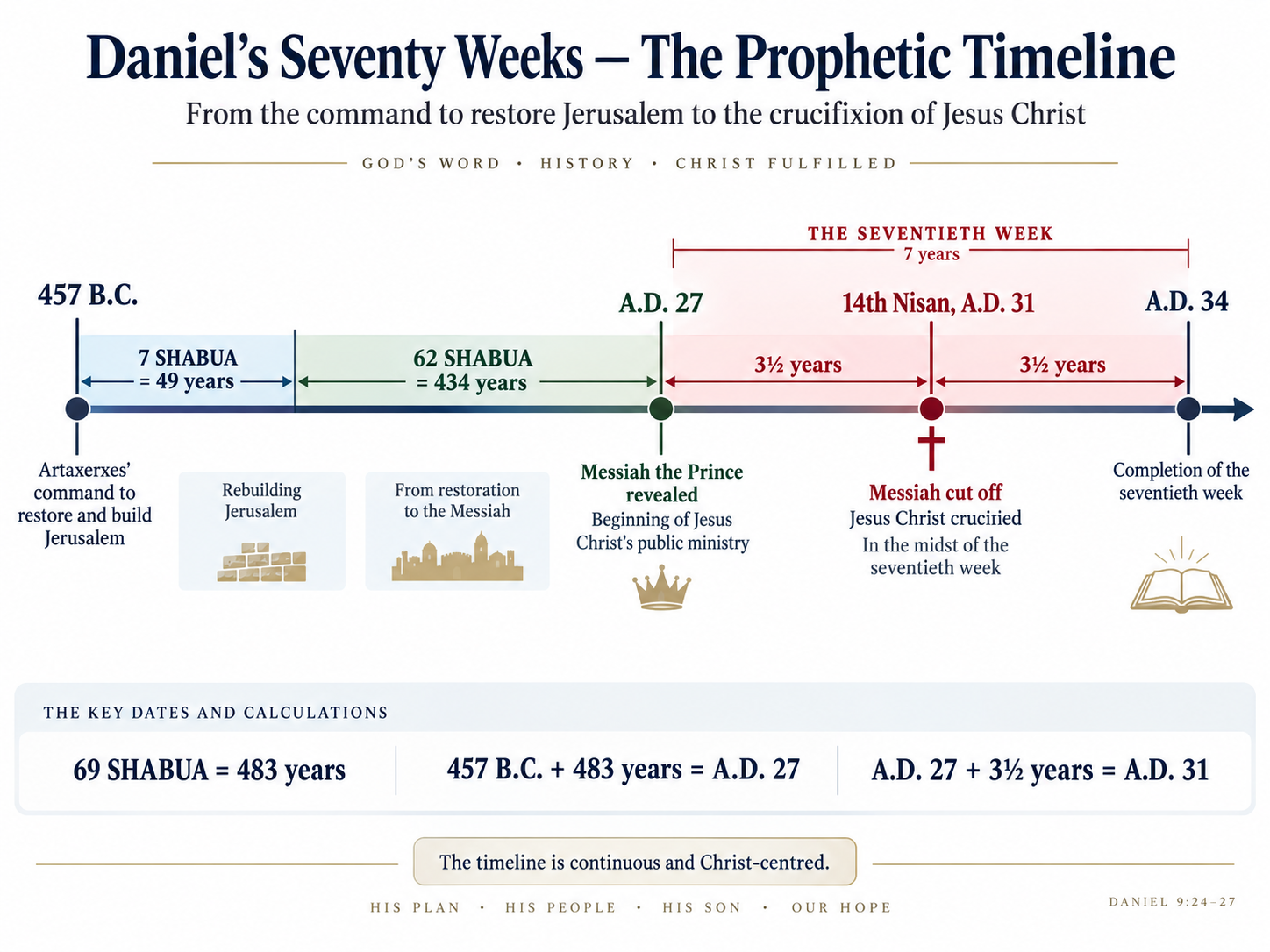
Jesus Christ began His public ministry in A.D. 27. Three and a half years later brings the chronology to the spring of A.D. 31. That is where Daniel places the cutting off of Messiah.
The Seventieth Week Is Seven Years
Daniel's seventy weeks consist of seventy SHABUA. One SHABUA is a period of seven years, so the seventieth week covers seven years.
Its midpoint is three and a half years. The first half extends from the beginning of Jesus Christ's public ministry in A.D. 27 to the spring of A.D. 31. This is the chronological position Daniel identifies when he says “in the midst of the week.”
The prophecy is precise.
From A.D. 27 to A.D. 31
The sixty-nine weeks ended in A.D. 27 when Messiah the Prince was publicly revealed. The seventieth week then began, and counting forward three years and six months brings the timeline to the spring of A.D. 31.
The calculation is:
A.D. 27 + 3½ years = A.D. 31.
Daniel had already said that Messiah would be cut off after the sixty-nine weeks. He now identifies the position of that event within the seventieth week. Messiah would be cut off in its midst.
The Crucifixion Occurred in the Spring
The chronology followed in this module places the crucifixion on the 14th of Nisan in A.D. 31. Nisan is the first month of the Hebrew sacred calendar, and the fourteenth day of Nisan was connected with Passover and its preparation.
The chronology therefore moves from A.D. 27, the beginning of Jesus Christ's public ministry, to the spring of A.D. 31, when Messiah was cut off. This places the crucifixion exactly where Daniel's prophecy requires it.
He Shall Confirm the Covenant
Daniel does not say that the central figure of the seventieth week makes an unrelated future covenant. He says, “he shall confirm the covenant with many for one week.”
The subject remains Jesus Christ. The Messiah of verse 25 is the Messiah of verse 26 and remains the central figure in verse 27. Jesus Christ confirms the covenant.
Jesus identified that covenant with His own blood.
Jesus said in Luke 22:20:
“Likewise also the cup after supper, saying, This cup is the new testament in my blood, which is shed for you.”
The New Covenant is therefore directly connected with His sacrificial death. Daniel's prophecy moves from Messiah to covenant fulfilment.
Personal Response
Key Truth
How does Christ's death end the sacrifices' divine purpose without stopping every outward offering that day?
Personal Reflection
What does the completed sacrifice help you understand about the New Covenant?
Action Step
Which words in Hebrews 10:9-10 will you compare with Daniel 9:27?
The Covenant Is Established Through Jesus Christ
The writer of Hebrews explains the covenant change accomplished through Jesus Christ.
Hebrews states in Hebrews 10:9-10:
“Then said he, Lo, I come to do thy will, O God. He taketh away the first, that he may establish the second. By the which will we are sanctified through the offering of the body of Jesus Christ once for all.”
Jesus Christ “taketh away the first” and establishes the second. The Old Covenant reached its fulfilment in Him, and the New Covenant was established through Him.
This did not wait until A.D. 70. A.D. 70 brought the visible Temple-centred order to its historical end, but the covenant purpose of that system had already been fulfilled in Jesus Christ.
Sacrifice and Oblation Cease
Daniel also states that “in the midst of the week he shall cause the sacrifice and the oblation to cease.” This does not mean that every animal sacrifice physically stopped being offered at the Temple on the day Jesus Christ died.
The outward system continued for a period, but its divine covenant purpose had ended. Jesus Christ offered the perfect sacrifice, fulfilling the purpose towards which the former sacrifices pointed.
The writer of Hebrews states in Hebrews 9:26:
“For then must he often have suffered since the foundation of the world: but now once in the end of the world hath he appeared to put away sin by the sacrifice of himself.”
Jesus Christ did not offer another sacrifice within the old system. He fulfilled the purpose of that sacrificial system through the sacrifice of Himself.
His Sacrifice Was Once for All
The Old Covenant required repeated offerings, but Jesus Christ offered Himself once.
Hebrews states in Hebrews 10:11-12:
“And every priest standeth daily ministering and offering oftentimes the same sacrifices, which can never take away sins: But this man, after he had offered one sacrifice for sins for ever, sat down on the right hand of God;”
The contrast is clear. The former sacrifices were repeated, but Jesus Christ offered “one sacrifice for sins for ever.”
The sacrificial system had therefore reached its fulfilment. The shadow had served its purpose, and the reality had come in Jesus Christ.
The Old Covenant System Lost Its Divine Purpose
Animal sacrifices could continue physically after the crucifixion. The Temple remained standing, priests continued serving and offerings continued being made. However, those outward actions no longer possessed the covenant standing they once held.
The divine purpose of sacrifice and oblation had been fulfilled in Jesus Christ. This is the meaning of Daniel's statement that Messiah would “cause the sacrifice and the oblation to cease.”
They ceased in their divine covenant purpose because the perfect sacrifice had been offered.
The Final Week Remains Centred Upon Jesus Christ
Nothing in Daniel 9 requires a change of subject from Messiah to Antichrist. The prophetic sequence remains centred upon Jesus Christ.
Messiah appears, Messiah is cut off, Messiah confirms the covenant, and Messiah causes sacrifice and oblation to cease. The final week belongs to Jesus Christ.
It does not need to be removed from the first century and placed thousands of years into the future. The events Daniel identifies are fulfilled in the work of Jesus Christ.
A.D. 31 Marks the Midpoint
The chronological line can now be followed clearly:
- 457 B.C.: The command goes forth;
- 483 years: Sixty-nine SHABUA;
- A.D. 27: Messiah the Prince is revealed;
- 3½ years: The first half of the seventieth week;
- A.D. 31: Messiah is cut off in the midst of the week;
- 14th Nisan: The crucifixion.
At that point, Jesus Christ confirms the New Covenant through His blood and causes sacrifice and oblation to cease in their divine purpose through His perfect sacrifice. Daniel's chronology therefore reaches the cross exactly where the prophecy said it would.
The Prophecy Authenticates Jesus Christ
The timeline is not a collection of disconnected dates. Every stage leads to Jesus Christ.
The command identifies the beginning, the sixty-nine weeks identify His public manifestation, and the midpoint of the seventieth week identifies His death. The covenant points to His blood, and the ending of sacrifice points to His perfect offering.
The chronology therefore authenticates both the prophecy and the Messiah. Daniel foretold that Messiah would be cut off in the midst of the final week, and the chronology places the crucifixion in A.D. 31.
Messiah the Prince gave Himself as the perfect sacrifice. The crucifixion occurred in the midst of the seventieth week, not at its end. Three and a half years of the seventieth week therefore remained after A.D. 31, bringing the full seventy-week period to A.D. 34. The events that mark the completion of the seventieth week will be examined in the next Study Guide.
Personal Response
Key Truth
Why does the midpoint in A.D. 31 leave three and a half years in the prophecy?
Personal Reflection
How does keeping the whole final week together guard your understanding of its fulfilment?
Action Step
How will you mark the beginning, midpoint and end of the final week in your study notes?
CALCULATING DATES IN BIBLICAL CONTEXT
Understanding biblical chronology requires us to recognise that the people and events recorded in Scripture were not operating according to the modern Gregorian calendar. Biblical days, months and years must therefore be understood within their own historical setting, especially when examining Daniel's seventy weeks and the chronology surrounding the death and resurrection of Jesus Christ.
If a modern method of counting days is imposed upon a biblical account, the resulting calculation can be incorrect. The foundation for biblical reckoning is seen from the creation account itself.
Moses wrote in Genesis 1:14:
“And God said, Let there be lights in the firmament of the heaven to divide the day from the night; and let them be for signs, and for seasons, and for days, and years:”
The movement of the heavenly bodies was connected with the measurement of seasons, days and years. The Hebrew calendar developed within this biblical framework.
The Hebrew Day Begins in the Evening
One of the most important differences between biblical and modern reckoning is the beginning of the day. Under the modern Gregorian system, a new calendar day begins at midnight, while the Hebrew day begins in the evening and continues from sunset to sunset. This pattern is already visible in the creation account.
Moses wrote in Genesis 1:5:
“And God called the light Day, and the darkness he called Night. And the evening and the morning were the first day.”
The order is evening and then morning. A biblical day therefore begins with the evening, and this principle is essential when examining Passover, the crucifixion, the Sabbaths surrounding the death of Jesus Christ and the Sign of Jonah.
An event that takes place after sunset belongs to a new Hebrew day. According to a modern clock and calendar, however, we might still think of that evening as belonging to the previous day.
Hebrew Months Follow the Lunar Cycle
The Hebrew calendar also differs from the Gregorian calendar in the reckoning of months. Hebrew months follow the lunar cycle, and a lunar month is approximately twenty-nine and one-half days long. Hebrew months therefore normally contain either twenty-nine or thirty days.
The beginning of the month was associated with the appearance of the new moon. Biblical months cannot therefore be treated as though they correspond exactly with January, February, March and the other months of the Gregorian calendar.
The biblical month of Nisan, for example, overlaps portions of what we now call March and April. The month of Av occurs later in the year and overlaps portions of July and August. These distinctions matter when placing biblical events on a modern historical timeline.
Personal Response
Key Truth
Why must biblical days and months be read within their own calendar setting?
Personal Reflection
How does recognising a sunset beginning help you avoid imposing a modern assumption?
Action Step
How will you mark one sunset-to-sunset day when reviewing the crucifixion sequence?
The Lunar and Solar Years Must Be Kept Together
Twelve lunar months are shorter than a solar year. Without adjustment, the months would gradually move away from the seasons in which Israel's appointed observances were to occur. The Hebrew calendar therefore required periodic adjustment so that the lunar months remained aligned with the solar seasons.
An additional month was inserted when necessary. The later fixed Jewish calendar developed a nineteen-year cycle in which seven additional months are inserted, keeping observances such as Passover within their proper seasonal setting.
For this study, the important principle is simple: biblical dates must be interpreted according to the Hebrew calendar rather than forced into a modern calendar without adjustment.
The Month of Nisan
Nisan is especially important to the chronology of Jesus Christ's death. God established the month connected with Passover as the beginning of the sacred calendar.
Moses wrote in Exodus 12:1-2:
“And the LORD spake unto Moses and Aaron in the land of Egypt, saying, This month shall be unto you the beginning of months: it shall be the first month of the year to you.”
The Passover lamb was connected with the fourteenth day of that month.
Moses wrote in Exodus 12:5-6:
“Your lamb shall be without blemish, a male of the first year: ye shall take it out from the sheep, or from the goats: And ye shall keep it up until the fourteenth day of the same month: and the whole assembly of the congregation of Israel shall kill it in the evening.”
The 14th of Nisan therefore becomes an important chronological marker when examining the crucifixion of Jesus Christ in A.D. 31. The biblical reckoning of the day must remain in view when that chronology is examined.
Biblical Days Must Be Counted From Sunset
Because the Hebrew day begins at sunset, the sequence surrounding the crucifixion cannot be calculated accurately by beginning each day at midnight. This becomes crucial when examining Jesus' statement that He would be in the heart of the earth for three days and three nights.
A night belongs to the beginning portion of the Hebrew day, and the following daylight hours complete that same day. Therefore, when the burial and resurrection chronology is examined, the sequence must be counted according to the biblical day, from evening to evening, rather than from midnight to midnight.
This distinction will become central when we examine the Sign of Jonah.
There Is No Year Zero
Another important chronological principle concerns the movement from B.C. to A.D. There is no year zero in the traditional B.C./A.D. system. The sequence moves directly from 1 B.C. to A.D. 1.
This is why the calculation from 457 B.C. through 483 years reaches A.D. 27 rather than A.D. 26. The arithmetic must account for the absence of a year zero, and this principle must remain consistent throughout the chronology.
Exact Hours Should Not Be Invented
The Hebrew calendar also reminds us that ancient biblical chronology does not always permit the exact modern precision of hours, minutes and seconds. The beginning of a month depended upon observation of the lunar cycle, and ancient timekeeping differed considerably from modern clocks.
We should therefore distinguish between what Scripture establishes clearly and details it does not give. We can establish the required sequence, the days involved, the three days and three nights, and the relationship between Nisan, Passover and the crucifixion. We should not invent an exact hour where Scripture does not provide one.
The Biblical Calendar Protects the Chronology
These principles provide the framework required for the final part of this Study Guide. A biblical day runs from sunset to sunset, Hebrew months follow the lunar cycle, and the calendar is adjusted to remain aligned with the seasons. Nisan is the first month of the sacred calendar, the crucifixion is connected with the 14th of Nisan, and there is no year zero between B.C. and A.D.
These are not minor technical details. They directly affect how the chronology of Jesus Christ's death and resurrection must be understood.
The next section will apply these principles to the sign Jesus Himself gave: three days and three nights.
Personal Response
Key Truth
Why should we distinguish a clear biblical sequence from an exact hour Scripture does not supply?
Personal Reflection
What does this distinction teach you about confidence and care when explaining dates?
Action Step
Which established calendar facts will you record separately from details the text leaves unstated?
THE SIGN OF JONAH
Jesus gave one direct sign concerning His death, burial and resurrection: the sign of the prophet Jonah. The sign was not based upon later tradition or an assumed day of crucifixion. Jesus Himself gave the measure that must govern the chronology.
Matthew wrote in Matthew 12:38-40:
“Then certain of the scribes and of the Pharisees answered, saying, Master, we would see a sign from thee. But he answered and said unto them, An evil and adulterous generation seeketh after a sign; and there shall no sign be given to it, but the sign of the prophet Jonas: For as Jonas was three days and three nights in the whale's belly; so shall the Son of man be three days and three nights in the heart of the earth.”
Jesus stated the sign plainly: three days and three nights. Jonah's experience was the shadow, and Jesus Christ was the reality to which that shadow pointed.
Jonah Establishes the Pattern
Jonah wrote in Jonah 1:17:
“Now the LORD had prepared a great fish to swallow up Jonah. And Jonah was in the belly of the fish three days and three nights.”
Jesus deliberately connected His own death, burial and resurrection with Jonah's experience. The wording therefore matters. Jesus did not say part of three days; He said “three days and three nights.” The chronology surrounding His burial and resurrection must therefore allow for three days and three nights.
The Traditional Friday-to-Sunday Timeline Does Not Fit
A traditional Christian chronology places the crucifixion on Friday afternoon and the resurrection on Sunday morning. That timeframe does not provide three days and three nights. From Friday afternoon to Sunday morning there are only two nights and one complete intervening day.
The words of Jesus must govern the chronology rather than inherited tradition. The question is not what day has traditionally been called Good Friday, but what chronology actually fulfils three days and three nights.
The Crucifixion Was Before a High Sabbath
One of the main reasons for the traditional Friday assumption is the statement that Jesus was crucified before a Sabbath. John, however, identifies that Sabbath more precisely.
John wrote in John 19:31:
“The Jews therefore, because it was the preparation, that the bodies should not remain upon the cross on the sabbath day, (for that sabbath day was an high day,) besought Pilate that their legs might be broken, and that they might be taken away.”
John does not simply say that the following day was the weekly Sabbath. He says “that sabbath day was an high day.” This was a special annual Sabbath associated with the Feast of Unleavened Bread and must not automatically be identified with the ordinary weekly Sabbath.
Personal Response
Key Truth
Why does a High Sabbath differ from the ordinary weekly Sabbath in the burial chronology?
Personal Reflection
How does this distinction challenge a conclusion based only on the word Sabbath?
Action Step
Which words in John 19:31 and Leviticus 23:5-6 will you compare?
The Passover and the Feast of Unleavened Bread
The Law distinguishes the fourteenth and fifteenth days of the first month.
Moses wrote in Leviticus 23:5-6:
“In the fourteenth day of the first month at even is the LORD'S passover. And on the fifteenth day of the same month is the feast of unleavened bread unto the LORD: seven days ye must eat unleavened bread.”
The fourteenth day was associated with Passover, and the fifteenth began the Feast of Unleavened Bread. The fifteenth was a special holy day. The crucifixion therefore occurred on the preparation day before that High Sabbath.
The chronology followed in this study places that preparation day on Wednesday, the 14th of Nisan, A.D. 31. This allows the three days and three nights to be counted according to the sign Jesus gave.
Jesus Was Buried Before Sunset
After Jesus died, Joseph of Arimathaea asked Pilate for His body.
Luke wrote in Luke 23:52-54:
“This man went unto Pilate, and begged the body of Jesus. And he took it down, and wrapped it in linen, and laid it in a sepulchre that was hewn in stone, wherein never man before was laid. And that day was the preparation, and the sabbath drew on.”
Jesus was placed in the tomb before sunset. At sunset, the Hebrew day changed: the 14th of Nisan ended and the 15th of Nisan began. The High Sabbath had arrived, giving us the starting point for counting the three nights and three days.
The First Night and First Day
Jesus was placed in the tomb before sunset on Wednesday. When the sun set, the first night began.
Wednesday night: 15th Nisan. Jesus was in the tomb, and this was the first night. The following daylight period was Thursday.
Thursday day: 15th Nisan. Jesus remained in the tomb, and this was the first day. The High Sabbath occupied this period.
The Second Night and Second Day
When Thursday ended at sunset, the next Hebrew day began. Thursday night: 16th Nisan. Jesus remained in the tomb, and this was the second night.
The following daylight period was Friday. Friday day: 16th Nisan. Jesus remained in the tomb, and this was the second day. The annual High Sabbath had ended, so Friday was available as a working day before the regular weekly Sabbath began.
The Women Prepared the Spices
Luke records what the women did after seeing where Jesus had been laid.
Luke wrote in Luke 23:55-56:
“And the women also, which came with him from Galilee, followed after, and beheld the sepulchre, and how his body was laid. And they returned, and prepared spices and ointments; and rested the sabbath day according to the commandment.”
The women prepared spices and then rested on the Sabbath. The existence of a working day between the High Sabbath and the weekly Sabbath allows these actions to fit naturally within the chronology. Friday provided that working day.
The Third Night and Third Day
At sunset on Friday, the weekly Sabbath began. Friday night: 17th Nisan. Jesus remained in the tomb, and this was the third night.
The following daylight period was Saturday. Saturday day: 17th Nisan. Jesus remained in the tomb, and this was the third day.
The sign had now reached three nights and three days. Jesus could not remain in the tomb into a fourth night if the sign He gave was to be fulfilled exactly. He therefore rose before the next night began.
The Empty Tomb Was Discovered on the First Day of the Week
The first day of the week began after the weekly Sabbath had ended. When Mary Magdalene later came to the tomb, it was still dark.
John wrote in John 20:1:
“The first day of the week cometh Mary Magdalene early, when it was yet dark, unto the sepulchre, and seeth the stone taken away from the sepulchre.”
The tomb was already empty. John does not say that Jesus rose while Mary was there. He says that when she arrived, “the stone [was] taken away.”
Sunday morning was therefore the time when the empty tomb was discovered. It was not the time Scripture identifies as the moment of resurrection.
The Complete Count
The chronology can now be stated clearly:
- Wednesday night: first night, 15th Nisan;
- Thursday day: first day, 15th Nisan;
- Thursday night: second night, 16th Nisan;
- Friday day: second day, 16th Nisan;
- Friday night: third night, 17th Nisan;
- Saturday day: third day, 17th Nisan.
That is three nights and three days, exactly as Jesus said. The sign of Jonah is fulfilled.
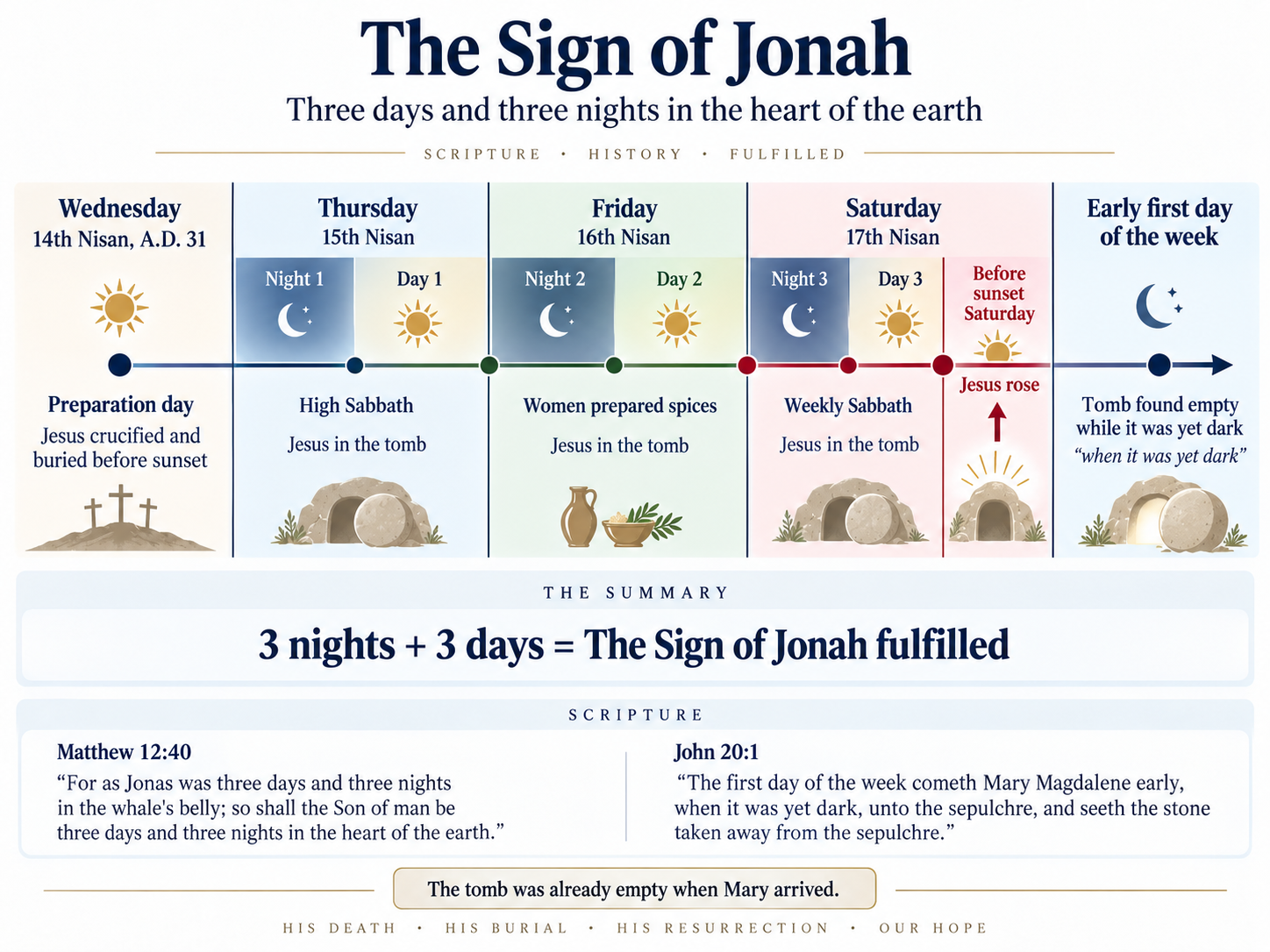
Jesus Christ Is Lord of the Sabbath
Jesus said in Mark 2:28:
“Therefore the Son of man is Lord also of the sabbath.”
The chronology places His resurrection before the weekly Sabbath had fully given way to the first day of the week. Jesus Christ is Lord of the Sabbath, and He is also the true spiritual rest to whom the Sabbath pointed.
Jesus said in Matthew 11:28-30:
“Come unto me, all ye that labour and are heavy laden, and I will give you rest. Take my yoke upon you, and learn of me; for I am meek and lowly in heart: and ye shall find rest unto your souls. For my yoke is easy, and my burden is light.”
The believer's true rest is found in Jesus Christ Himself. The shadow points to the reality found in Him.
The Sign Authenticates Messiah
The sign of Jonah is not an isolated chronological curiosity. It belongs with the wider prophetic testimony concerning Jesus Christ. Daniel identifies the year in which Messiah would be cut off, the Gospel record identifies the Passover setting, and Jesus identifies the required duration: three days and three nights.
The chronology therefore comes together around Jesus Christ. He is Messiah the Prince. He was cut off in the midst of the seventieth week and buried before the High Sabbath.
He remained in the tomb for three days and three nights. When the women arrived while it was still dark on the first day of the week, the tomb was already empty.
The sign Jesus gave was fulfilled, and the timeline authenticates Jesus Christ as the true Messiah.
Personal Response
Key Truth
How does the Wednesday-to-Saturday count fulfil Jesus' three nights and three days?
Personal Reflection
What does the already empty tomb help you recognise about discovery and resurrection?
Action Step
When will you count the nights and days alongside Matthew 12:40 and John 20:1?
CONCLUSION: THE TIMELINE LEADS TO JESUS CHRIST
Daniel's seventy weeks provide a precise prophetic timeline that leads directly to Jesus Christ. The chronology begins with the command to restore and build Jerusalem, moves through sixty-nine prophetic weeks to Messiah the Prince, and then places the cutting off of Messiah within the seventieth week.
The prophecy is not vague. It has a definite beginning, a measured duration and a defined destination. That destination is Jesus Christ.
The Prophecy Begins in 457 B.C.
Daniel wrote in Daniel 9:25:
“Know therefore and understand, that from the going forth of the commandment to restore and to build Jerusalem unto the Messiah the Prince shall be seven weeks, and threescore and two weeks: the street shall be built again, and the wall, even in troublous times.”
The command associated with Artaxerxes in the seventh year of his reign fulfils Daniel's requirement. Cyrus authorised the rebuilding of the Temple, Darius confirmed the earlier Temple decree, and Artaxerxes restored the civil and judicial functioning of Jerusalem.
The prophetic clock therefore begins in 457 B.C.
Sixty-Nine SHABUA Lead to Messiah
The Hebrew word SHABUA means a period of seven years. Sixty-nine SHABUA therefore equal 483 years.
69 × 7 = 483 years.
Counting 483 years from 457 B.C., allowing for the absence of a year zero, brings the chronology to A.D. 27. This is the year in which Jesus Christ entered His public ministry, and Daniel's prophecy reaches “Messiah the Prince.”
The Hebrew word MASHIACH means “Anointed One.” Jesus Christ is the Anointed One to whom the prophecy points.
Messiah Is Cut Off
Daniel then states what happens after the sixty-nine weeks.
Daniel wrote in Daniel 9:26:
“And after threescore and two weeks shall Messiah be cut off, but not for himself: and the people of the prince that shall come shall destroy the city and the sanctuary; and the end thereof shall be with a flood, and unto the end of the war desolations are determined.”
The Hebrew word KARATH means “to be put to death.” Daniel therefore foretold the death of Messiah. Jesus Christ was not cut off for His own sin, but gave Himself for the sins of others.
The prophecy moves directly from Messiah revealed to Messiah crucified.
The Crucifixion Occurs in the Midst of the Week
Daniel identifies the position of the crucifixion within the seventieth week.
Daniel wrote in Daniel 9:27:
“And he shall confirm the covenant with many for one week: and in the midst of the week he shall cause the sacrifice and the oblation to cease, and for the overspreading of abominations he shall make it desolate, even until the consummation, and that determined shall be poured upon the desolate.”
The seventieth week is seven years, and the midst of seven years is three and a half years. From A.D. 27, three and a half years bring the chronology to the spring of A.D. 31.
The prophecy therefore places the crucifixion in the midst of the seventieth week. Messiah was cut off exactly where Daniel said He would be.
Jesus Christ Confirmed the Covenant
The “he” of Daniel 9:27 is Jesus Christ. He confirms the covenant and causes sacrifice and oblation to cease in their divine purpose through His own perfect sacrifice.
Jesus said in Luke 22:20:
“Likewise also the cup after supper, saying, This cup is the new testament in my blood, which is shed for you.”
The New Covenant was established through Jesus Christ. The prophecy therefore does not direct us towards a future covenant with another central figure. It directs us to the covenant work of Jesus Christ.
The Sign of Jonah Confirms the Chronology
Jesus Himself gave the sign connected with His death and resurrection: “three days and three nights.” The chronology followed in this study places His burial before sunset on Wednesday, the 14th of Nisan, and His resurrection before sunset on Saturday, the 17th of Nisan.
This gives three nights and three days. When Mary Magdalene arrived at the tomb on the first day of the week while it was still dark, Jesus had already risen. The Sign of Jonah had been fulfilled.
The Whole Timeline Points to One Person
The chronology can now be seen as one continuous line:
- 457 B.C.: The command to restore and build Jerusalem;
- 483 years: Sixty-nine SHABUA;
- A.D. 27: Messiah the Prince is revealed;
- Three and a half years: The first half of the seventieth week;
- A.D. 31: Messiah is cut off in the midst of the week;
- 14th Nisan: The crucifixion;
- Three days and three nights: The Sign of Jonah fulfilled.
Every major point in the timeline leads to Jesus Christ. The decree establishes the starting point, the sixty-nine weeks lead to Messiah, the seventieth week contains His sacrificial death, and the Sign of Jonah confirms the chronology surrounding His death and resurrection.
Prophecy Authenticates Jesus Christ
The purpose of this chronology is not simply to produce an impressive chart. Its purpose is to authenticate the Messiah.
God declared beforehand when Messiah would appear. He foretold that Messiah would be cut off and identified where that death would occur within the final week. Jesus then gave the Sign of Jonah concerning His death and resurrection.
The fulfilment confirms the truthfulness of God's Word. Daniel's timeline therefore stands as a powerful testimony to Jesus Christ.
It does not point us towards an unfinished prophetic programme. It points us towards the One in whom the prophecy is fulfilled.
The timeline leads to Jesus Christ.
Personal Response
Key Truth
How does the whole timeline authenticate Jesus Christ as Messiah?
Personal Reflection
Which connection between prophecy and fulfilment has strengthened your confidence in Him?
Action Step
How will you explain one part of the timeline with Scripture while keeping Jesus Christ central?
SUBMISSION TO COGMA FOR APPRAISAL
Instructions
Complete this section after you have finished the Study Guide. It must be completed online. The link to the online form that you must complete and submit is located at the bottom of this Study Guide.
Your answers should reflect your understanding, your personal response, and how you intend to live by the truth you have studied.
Answer honestly and be specific.
1. Main Truth
Explain how the command to restore Jerusalem, the measured years and Messiah's appearance and death form one continuous prophetic timeline. Why does that timeline bear witness to Jesus Christ rather than simply provide dates?
2. Understanding
How do the commands of Cyrus, Darius and Artaxerxes compare with the requirement to restore and build Jerusalem? Why does restored civil and judicial authority matter, and how do Ezra's arrival and Artaxerxes' seventh year establish 457 B.C.?
3. Personal Reflection
How has the distinction between a date supported by Scripture's conditions and a date accepted from tradition challenged your thinking? Explain how you would test a proposed beginning for Daniel's prophecy.
4. Response to Truth
What does Messiah being cut off, but not for Himself, call you to recognise about His death and your response to Him? Use a verse to explain why the cross was the fulfilment of His mission.
5. Action Step
This week, work through the calculation from 457 B.C. to A.D. 27 and then to the midpoint in A.D. 31. Explain how you will account for the absence of a year zero and the final week's two halves, and when you will begin.
6. Early Response
Have you already worked through the calculation from 457 B.C. to A.D. 27 and then to the midpoint in A.D. 31, accounting for the absence of a year zero and the final week's two halves? If yes, briefly explain what you did or what became clear. If not, explain what has made it difficult to begin.
7. Ongoing Practice
How will you continue to check biblical dates using sunset-to-sunset days, lunar months and the limits of the evidence? Explain how you will distinguish the sequence Scripture gives from exact hours it does not give.
8. Doctrinal Clarity
Explain why Jesus' anointing for public ministry in A.D. 27 did not make Him holy or divine. How does the same Messiah's death in A.D. 31 connect the New Covenant with sacrifices ceasing in their divine purpose? Use verses to support your explanation.
9. Living the Truth
A person says that discovering the empty tomb on Sunday proves a Sunday resurrection and that the preceding Sabbath proves a Friday crucifixion. How would you explain the High Sabbath, the women's preparation of spices and Jesus' three days and three nights, while answering with care?
10. Final Response
Bring together Artaxerxes' command, the 483 years, Messiah's public ministry, the midpoint of the final week and the Sign of Jonah. What has been clarified or corrected for you, and how will this testimony to Jesus Christ guide your future study and response to Him?
You must submit your answers to the above 10 questions ONLINE.
Use the link below for your final submission after finishing this Study Guide. Answer honestly and be specific.
Would you prefer a printable copy?