
Search results will appear as highlighted text.
Quick Navigation
INSTRUCTIONS FOR THE STUDENTPREFACEINTRODUCTION: FATHER, SON AND HOLY GHOST WITHIN THE ONE-GOD REVELATIONREAD EACH SCRIPTURE WITHIN THE ONE-GOD FOUNDATIONMATTHEW 28:19 – “IN THE NAME”THE FATHER, THE SON AND THE HOLY GHOST IN ONE VERSETHE BAPTISM OF JESUS – TWO BAPTISMS COME INTO VIEW2 CORINTHIANS 13:14 – A BLESSING, NOT A DEFINITION OF GODCONCLUSION: ONE GOD IN FATHER, SON AND HOLY GHOSTSUBMISSION TO COGMA FOR APPRAISAL
INSTRUCTIONS FOR THE STUDENT
My Study Plan
Preparing a Study Plan before starting this Study Guide will assist you in completing it within a designated timeframe. It also helps in developing the discipline required for studying God’s Word effectively.
Proverbs 16:3:
Commit thy works unto the LORD, and thy thoughts shall be established.
My Study Guide Journal
Keep a record as you progress through your Study Guide, including the Personal Responses for each section, for future reference and goal setting.
Content
- Preface
- INTRODUCTION: FATHER, SON AND HOLY GHOST WITHIN THE ONE-GOD REVELATION
- READ EACH SCRIPTURE WITHIN THE ONE-GOD FOUNDATION
- MATTHEW 28:19 – “IN THE NAME”
- THE FATHER, THE SON AND THE HOLY GHOST IN ONE VERSE
- THE BAPTISM OF JESUS – TWO BAPTISMS COME INTO VIEW
- 2 CORINTHIANS 13:14 – A BLESSING, NOT A DEFINITION OF GOD
- CONCLUSION: ONE GOD IN FATHER, SON AND HOLY GHOST
Important Points
- COGMA does not claim to be infallible or the authority.
- Infallibility and authority belong only to God and His Word.
COGMA therefore strongly advises that you prayerfully study the content of each Study Guide with the heart of a Berean (Acts 17:10–12).
Contact and Links
Website: cogma.com.au
Email: admin@cogma.org.au
Radio COGMA: radiocogma.com
YouTube: youtube.com/@COGMAChannel
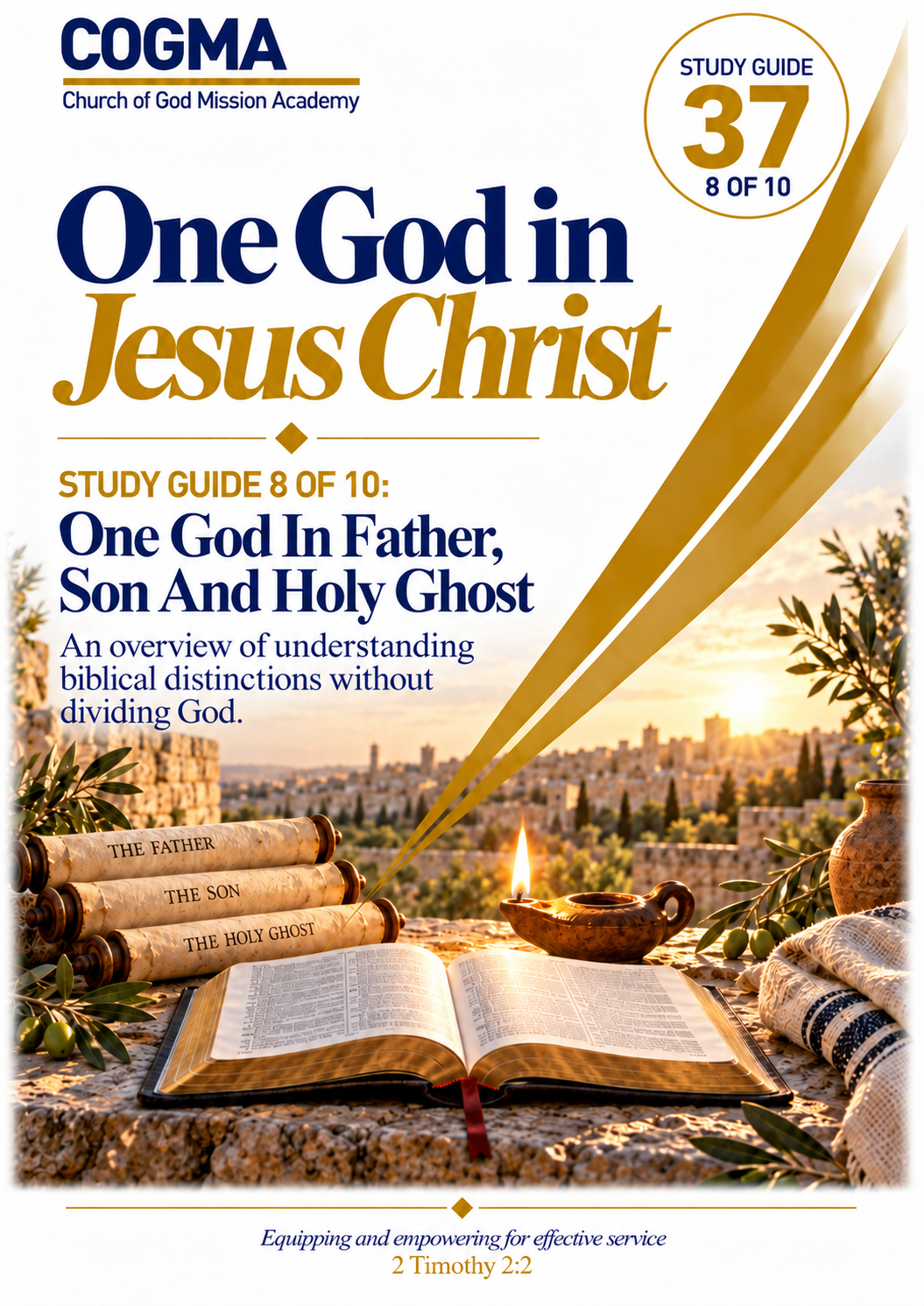
PREFACE
The previous Study Guide followed Jesus Christ through humiliation, death, resurrection, exaltation, intercession and reign. It brought that mediating work to its appointed conclusion in Paul’s declaration that the Son delivers up the kingdom to God and that the final purpose is “that God may be all in all.”
We now turn to another group of Scriptures. These Scriptures mention the Father, the Son and the Holy Ghost together, and they are often used to support the belief that God exists as three distinct divine persons. Our purpose in this Study Guide is to examine those Scriptures carefully within the Scriptural foundation already established throughout this module.
Moses wrote in Deuteronomy 6:4:
“Hear, O Israel: The LORD our God is one LORD:”
That declaration does not change when the New Testament speaks of the Father, the Son and the Holy Ghost in the same verse or event. Scripture must remain consistent with itself, and no verse should be interpreted in a way that overturns the Bible’s repeated testimony that God is one.
The meaning of these expressions has already been established from Scripture. The Father is the eternal Spirit, the Son is the complete and genuine human life of Jesus Christ through whom the one invisible God was revealed, and the Holy Ghost is the same one Spirit of God and of Christ.
These distinctions are real, and Scripture must be allowed to preserve them exactly as given. Yet they do not divide God into separate divine persons or create separate sources of Deity. The Father was not another God standing apart from Jesus Christ, because Jesus said that the Father dwelt within Him.
Neither is the Holy Ghost another divine Spirit separate from Christ. Scripture identifies the Spirit of God as the Spirit of Christ and declares that “the Lord is that Spirit.” The different expressions must therefore be understood within the truth that there is one God and one Spirit.
This Study Guide will examine several important Scriptures in their own context. We will consider Matthew 28:19 and the singular expression “in the name,” the baptism of Jesus, verses where the Father, the Son and the Holy Ghost appear together, and Paul’s blessing in 2 Corinthians 13:14.
Our task is not simply to count the expressions appearing in a verse. We must ask what Scripture means by Father, Son and Holy Ghost and allow the whole testimony of the Word of God to govern our understanding.
The foundation remains unchanged: there is one God, fully revealed in Jesus Christ, and there is one Spirit. Every verse that follows must be read within that one-God revelation. We are not beginning with a theological formula and fitting Scripture into it. We are beginning with Scripture itself and allowing its clear declarations to govern the Scriptures that require closer examination.
Personal Response
Key Truth
Why must verses naming Father, Son and Holy Ghost be understood within Scripture's declaration of one God?
Personal Reflection
What question about these expressions do you most want to understand?
Action Step
Is there a verse you want to reconsider in light of the one-God foundation?
INTRODUCTION: FATHER, SON AND HOLY GHOST WITHIN THE ONE-GOD REVELATION
Scripture contains several verses in which the Father, the Son and the Holy Ghost are mentioned together. Because three expressions appear within the same verse or event, these verses are often used to teach that the one God exists as three distinct divine persons. We must therefore examine carefully what Scripture actually says and allow the Bible itself to define each expression.
The presence of Father, Son and Holy Ghost language does not permit us to set aside the clear declarations concerning the identity of God. A verse containing three expressions must remain in harmony with every direct statement that God is one.
Moses wrote in Deuteronomy 6:4:
“Hear, O Israel: The LORD our God is one LORD:”
This declaration forms a foundation that does not change when we enter the New Testament. The apostles did not announce another God or replace the one LORD with a different understanding of Deity. Their teaching continued to affirm the one God revealed throughout Scripture.
Paul wrote in 1 Timothy 2:5:
“For there is one God, and one mediator between God and men, the man Christ Jesus;”
Paul distinguishes between the one God and the man Christ Jesus in His mediating role without introducing a second God. The Son is the complete and genuine human life of Jesus Christ through whom the invisible God was revealed and through whom reconciliation was accomplished.
Scripture has also established that there is one Spirit. Paul wrote in Ephesians 4:4:
“There is one body, and one Spirit, even as ye are called in one hope of your calling;”
This statement must remain clear whenever Scripture speaks of the Holy Ghost. The Holy Ghost cannot be understood as another divine Spirit existing beside the Spirit of God and the Spirit of Christ, because Paul expressly says there is “one Spirit.”
The language Scripture uses concerning Father, Son and Holy Ghost therefore carries established meanings. The Father is the eternal Spirit, the Son is the complete and genuine human life through whom that eternal Spirit was revealed, and the Holy Ghost is the same one Spirit of God and of Christ.
These distinctions must not be erased. The Son is not the Father as to His genuine humanity, and the language of Father and Son describes a real relationship within the Incarnation. Yet that distinction does not require two divine persons, because Jesus Himself said that the Father dwelt within Him.
In the same way, the Holy Ghost must not be separated from Jesus Christ as another source of divine life. Scripture speaks of the Spirit of God and the Spirit of Christ and then declares that Christ dwells within the believer by that Spirit. The different expressions therefore remain distinct in language while belonging to the same one-God revelation.
Our task is not to count how many expressions occur in a verse and then assign a separate divine person to each expression. We must ask what each expression means according to the whole testimony of Scripture and what the verse itself is actually teaching.
A verse may speak of the Father, the Son and the Holy Ghost while describing salvation, revelation, mission, authority, fellowship, indwelling or witness. The subject of the verse must determine how its language is understood. The presence of three expressions does not by itself establish three divine persons.
This becomes especially important when we examine Scriptures such as Matthew 28:19, the baptism of Jesus and 2 Corinthians 13:14. Each contains language that must be allowed to stand exactly as Scripture gives it, but none should be isolated from the repeated biblical declaration that God is one.
The correct approach is therefore to begin with the clear statements of Scripture and then understand the Scriptures requiring closer examination in harmony with them. Before turning to those individual Scriptures, we must establish that governing principle more fully: Read each Scripture within the one-God foundation.
Personal Response
Key Truth
Why is naming three expressions in a verse different from defining three divine persons?
Personal Reflection
What does the actual subject of a verse help you understand?
Action Step
How could you read a verse naming Father, Son and Holy Ghost more carefully in your own study?
READ EACH SCRIPTURE WITHIN THE ONE-GOD FOUNDATION
Before we examine Matthew 28:19, 2 Corinthians 13:14 and the other Scriptures in which the Father, the Son and the Holy Ghost appear together, we must establish the principle that governs how those Scriptures are read. No verse should be interpreted in a way that overturns the Bible’s clear and repeated declaration that God is one.
The correct approach is to begin with the clear statements of Scripture and then understand the Scriptures requiring closer examination in harmony with them. Scripture must remain consistent with itself.
The Bible Repeatedly Declares One God
Moses wrote in Deuteronomy 6:4:
“Hear, O Israel: The LORD our God is one LORD:”
This statement is direct. It does not leave the identity of God open to a later redefinition. The LORD our God is one LORD, and every verse concerning the Father, the Son or the Holy Ghost must remain in harmony with that truth.
God spoke with the same certainty through Isaiah. God said in Isaiah 45:5-6:
“I am the LORD, and there is none else, there is no God beside me: I girded thee, though thou hast not known me: That they may know from the rising of the sun, and from the west, that there is none beside me. I am the LORD, and there is none else.”
The words are repeated for emphasis: “there is none else,” “there is no God beside me,” and “there is none beside me.” Scripture therefore presents one God without another God existing beside Him.
The LORD Created Alone
God also declared that He alone created all things. God said in Isaiah 44:24:
“Thus saith the LORD, thy redeemer, and he that formed thee from the womb, I am the LORD that maketh all things; that stretcheth forth the heavens alone; that spreadeth abroad the earth by myself;”
God says that He stretched forth the heavens “alone” and spread abroad the earth “by myself.” Creation therefore belongs to the one LORD. This becomes important whenever a more difficult expression is encountered.
Whatever the words “Let us make man” may mean, it cannot be interpreted in a way that contradicts God’s own declaration that He created alone and by Himself. The repeated nature of these declarations matters because Scripture does not state the unity of God once and then leave the matter uncertain. The same truth appears again and again through the Law, the Prophets and the apostolic writings.
A verse may require careful study, but difficulty does not give us permission to overturn what God has already stated plainly. Where Scripture gives a direct declaration and another verse uses language that requires interpretation, the interpretation must remain in harmony with the direct declaration. This is allowing the whole testimony of Scripture to speak consistently.
The New Testament continues the same testimony. Paul wrote in 1 Corinthians 8:4:
“As concerning therefore the eating of those things that are offered in sacrifice unto idols, we know that an idol is nothing in the world, and that there is none other God but one.”
Paul does not introduce a new numerical understanding of God. He states plainly that “there is none other God but one.” The apostolic testimony therefore remains in harmony with the revelation already established in the Old Testament.
Personal Response
Key Truth
How does the LORD creating alone guide the reading of verses about Father, Son and Holy Ghost?
Personal Reflection
What does this clear foundation help you understand about the number of Gods?
Action Step
Is there an explanation you have accepted that you want to compare with the one Creator's words?
One God, One Mediator and One Spirit
The New Testament also distinguishes the one God from the mediating role of Jesus Christ without creating a second God.
Paul wrote in 1 Timothy 2:5:
“For there is one God, and one mediator between God and men, the man Christ Jesus;”
Paul begins with “there is one God” and then identifies the mediator as “the man Christ Jesus.” Jesus Christ is not presented as another God beside the Father. He is identified in His genuine human mediating role.
This distinction must remain clear whenever God and Jesus Christ are mentioned together. There is one God, and the mediator is the man Christ Jesus through whom the one God was revealed and through whom reconciliation was accomplished.
Scripture is equally clear concerning the Spirit. Paul wrote in Ephesians 4:4:
“There is one body, and one Spirit, even as ye are called in one hope of your calling;”
Paul says plainly “one Spirit.” Therefore, when Scripture speaks of the Spirit of God, the Spirit of Christ and the Holy Ghost, we must not turn those expressions into separate divine Spirits.
Paul shows this directly in Romans 8:9:
“But ye are not in the flesh, but in the Spirit, if so be that the Spirit of God dwell in you. Now if any man have not the Spirit of Christ, he is none of his.”
Paul moves naturally from “the Spirit of God” to “the Spirit of Christ.” He does not introduce another Spirit. The same indwelling Spirit is described in relation to God and to Christ.
Paul makes the identification even more direct in 2 Corinthians 3:17:
“Now the Lord is that Spirit: and where the Spirit of the Lord is, there is liberty.”
The statement is plain: “The Lord is that Spirit.” This truth must remain part of our foundation when Jesus Christ and the Holy Ghost are mentioned in the same verse. Different Scriptural expressions do not require different divine persons.
God Was in Christ
Scripture also tells us how the one invisible God was revealed through Jesus Christ.
Paul wrote in 2 Corinthians 5:19:
“To wit, that God was in Christ, reconciling the world unto himself, not imputing their trespasses unto them; and hath committed unto us the word of reconciliation.”
Paul does not say that God was standing apart from Christ while another divine person independently accomplished reconciliation. He says “God was in Christ.” The saving work accomplished through Jesus Christ was therefore the work of the one God reconciling the world unto Himself.
Jesus described the same reality when He spoke of the Father dwelling within Him. Jesus said in John 14:10:
“Believest thou not that I am in the Father, and the Father in me? the words that I speak unto you I speak not of myself: but the Father that dwelleth in me, he doeth the works.”
Jesus said “the Father that dwelleth in me.” The Father and the Son are distinguishable within the reality of the Incarnation, but this distinction does not require two divine persons within God. The Father is the eternal Spirit, while the Son is the complete and genuine human life of Jesus Christ in whom that Spirit dwelt.
Paul also wrote in Colossians 2:9:
“For in him dwelleth all the fulness of the Godhead bodily.”
Paul says that ‘all the fulness of the Godhead’ dwelt bodily in Jesus Christ. Nothing belonging to Deity was absent from Him, and the one true God was fully revealed through genuine humanity.
Clear Scripture Must Govern the More Difficult Verses
We now have a clear Scriptural foundation. God is one, there is none beside Him, and He created alone and by Himself. There is one Spirit, the Spirit of God is the Spirit of Christ, and the Lord is that Spirit.
Scripture also says that God was in Christ, that the Father dwelt in Christ and that all the fulness of the Godhead dwelt bodily in Him. These are not conclusions built from speculation. They are direct statements of Scripture.
Therefore, when we come to a account in which the Father speaks, the Son is present and the Spirit is mentioned, that account must still agree with “The LORD our God is one LORD.” The presence of several expressions in one event cannot overturn the direct declaration that God is one.
The same principle applies to every expression that requires closer examination. We must not isolate a word or phrase and use it to cancel the clearer and repeated testimony of Scripture. Context must determine meaning, and Scripture must interpret Scripture.
This does not mean ignoring distinctions that the Bible itself makes. Father, Son and Holy Ghost are Scriptural expressions and must be preserved exactly as Scripture gives them. The question is not whether the distinctions exist, but what those distinctions mean according to the Bible itself.
The repeated testimony of Scripture gives us the foundation. The Father is the eternal Spirit, the Son is the complete and genuine human life of Jesus Christ through whom the one God was revealed, and the Holy Ghost is the same one Spirit of God and of Christ.
There is no verse of Scripture that states that the one God eternally exists as three distinct, coequal and coeternal divine persons. Verses used to support that doctrine therefore depend upon interpretation, and that interpretation must be tested against the whole testimony of Scripture.
Our task is not to begin with a predetermined theological explanation and then make Scripture fit it. If Scripture says “one God,” we begin there. If Scripture says “God was in Christ,” we accept it. If Scripture says “The Lord is that Spirit,” we accept that also.
These clear truths supply the foundation for the verses that require closer examination. As we now turn to Matthew 28:19, we do not begin again as though nothing has already been established. The one-God foundation remains unchanged.
There is one God. The Father is the eternal Spirit. The Son is the complete and genuine human life of Jesus Christ in whom that one God was fully revealed. The Holy Ghost is the same one Spirit of God and of Christ.
With that foundation firmly established, we are ready to examine the words of Jesus: “in the name of the Father, and of the Son, and of the Holy Ghost.”
Personal Response
Key Truth
Why must difficult verses agree with the clear declarations of one God and one Spirit?
Personal Reflection
What does this principle help you understand about reading Scripture together?
Action Step
How could remembering one God and one Spirit help your own understanding of a difficult verse?
MATTHEW 28:19 – “IN THE NAME”
One of the most frequently quoted verses concerning the Father, the Son and the Holy Ghost is Matthew 28:19. Because all three expressions appear together, the verse is often used to support the belief that God exists as three distinct divine persons. We must therefore read the words of Jesus carefully and allow the rest of Scripture to explain what He meant.
Jesus said in Matthew 28:18-20:
“And Jesus came and spake unto them, saying, All power is given unto me in heaven and in earth. Go ye therefore, and teach all nations, baptizing them in the name of the Father, and of the Son, and of the Holy Ghost: Teaching them to observe all things whatsoever I have commanded you: and, lo, I am with you alway, even unto the end of the world. Amen.”
Matthew 28:19 clearly mentions the Father, the Son and the Holy Ghost. We should not weaken or remove any of those words. At the same time, the verse itself does not say that these are three distinct, coequal and coeternal divine persons who together constitute one God.
Jesus was giving a Gospel commission. His words must therefore be understood within the revelation of God already established throughout Scripture and within the saving work centred in Jesus Christ.
The Name Is Singular
The first detail to notice is the wording Jesus used. He said “in the name,” not “in the names.” The word “name” is singular, so Jesus brings the Father, the Son and the Holy Ghost together under the singular expression “the name.”
This does not by itself answer every question concerning the verse, but it is important. Jesus did not give three separate divine names belonging to three separate divine persons. We must allow Scripture to explain how the Father, the Son and the Holy Ghost are made known within that singular name.
Jesus said in John 5:43:
“I am come in my Father's name, and ye receive me not: if another shall come in his own name, him ye will receive.”
Jesus said plainly, “I am come in my Father's name.” The Son therefore did not come with an independent divine identity separate from the Father. He came in the Father's name because the Father, the eternal Spirit, was being revealed through the genuine human life of Jesus Christ.
Jesus also prayed concerning the Father's name. Jesus said in John 17:6:
“I have manifested thy name unto the men which thou gavest me out of the world: thine they were, and thou gavest them me; and they have kept thy word.”
Jesus said, “I have manifested thy name.” The Father's name was therefore made known through Jesus Christ. The Father was not another God hidden somewhere apart from the Son. The Son manifested the Father because the Father dwelt within Him.
Matthew also tells us the name given to the Son. Matthew recorded in Matthew 1:21:
“And she shall bring forth a son, and thou shalt call his name JESUS: for he shall save his people from their sins.”
The name of the Son is plainly given as JESUS, and the angel connects that name with salvation: “for he shall save his people from their sins.”
Matthew then gives another important description of the One who was born. Matthew wrote in Matthew 1:23:
“Behold, a virgin shall be with child, and shall bring forth a son, and they shall call his name Emmanuel, which being interpreted is, God with us.”
Jesus Christ is Emmanuel, “God with us.” The Son is not another God beside the Father. The one eternal God was revealed among humanity through the complete and genuine human life of Jesus Christ.
Personal Response
Key Truth
Why does Jesus say 'in the name' rather than 'in the names' in Matthew 28:19?
Personal Reflection
What does this help you understand about the one saving name?
Action Step
What do you want to examine more carefully about the singular name and your own understanding of salvation?
The Father and the Holy Ghost Are Revealed Through Jesus Christ
Jesus explained clearly how the Father was made known through Him. Jesus said in John 14:9-10:
“Jesus saith unto him, Have I been so long time with you, and yet hast thou not known me, Philip? he that hath seen me hath seen the Father; and how sayest thou then, Shew us the Father? Believest thou not that I am in the Father, and the Father in me? the words that I speak unto you I speak not of myself: but the Father that dwelleth in me, he doeth the works.”
Jesus said, “he that hath seen me hath seen the Father,” and then explained why: “the Father that dwelleth in me.” The Father was made known through the Son because the Father, the eternal Spirit, dwelt within Him.
Therefore, when Matthew 28:19 speaks of the Father and the Son, it is not identifying two Gods or two eternal divine persons standing beside one another. The Son is the complete and genuine human life of Jesus Christ through whom the Father was revealed. This preserves both the genuine humanity of the Son and the unity of God.
Jesus also spoke about the Holy Ghost coming in His name. Jesus said in John 14:26:
“But the Comforter, which is the Holy Ghost, whom the Father will send in my name, he shall teach you all things, and bring all things to your remembrance, whatsoever I have said unto you.”
Jesus said that the Holy Ghost would come “in my name.” This is important when we return to the singular “name” of Matthew 28:19. The Son came in the Father's name, the Father's name was manifested through the Son, and the Holy Ghost comes in Jesus' name.
Jesus also explained who would come to His disciples. Jesus said in John 14:16-18:
“And I will pray the Father, and he shall give you another Comforter, that he may abide with you for ever; Even the Spirit of truth; whom the world cannot receive, because it seeth him not, neither knoweth him: but ye know him; for he dwelleth with you, and shall be in you. I will not leave you comfortless: I will come to you.”
After speaking of the Comforter, Jesus said, “I will come to you.” The Holy Ghost is therefore not another divine person who replaces Jesus Christ while He remains absent from His people. The One who had been with the disciples would be in them. Jesus Christ came to dwell within His born-again people by His Spirit.
The Spirit of Christ Dwells Within
Paul confirms the same truth. Paul wrote in Romans 8:9-10:
“But ye are not in the flesh, but in the Spirit, if so be that the Spirit of God dwell in you. Now if any man have not the Spirit of Christ, he is none of his. And if Christ be in you, the body is dead because of sin; but the Spirit is life because of righteousness.”
Paul moves from “the Spirit of God” to “the Spirit of Christ” and then says “Christ be in you.” He is not describing three different divine Spirits or three separate divine persons. He is describing the same one Spirit. The Spirit of God is the Spirit of Christ, and Christ dwells within the believer by that Spirit.
The three expressions in Matthew 28:19 therefore do not require three separate divine identities. The Father is the eternal Spirit, the Son is the genuine human revelation through whom that Spirit was made known, and the Holy Ghost is the same one Spirit of God and of Christ.
The Apostolic Record Centres the Name of Jesus Christ
When we move from the command recorded in Matthew 28:19 to the historical record in Acts, the language repeatedly centres upon the name of Jesus Christ. These accounts are important because they show how the apostles understood and used the singular “name” connected with the Gospel commission.
Our purpose in considering these historical baptism accounts is the name they identify, not to reopen here the separate question of the continuing place of water baptism under the New Covenant.
Peter said in Acts 2:38:
“Then Peter said unto them, Repent, and be baptized every one of you in the name of Jesus Christ for the remission of sins, and ye shall receive the gift of the Holy Ghost.”
Peter had heard the words of Jesus recorded in Matthew 28:19, yet the recorded language on the Day of Pentecost is “in the name of Jesus Christ.” The apostolic record therefore connects the singular “name” of the Gospel commission with Jesus Christ.
The same language appears in Samaria. Luke wrote in Acts 8:16:
“For as yet he was fallen upon none of them: only they were baptized in the name of the Lord Jesus.”
Again, Scripture records “in the name of the Lord Jesus.” The account does not present three separate divine names. The recorded name is centred upon the Lord Jesus.
The same pattern appears in the account of Cornelius and his household. Luke wrote in Acts 10:47-48:
“Can any man forbid water, that these should not be baptized, which have received the Holy Ghost as well as we? And he commanded them to be baptized in the name of the Lord. Then prayed they him to tarry certain days.”
Again, the account centres upon “the name of the Lord.”
The pattern continues when Paul meets the disciples at Ephesus. Luke wrote in Acts 19:4-5:
“Then said Paul, John verily baptized with the baptism of repentance, saying unto the people, that they should believe on him which should come after him, that is, on Christ Jesus. When they heard this, they were baptized in the name of the Lord Jesus.”
The recorded language is again “in the name of the Lord Jesus.” Matthew 28:19 and these accounts in Acts must be allowed to stand together. Peter, Philip and Paul did not reject or misunderstand the command of Jesus. The apostolic record consistently centres the saving revelation of God in the name of Jesus Christ.
Jesus had spoken of “the name of the Father, and of the Son, and of the Holy Ghost.” Acts repeatedly records “the name of Jesus Christ,” “the name of the Lord Jesus” and “the name of the Lord.” The apostles did not treat Father, Son and Holy Ghost as three separate divine names. Their preaching and recorded practice centred upon Jesus Christ.
The Saving Name Is Jesus Christ
Peter later spoke directly about the saving name. Peter declared in Acts 4:10-12:
“Be it known unto you all, and to all the people of Israel, that by the name of Jesus Christ of Nazareth, whom ye crucified, whom God raised from the dead, even by him doth this man stand here before you whole. This is the stone which was set at nought of you builders, which is become the head of the corner. Neither is there salvation in any other: for there is none other name under heaven given among men, whereby we must be saved.”
Peter first identifies “the name of Jesus Christ of Nazareth.” He then declares “there is none other name under heaven given among men, whereby we must be saved.” The saving name is therefore plainly centred in Jesus Christ.
Paul also connects the exaltation of Jesus Christ with His name. Paul wrote in Philippians 2:9-11:
“Wherefore God also hath highly exalted him, and given him a name which is above every name: That at the name of Jesus every knee should bow, of things in heaven, and things in earth, and things under the earth; And that every tongue should confess that Jesus Christ is Lord, to the glory of God the Father.”
The name of Jesus is “above every name.” Every knee bows “at the name of Jesus,” and every tongue confesses “that Jesus Christ is Lord.” Yet Paul immediately says that this is “to the glory of God the Father.”
The name of Jesus therefore does not compete with the Father or draw glory away from God. The Father is revealed through the Son, and the confession of Jesus Christ as Lord glorifies the one God who was revealed through Him.
Paul makes the practical breadth of that name equally clear. Paul wrote in Colossians 3:17:
“And whatsoever ye do in word or deed, do all in the name of the Lord Jesus, giving thanks to God and the Father by him.”
Paul says that “whatsoever ye do in word or deed” is to be done “in the name of the Lord Jesus.” The apostolic testimony consistently centres the saving revelation of God in Jesus Christ.
We can now bring the Scriptural testimony together. The Father is the eternal Spirit revealed through Jesus Christ, the Son bears the name Jesus and is the complete and genuine human life through whom the invisible God was made known, and the Holy Ghost comes in Jesus' name and is the Spirit of God and the Spirit of Christ.
Matthew 28:19 therefore contains three Scriptural expressions, but one singular “name.” The verse itself does not define three distinct divine persons, and the rest of Scripture does not require us to impose that definition upon it.
The Son came in the Father's name, the Father's name was manifested through the Son, and the Holy Ghost comes in Jesus' name. The apostolic record centres upon the name of Jesus Christ, salvation is in the name of Jesus Christ, every knee bows at the name of Jesus, and everything is to be done in the name of the Lord Jesus.
The Father, the Son and the Holy Ghost therefore meet within the one saving revelation of God made known in Jesus Christ. Their appearance together does not overturn the Scriptural declaration that God is one.
Matthew 28:19 must be allowed to say exactly what it says: there is “the name of the Father, and of the Son, and of the Holy Ghost.” That singular name is understood through the wider testimony of Scripture, which centres the revelation and saving name of God in Jesus Christ.
This prepares us to look more broadly at other Scriptures in which the Father, the Son and the Holy Ghost appear together and to ask what those verses themselves are actually teaching.
Personal Response
Key Truth
How do the apostles' accounts of baptism help explain the saving name in Matthew 28:19?
Personal Reflection
What has become clearer to you about the name of Jesus Christ?
Action Step
What does this connected testimony mean for your own belief about salvation?
THE FATHER, THE SON AND THE HOLY GHOST IN ONE VERSE
Matthew 28:19 has shown us that the Father, the Son and the Holy Ghost can appear together in one verse without the verse defining three distinct divine persons. The same principle applies elsewhere in the New Testament.
Whenever these expressions appear together, we must ask a simple question: What is the verse actually teaching? A verse may be describing salvation, access to God, revelation, indwelling, fellowship, authority or witness. The presence of several expressions does not automatically turn that verse into a definition of God's nature.
The meaning of Father, Son and Holy Ghost must remain consistent with what Scripture has already established. The Father is the eternal Spirit, the Son is the complete and genuine human life of Jesus Christ through whom that Spirit was revealed, and the Holy Ghost is the same one Spirit of God and of Christ.
Three Expressions Can Describe One Saving Work
Paul gives us a clear example in his letter to the Ephesians. The verse contains several expressions, but its subject is the believer's access to God.
Paul wrote in Ephesians 2:18:
“For through him we both have access by one Spirit unto the Father.”
Three expressions appear in this single verse: “through him,” “by one Spirit,” and “unto the Father.” Yet Paul's subject is not the number of divine persons within God. His subject is access to God.
Through Jesus Christ, by the one Spirit, believers come unto the Father. The expressions therefore belong together within one saving work. The Son is the mediator through whom access is given, the Spirit is the one Spirit by whom divine life is present within the believer, and the Father is the eternal Spirit unto whom humanity is reconciled.
This is a description of salvation, not a statement that God consists of three divine persons. The context of Ephesians makes this especially clear because Paul is explaining how those who had been separated are brought near and reconciled through Jesus Christ. Jew and Gentile are brought into one body and given access to God through the same Spirit.
The different expressions describe real relationships within that saving work, but those relationships do not multiply God. God reaches humanity through Jesus Christ, humanity is reconciled to God through Jesus Christ, and the one Spirit gives the believer living access to God. The saving work is one because the God accomplishing it is one.
Personal Response
Key Truth
How can Father, Son and Holy Ghost language describe one saving work?
Personal Reflection
What does this help you understand about the difference between expressions and separate Gods?
Action Step
Is there a verse whose subject you want to consider more carefully for your own understanding?
One God and One Spirit Remain the Foundation
Paul himself gives the foundation only a short time later. His words emphasise unity throughout these verses.
Paul wrote in Ephesians 4:4-6:
“There is one body, and one Spirit, even as ye are called in one hope of your calling; One Lord, one faith, one baptism, One God and Father of all, who is above all, and through all, and in you all.”
Paul's emphasis is unmistakably upon oneness. There is “one Spirit,” “One Lord,” and “One God and Father of all.” We must not take these expressions of Spirit, Lord and Father and turn Paul's declaration of unity into a declaration of three divine persons.
Paul says “one Spirit.” Therefore, the Holy Ghost cannot be another divine Spirit existing beside the Spirit of God. Paul also says “One God and Father of all,” and describes this one God as “above all, and through all, and in you all.”
This language is important because God is not confined to a physical location or limited to one sphere of activity. He is the eternal Spirit who is above all, through all and present within His people.
The same truth governs every verse in which the Holy Ghost appears. Paul wrote in Romans 8:9:
“But ye are not in the flesh, but in the Spirit, if so be that the Spirit of God dwell in you. Now if any man have not the Spirit of Christ, he is none of his.”
Paul first calls the indwelling Spirit “the Spirit of God” and then calls that same Spirit “the Spirit of Christ.” He does not change from one divine Spirit to another. The Spirit of God is the Spirit of Christ.
Paul makes that truth even more direct.
Paul wrote in 2 Corinthians 3:17:
“Now the Lord is that Spirit: and where the Spirit of the Lord is, there is liberty.”
Paul does not say that the Lord is one divine person and the Spirit is another divine person. He says, “the Lord is that Spirit.” Jesus Christ therefore dwells within His born-again people by His Spirit, and the indwelling Spirit is not another divine person who has taken His place.
This is why Father, Son and Holy Ghost language can appear together without dividing God. Scripture has already told us that there is one God and one Spirit.
The Son Reveals the Father
The relationship between the Father and the Son must also be understood according to the words of Jesus Himself. Jesus explained directly how the Father was revealed through Him.
Jesus said in John 14:9-10:
“Jesus saith unto him, Have I been so long time with you, and yet hast thou not known me, Philip? he that hath seen me hath seen the Father; and how sayest thou then, Shew us the Father? Believest thou not that I am in the Father, and the Father in me? the words that I speak unto you I speak not of myself: but the Father that dwelleth in me, he doeth the works.”
Jesus said, “he that hath seen me hath seen the Father,” and then explained why: “the Father that dwelleth in me.” The Son reveals the Father because the Father dwelt within Him.
Father and Son language therefore describes a real distinction, but it does not require two eternal divine persons standing beside one another. The Father is the eternal Spirit, while the Son is the complete and genuine human life of Jesus Christ in whom that Spirit dwelt.
The Son must never be reduced to a physical body. Jesus Christ possessed genuine human life, including body, soul, mind, emotions and will. Yet the Spirit dwelling within the man Christ Jesus was not a separate created human spirit alongside God. The Spirit within Him was the Father, the eternal Spirit, the one true God Himself.
This is why the Son could genuinely pray, obey, suffer and live in dependence upon God while at the same time revealing the Father perfectly. The distinction is real, the humanity is real, and the indwelling Deity is real, but God remains one.
Different Expressions Do Not Multiply God
Once these truths are established, there is no difficulty in Scripture mentioning the Father, the Son and the Holy Ghost together. The expressions belong together because the complete saving revelation and work of the one God are being described.
The Father is the eternal Spirit, the Son is the genuine human revelation through whom the invisible God was made known, and the Holy Ghost is the same Spirit present and active within God's people. These expressions do not describe three independent divine programmes.
God loved humanity, God was in Christ reconciling the world unto Himself, Jesus Christ gave Himself for humanity, God raised Him from the dead, and the risen Christ now dwells within His people by His Spirit. The whole saving work belongs to the one God.
We must therefore be careful not to begin with the number of expressions in a verse and then assign a separate divine person to each one. Scripture itself must determine what the verse is teaching. If a verse is about access, salvation, indwelling, witness or revelation, we should allow it to teach that subject without adding a definition of God's internal nature that the verse itself does not give.
We must preserve everything Scripture actually says without adding a theological definition that is not present in the Scripture. We must also preserve every distinction Scripture genuinely makes without turning those distinctions into separate divine persons.
The Father, the Son and the Holy Ghost can therefore appear together naturally within one verse because the one God's complete saving revelation is being described. The Father is the eternal Spirit from whom the saving purpose proceeds, the Son is the genuine man through whom that saving purpose was revealed and accomplished, and the Holy Ghost is the one Spirit of God and of Christ dwelling within the born-again believer.
The expressions are different, and the distinctions are real, but the saving work is one, the Spirit is one and God is one.
This principle becomes especially important when we come to one of the most familiar events in the Gospel record. Jesus had completed John's baptism and come up out of the water; then the visible sign like a dove appeared, representing the Spirit of God, and a voice spoke from heaven. These elements are clearly present in the event, so we must allow Matthew's account itself, together with the Scriptural foundation already established, to explain what the baptism of Jesus reveals.
Personal Response
Key Truth
Why do the real distinctions between Father, Son and Holy Ghost not multiply God?
Personal Reflection
What has become clearer to you about the eternal Spirit and His revelation in genuine humanity?
Action Step
How could you explain your own understanding of these expressions without ignoring their distinctions?
THE BAPTISM OF JESUS – TWO BAPTISMS COME INTO VIEW
The baptism of Jesus is often raised when discussing the Father, the Son and the Holy Ghost because Matthew records Jesus, the Spirit of God and a voice from heaven within the same event. However, there is another important feature of Matthew 3 that must not be overlooked: the chapter does not present only one baptism. It brings two baptisms into view.
John identified those two baptisms before Jesus ever entered the water. John said in Matthew 3:11:
“I indeed baptize you with water unto repentance: but he that cometh after me is mightier than I, whose shoes I am not worthy to bear: he shall baptize you with the Holy Ghost, and with fire:”
John clearly distinguishes between his baptism and the baptism Jesus Christ would bring. John baptised in water, while Jesus Christ would baptise in the Holy Ghost. These two baptisms belong to two different orders: John's water baptism belonged to the order reaching its fulfilment, while the baptism Jesus Christ would bring was the greater spiritual reality.
John's Water Baptism Was Completed First
When Jesus came to John, John immediately recognised that Jesus possessed something greater than the baptism he himself administered. Matthew wrote in Matthew 3:13-15:
“Then cometh Jesus from Galilee to Jordan unto John, to be baptized of him. But John forbad him, saying, I have need to be baptized of thee, and comest thou to me? And Jesus answering said unto him, Suffer it to be so now: for thus it becometh us to fulfil all righteousness. Then he suffered him.”
John said, “I have need to be baptized of thee.” He had already declared what that greater baptism would be: Jesus Christ would baptise in the Holy Ghost.
Yet Jesus told John, “Suffer it to be so now.” John therefore administered the baptism God had given him, and Jesus submitted to it “to fulfil all righteousness.” The word “now” is important because Jesus was fulfilling the righteous order appointed for that time.
He did not receive John's water baptism because water baptism was to remain the final New Covenant reality. He submitted to it as part of fulfilling the order that was reaching its completion in Him.
Matthew then records what happened next. Matthew wrote in Matthew 3:16-17:
“And Jesus, when he was baptized, went up straightway out of the water: and, lo, the heavens were opened unto him, and he saw the Spirit of God descending like a dove, and lighting upon him: And lo a voice from heaven, saying, This is my beloved Son, in whom I am well pleased.”
Notice the order. Matthew first says “when he was baptized.” John's baptism had been completed, and Jesus then “went up straightway out of the water.”
The Greek wording gives further clarity. The phrase is ANEBE EUTHYS APO TOU HYDATOS. ANEBE means went up, EUTHYS means immediately or straightway, APO means from or away from, and TOU HYDATOS means the water. The important word is APO, which expresses movement from or away from the water. Matthew first describes the baptism as completed, not as an action still taking place.
Young’s Literal Translation (YLT) begins Matthew 3:16: “And having been baptized, Jesus went up immediately from the water”. The Literal Translation of the Holy Bible (LITV) likewise says: “And having been baptized, Jesus went up immediately from the water.” These literal translations make the completed baptism and the subsequent movement from the water particularly clear.
The natural picture is Jesus moving from the water to the land beside the Jordan after John had finished baptising Him. Matthew then records the opening of heaven, the Spirit descending like a dove and the voice from heaven. This sequence distinguishes the completed water baptism from the sign identifying Jesus Christ as the One who would bring the greater baptism in the Holy Ghost.
Only after the water baptism had been completed and Jesus had come up out of the water does Matthew record the opening of heaven, the visible sign like a dove and the voice from heaven. The sequence is therefore important. Jesus was no longer undergoing John's water baptism when the sign appeared and the voice declared, “This is my beloved Son.”
The Voice Came After the Water Baptism
The order is significant because the voice identifies Jesus Christ as the Son, alongside the God-given sign representing the Spirit of God. It is not presented as God's endorsement of water baptism as the permanent New Covenant reality.
The Dove Was a Sign Identifying Jesus
The descent like a dove must be understood carefully. It must not be described as though Jesus Christ lacked the Spirit of God and then received the Holy Ghost at the Jordan.
The Spirit within the man Christ Jesus was already the Father, the eternal Spirit, the one true God Himself. Jesus later said, “the Father that dwelleth in me.” He did not possess a separate created human spirit which then needed to be joined by another divine Spirit.
What appeared at the Jordan was therefore not the Holy Ghost becoming present in Jesus for the first time. The dove was a visible sign or figure representing the Spirit of God and publicly identifying Jesus Christ.
John later explained exactly what God had told him. John wrote in John 1:32-34:
“And John bare record, saying, I saw the Spirit descending from heaven like a dove, and it abode upon him. And I knew him not: but he that sent me to baptize with water, the same said unto me, Upon whom thou shalt see the Spirit descending, and remaining on him, the same is he which baptizeth with the Holy Ghost. And I saw, and bare record that this is the Son of God.”
Scripture also gives us an important controlling truth concerning the Spirit. Paul wrote in Ephesians 4:4:
“There is one body, and one Spirit, even as ye are called in one hope of your calling;”
Paul says plainly “one Spirit.” There was not one Spirit already dwelling within Jesus Christ and then another divine Spirit descending upon Him at the Jordan. There is one Spirit.
This also removes any suggestion that three divine persons were appearing at the Jordan. The man Christ Jesus stood there in genuine humanity, the visible sign represented the one Spirit of God, and the voice from heaven identified Him as the beloved Son. The whole event centred upon the revelation and confirmation of Jesus Christ.
The Greater Baptism Now Comes Into View
This distinction is essential. John was sent to baptise in water, while Jesus Christ was identified as the One who baptises in the Holy Ghost. The scene at Jordan therefore brings both baptisms before us: the first is actually performed and completed, while the second is revealed as the greater spiritual baptism Jesus Christ would bring.
Water Was the Figure; Baptism in the Holy Ghost Is the Reality
This distinction agrees with the wider Scriptural teaching concerning baptism. John’s baptism was outward and in water, while Jesus Christ brings the inward spiritual baptism by which the believer is brought into Christ.
Paul wrote in 1 Corinthians 12:13:
“For by one Spirit are we all baptized into one body, whether we be Jews or Gentiles, whether we be bond or free; and have been all made to drink into one Spirit.”
The baptism that brings the believer into the body is accomplished in the one Spirit. Paul does not say that water places the believer into the body of Christ. He says, “by one Spirit are we all baptized into one body.”
John's baptism had served its appointed purpose, and Jesus fulfilled it. The scene then directs attention to the One who would bring the greater baptism. The water pointed forward, while baptism in the Holy Ghost is the spiritual reality.
This helps us understand the event without turning it into either a command to perpetuate the outward figure or a picture of three separate divine persons. John baptised in water, but Jesus Christ baptises in the Holy Ghost.
Personal Response
Key Truth
How does John's water baptism point to the greater baptism in the Holy Ghost?
Personal Reflection
What does the order of events at Jesus' baptism help you understand?
Action Step
What does the difference between the outward figure and the spiritual reality mean for your own understanding of entry into Christ's body?
2 CORINTHIANS 13:14 – A BLESSING, NOT A DEFINITION OF GOD
Another verse frequently used in discussions concerning the Father, the Son and the Holy Ghost appears at the close of Paul's second letter to the Corinthians. Jesus Christ, God and the Holy Ghost are all mentioned within the same verse, so the verse is often treated as though Paul were defining the nature of God.
However, the purpose of the verse must be determined by its context. Paul is closing his letter with a blessing to the Church. He is speaking of grace, love and communion, not giving a theological definition of three divine persons.
Paul wrote in 2 Corinthians 13:14:
“The grace of the Lord Jesus Christ, and the love of God, and the communion of the Holy Ghost, be with you all. Amen.”
Every expression in this verse should be preserved exactly as Paul wrote it. He speaks of “the grace of the Lord Jesus Christ,” “the love of God,” and “the communion of the Holy Ghost.” Yet the presence of these three expressions does not by itself tell us that God consists of three distinct divine persons.
We must therefore consider what blessings Paul is invoking upon the believers.
The Verse Is a Benediction
The setting of the verse is important. Paul is bringing his letter to a close and expressing his desire for the believers to experience the saving blessings of God. He speaks of the grace of the Lord Jesus Christ, the love of God, and the communion of the Holy Ghost.
The subject is spiritual blessing and fellowship. Paul does not say that God consists of three divine persons, nor does he say that the Lord Jesus Christ is one eternal divine person, God another eternal divine person and the Holy Ghost a third. Neither does he say that these three together constitute one God.
Those statements are not found in the verse. Paul is blessing the Church, so the meaning of the verse must be understood through the grace, love and communion of which he actually speaks.
This also means that the verse must remain within Paul's wider teaching. The same apostle repeatedly declares one God, one Spirit and one Lord. A closing blessing cannot be interpreted in a way that overturns those clear declarations.
Grace and Love Belong to the Same Saving Work
Paul begins with “The grace of the Lord Jesus Christ.” Grace came to humanity through Jesus Christ.
John wrote in John 1:17:
“For the law was given by Moses, but grace and truth came by Jesus Christ.”
Grace was made known through the genuine human life and saving work of Jesus Christ. He obeyed, suffered, died and accomplished the work through which God's saving grace reached humanity. Yet the grace revealed through Jesus Christ did not come from another God separate from the Father.
Earlier in the same letter, Paul wrote in 2 Corinthians 5:19:
“To wit, that God was in Christ, reconciling the world unto himself, not imputing their trespasses unto them; and hath committed unto us the word of reconciliation.”
Paul says “God was in Christ.” The saving work accomplished through Jesus Christ was therefore the work of the one God reconciling the world unto Himself. The grace of Jesus Christ and the saving purpose of God cannot be separated into independent divine works.
Personal Response
Key Truth
How do grace and love in Paul's blessing describe one saving work?
Personal Reflection
What does this help you understand about the God revealed in Jesus Christ?
Action Step
What does God's grace and love mean for a personal response you are considering?
The Love of God Made Known in Christ
Paul then speaks of “the love of God.” Scripture identifies love with the very character of God and shows how that love was manifested through Jesus Christ.
John wrote in 1 John 4:8-9:
“He that loveth not knoweth not God; for God is love. In this was manifested the love of God toward us, because that God sent his only begotten Son into the world, that we might live through him.”
John first says “God is love” and then explains how that love was manifested: “God sent his only begotten Son into the world, that we might live through him.” The love belongs to God, and that love was made known through His saving work in Jesus Christ.
Paul makes the same connection. Paul wrote in Romans 5:8:
“But God commendeth his love toward us, in that, while we were yet sinners, Christ died for us.”
God's love is revealed in the death of Jesus Christ. The verse does not present one divine person loving humanity while another divine person carries out an unrelated saving work. It says that God “commendeth his love toward us” and that “Christ died for us.”
Grace and love therefore belong together. The grace made known through Jesus Christ is the grace of the one God, and the love revealed through the death of Jesus Christ is the love of the one God. God's saving purpose and Christ's saving work cannot be divided.
The Communion of the Holy Ghost Is the Indwelling Life of God
Paul then speaks of “the communion of the Holy Ghost.” Communion speaks of fellowship, participation and sharing. The salvation that God accomplished through Jesus Christ does not remain outside the believer. God comes to dwell within His born-again people by His Spirit.
Paul wrote in Ephesians 4:4:
“There is one body, and one Spirit, even as ye are called in one hope of your calling;”
Paul says plainly “one Spirit.” Therefore, the Holy Ghost in 2 Corinthians 13:14 must remain within this one-Spirit foundation. The Holy Ghost is not another divine Spirit existing alongside the Spirit of God and the Spirit of Christ.
Paul describes the believer as the temple of the Holy Ghost. Paul wrote in 1 Corinthians 6:19:
“What? know ye not that your body is the temple of the Holy Ghost which is in you, which ye have of God, and ye are not your own?”
The Holy Ghost dwells within the believer. Elsewhere, Paul calls this same indwelling Spirit the Spirit of God and the Spirit of Christ.
Paul wrote in Romans 8:9-10:
“But ye are not in the flesh, but in the Spirit, if so be that the Spirit of God dwell in you. Now if any man have not the Spirit of Christ, he is none of his. And if Christ be in you, the body is dead because of sin; but the Spirit is life because of righteousness.”
Notice Paul's progression. He says “the Spirit of God,” then “the Spirit of Christ,” and then “Christ be in you.” Paul is not describing several different indwelling Spirits. He is describing the same one Spirit.
The Holy Ghost is the Spirit of God, the Spirit of God is the Spirit of Christ, and Christ dwells within His people by that Spirit. The communion of the Holy Ghost is therefore fellowship in the divine life of the one God dwelling within the believer.
This is not an external religious relationship in which the believer tries to imitate an absent Christ. Jesus Christ Himself dwells within His born-again people by His Spirit, and His life is present within them.
The Lord Is That Spirit
Paul gives an especially important statement in the same letter that contains the blessing of 2 Corinthians 13:14. Paul wrote in 2 Corinthians 3:17:
“Now the Lord is that Spirit: and where the Spirit of the Lord is, there is liberty.”
Paul says directly, “The Lord is that Spirit.” This statement comes from the same epistle. Therefore, when Paul later speaks of “the communion of the Holy Ghost,” he has not suddenly introduced another divine person separate from the Lord.
The communion of the Holy Ghost is inseparable from the presence of Jesus Christ by His Spirit.
Grace, Love and Communion Reveal One Salvation
We can now see why Paul brings these expressions together. The believer experiences grace through Jesus Christ, the love of God and communion through the Holy Ghost. These are not three independent divine works. They belong to one saving purpose.
The God who loved us revealed that love through Jesus Christ. God was in Christ reconciling the world unto Himself, and through the saving work of Jesus Christ grace came to humanity. That same God now dwells within His born-again people by His Spirit.
Love, grace and communion therefore belong together within the one salvation provided by the one God. The saving work moves from God, through Jesus Christ, and into the inward experience of the believer by His Spirit. Nothing in this movement requires separate divine persons acting independently.
Paul's own statements within the same letter make this especially clear. He says “God was in Christ,” and he also says “The Lord is that Spirit.” Therefore, when he closes the letter with the grace of the Lord Jesus Christ, the love of God and the communion of the Holy Ghost, he has not changed his teaching concerning God.
The same one God is working throughout the entire saving experience. The verse contains three expressions, and we should acknowledge all three exactly as Scripture gives them. But the verse does not define those expressions as three coequal and coeternal divine persons within one God.
That definition is not present in the verse. Paul is speaking of blessing, salvation, grace, love and communion, and the context must govern how the verse is understood.
The grace of the Lord Jesus Christ is the saving grace made known through the One in whom God was revealed. The love of God is the love that was manifested through Jesus Christ. The communion of the Holy Ghost is fellowship in the one Spirit of God and of Christ dwelling within the believer.
These expressions describe different aspects of one saving reality. They do not divide God. The God who loved us was revealed in Jesus Christ, the grace of God reached humanity through Jesus Christ, and the same God now dwells within His people by the Holy Ghost, the Spirit of God and the Spirit of Christ.
Therefore, 2 Corinthians 13:14 is a blessing, not a definition of three divine persons. It describes the grace, love and communion experienced by the believer through the one saving work of the one God.
With this final Scripture examined, we can now bring together what Scripture has established concerning the Father, the Son and the Holy Ghost within the one-God revelation.
Personal Response
Key Truth
How does communion of the Holy Ghost belong with the grace of Christ and love of God?
Personal Reflection
Why does Paul's blessing not define three separate Gods?
Action Step
What does this one salvation mean for your own trust and fellowship with God?
CONCLUSION: ONE GOD IN FATHER, SON AND HOLY GHOST
Throughout this Study Guide, we have examined Scriptures in which the Father, the Son and the Holy Ghost appear together. At every point, the same Scriptural foundation has remained unchanged: there is one God, and every expression concerning the Father, the Son and the Holy Ghost must be understood within that truth.
Moses wrote in Deuteronomy 6:4:
“Hear, O Israel: The LORD our God is one LORD:”
Nothing in Matthew 28:19, the baptism of Jesus or 2 Corinthians 13:14 overturns this declaration. The New Testament does not replace the one God revealed throughout Scripture with three distinct divine persons.
The Father is the eternal Spirit. The Son is the complete and genuine human life of Jesus Christ through whom the invisible God was revealed. The Holy Ghost is the same one Spirit of God and of Christ.
Paul expressed this unity clearly in Ephesians 4:4-6:
“There is one body, and one Spirit, even as ye are called in one hope of your calling; One Lord, one faith, one baptism, One God and Father of all, who is above all, and through all, and in you all.”
Paul's language is centred upon oneness: one Spirit, one Lord and one God and Father of all. These expressions do not divide God, but belong within the complete revelation and saving work of the one God.
Matthew 28:19 speaks of “the name of the Father, and of the Son, and of the Holy Ghost.” Jesus said “the name,” not “the names.” Scripture then shows that the Son came in the Father's name, the Father's name was manifested through Jesus Christ, the name of the Son is Jesus, and the Holy Ghost comes in Jesus' name.
The baptism of Jesus must also be read carefully. Matthew 3 presents two baptisms: John baptised in water, while Jesus Christ would baptise in the Holy Ghost. John's water baptism was completed, Jesus came up out of the water, and then the visible sign like a dove appeared and the voice from heaven declared, “This is my beloved Son, in whom I am well pleased.”
The dove was not the Holy Ghost Himself entering Jesus as though Jesus had previously lacked the Spirit of God. The eternal Spirit already dwelt within the man Christ Jesus. The visible sign represented the one Spirit of God and identified Jesus as the One who would bring the greater baptism in the Holy Ghost.
John's baptism belonged to the order Jesus fulfilled. The baptism Jesus Christ brings is the New Covenant spiritual reality by which believers are brought into Him through the one Spirit.
The same principle governs 2 Corinthians 13:14. Paul speaks of the grace of the Lord Jesus Christ, the love of God and the communion of the Holy Ghost. He is giving a blessing to the Church, not defining God as three divine persons.
The grace revealed through Jesus Christ is the grace of the one God who was in Christ reconciling the world unto Himself. The love of God was manifested through Jesus Christ, and the communion of the Holy Ghost is fellowship in the one Spirit of God and of Christ dwelling within the believer.
Scripture therefore gives us real distinctions without dividing God. The Father is the eternal Spirit, the Son is the genuine human revelation through whom that Spirit was made known, and the Holy Ghost is the same Spirit present within God's born-again people.
Three expressions do not require three divine persons. The context of each verse must determine what is being taught, while the clear declarations of Scripture continue to govern our understanding.
The centre of the revelation remains Jesus Christ. God was in Christ, the Father dwelt within Him, and all the fulness of the Godhead dwelt bodily in Him. The Lord now dwells within His people by His Spirit.
There is one God from beginning to end.
The next Study Guide will continue this examination by turning to 1 John 5, where John speaks of the Spirit, the water and the blood and where the King James Version contains the important words, “these three are one.”
That brings us to: Study Guide 38 – “These Three Are One” – One Testimony
Personal Response
Key Truth
How do the singular name, Jesus' baptism and Paul's blessing agree within the one-God revelation?
Personal Reflection
Which verse has most corrected or strengthened your understanding?
Action Step
What do you want to consider further about Father, Son and Holy Ghost in your own belief?
SUBMISSION TO COGMA FOR APPRAISAL
Instructions
Complete this section after you have finished the Study Guide. It must be completed online. The link to the online form that you must complete and submit is located at the bottom of this Study Guide.
Your answers should reflect your understanding, your personal response, and how you intend to live by the truth you have studied.
Answer honestly and be specific.
1. Main Truth
Explain how the Father, Son, and Holy Ghost can be named together while Scripture continues to declare one God. Use two examples to show why the subject of each verse matters.
2. Understanding
How do the singular 'name' in Matthew 28:19 and the apostles' use of Jesus' name fit together? Explain what the command and its fulfilment show about salvation.
3. Personal Reflection
Has reading Father, Son, and Holy Ghost language within the one-God testimony corrected an earlier assumption? Explain what changed and which verse helped you.
4. Response to Truth
When a verse names all three expressions, how will you decide what it teaches? Explain how you will keep a clear statement of one God in view without ignoring the verse's words.
5. Action Step
What do you understand when you compare Matthew 28:19 with an account of baptism in Acts? Explain what the singular name means for your own understanding of salvation and what you still want to understand more clearly.
6. Early Response
Have you already begun comparing Matthew 28:19 with an account of baptism in Acts to consider what the singular name means for your own understanding of salvation? If yes, explain what you now understand. If not, explain what you are still considering or what has made it difficult to begin.
7. Ongoing Practice
What will help you continue to read verses naming Father, Son, and Holy Ghost by their own subject? Explain how you will check them against Scripture's clear one-God statements.
8. Doctrinal Clarity
Why must John's water baptism of Jesus be distinguished from the later sign of the Spirit? Explain the order of events and why this prevents the scene from being used to define three divine persons.
9. Living the Truth
If someone treats 2 Corinthians 13:14 as a definition of three Gods, how would you respond? Explain Paul's blessing and how grace, love, and communion serve one salvation.
10. Final Response
Bring together Matthew 28:19, Jesus' baptism, and Paul's blessing in 2 Corinthians 13:14. What do these accounts show you about the one God at work, and how will you explain this truth to others?
You must submit your answers to the above 10 questions ONLINE.
Use the link below for your final submission after finishing this Study Guide. Answer honestly and be specific.
Would you prefer a printable copy?