
Search results will appear as highlighted text.
Quick Navigation
INTRODUCTIONTHE TIME SPANDETERMINED UPON DANIEL’S PEOPLETHE NEW NATIONDETERMINED UPON DANIEL’S HOLY CITYWHEN DID THE TIME CLOCK BEGIN?FROM THE DECREE TO MESSIAH THE PRINCEMESSIAH BE CUT OFFTHE SIGN OF JONAHCALCULATING DATES IN BIBLICAL CONTEXTPROPHECY AUTHENTICATES CHRISTSUMMARYSUBMISSION TO COGMA FOR APPRAISAL
INTRODUCTION
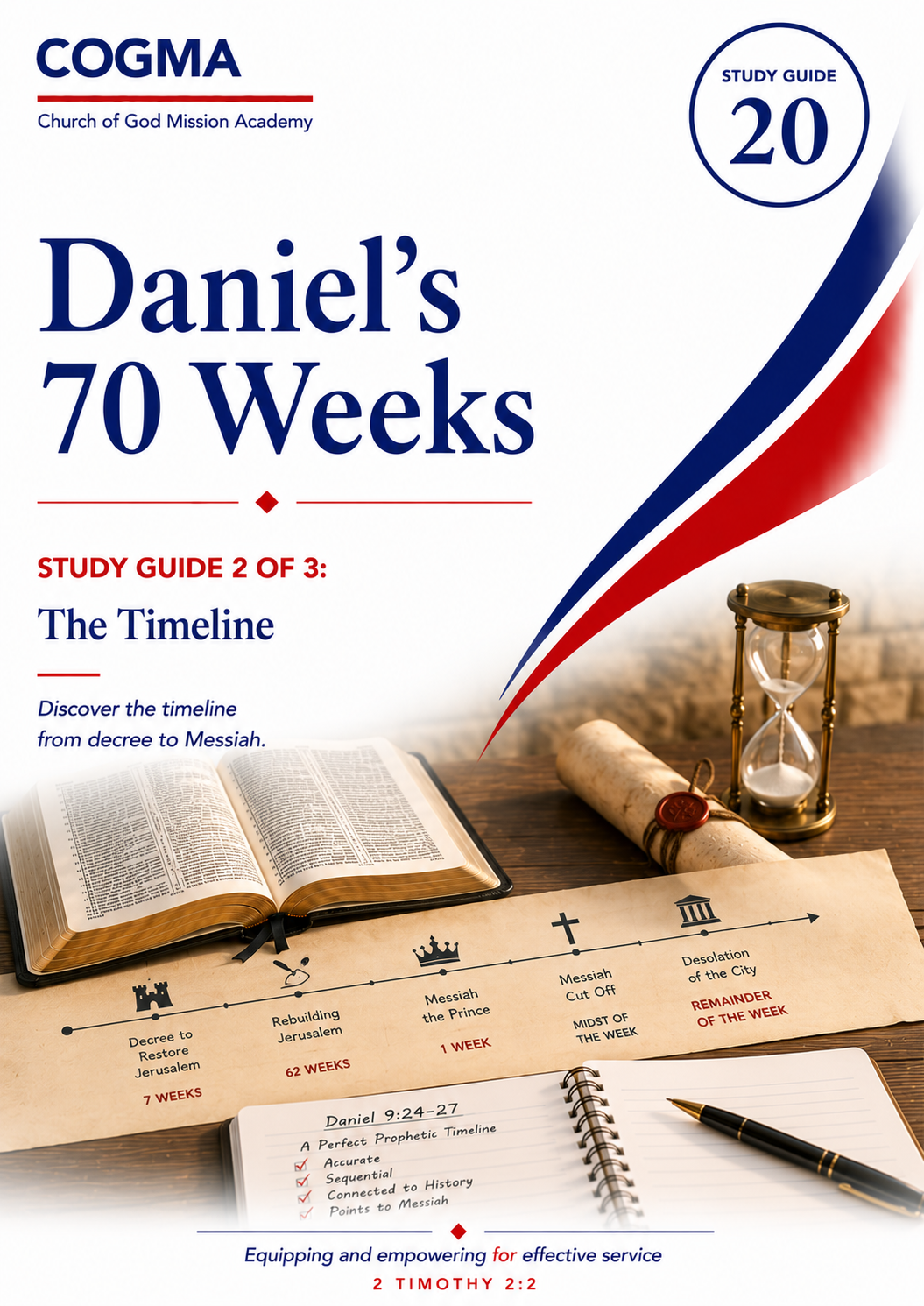
In this Study Guide — the second in the Daniel’s Seventy Weeks series — we examine the timeline of one of the most significant prophecies in the Old Testament. The prophecy of Daniel’s seventy weeks spans 490 years and culminates in the ministry, death, and resurrection of Jesus Christ.
The prophecy states:
Daniel 9:24–27 states:
“Seventy weeks are determined upon thy people and upon thy holy city, to finish the transgression, and to make an end of sins, and to make reconciliation for iniquity, and to bring in everlasting righteousness, and to seal up the vision and prophecy, and to anoint the most Holy. Know therefore and understand, that from the going forth of the commandment to restore and to build Jerusalem unto the Messiah the Prince shall be seven weeks, and threescore and two weeks: the street shall be built again, and the wall, even in troublous times. And after threescore and two weeks shall Messiah be cut off, but not for himself: and the people of the prince that shall come shall destroy the city and the sanctuary; and the end thereof shall be with a flood, and unto the end of the war desolations are determined. And he shall confirm the covenant with many for one week: and in the midst of the week he shall cause the sacrifice and the oblation to cease, and for the overspreading of abominations he shall make it desolate, even until the consummation, and that determined shall be poured upon the desolate.”
In our first Study Guide, “Study for Approval,” we learned that effective study involves asking the key questions: who, what, why, where, when, and how? This Study Guide applies those questions to Daniel’s seventy weeks.
Key Points to Understand
- When the seventy weeks begin — the prophecy outlines a specific timeline starting from “the going forth of the commandment to restore and to build Jerusalem.”
- Who “thy people” are — this phrase refers to the Jewish people, Daniel’s own ethnic and religious community.
- “Thy holy city” — the holy city mentioned here is Jerusalem.
Purpose of the Prophecy
- Finish the transgression — to put an end to rebellion against God.
- Make an end of sins — to bring a conclusion to sin.
- Make reconciliation for iniquity — to atone for wrongdoing.
- Bring in everlasting righteousness — to establish eternal righteousness.
- Seal up the vision and prophecy — to confirm and complete the prophecy.
- Anoint the most Holy — to consecrate the most holy place or person.
This Study Guide clarifies the details of this prophecy by allowing the Bible to interpret itself. By examining the scriptural context and related passages, you will gain a deeper understanding of the prophecy’s meaning and its fulfilment in Jesus Christ.
Personal Response
Key Truth
What does this introduction reveal to you about the scope and purpose of Daniel’s seventy weeks prophecy?
Personal Reflection
How does the method of letting the Bible interpret itself challenge or confirm your current approach to studying prophecy?
Action Step
Choose one of the six purposes of Daniel’s prophecy and study one scripture this week that relates to its fulfilment in Christ.
THE TIME SPAN
Daniel’s prophecy does not specify exact calendar dates, but it does define a precise period of seventy weeks.
Understanding the Hebrew Terms
The original Hebrew term “Shibiym shabua” translates as:
- Shibiym — seventy
- Shabua — a period of seven years
The same Hebrew word “shabua” appears in Genesis 29, where Laban deceives Jacob over his marriage to Leah instead of Rachel. Laban then requires Jacob to serve another seven years for Rachel’s “shabua” or “week.”
Genesis 29:25–28 states:
“And it came to pass, that in the morning, behold, it was Leah: and he said to Laban, What is this thou hast done unto me? did not I serve with thee for Rachel? wherefore then hast thou beguiled me? And Laban said, It must not be so done in our country, to give the younger before the firstborn. Fulfil her week, and we will give thee this also for the service which thou shalt serve with me yet seven other years. And Jacob did so, and fulfilled her week: and he gave him Rachel his daughter to wife also.”
In Genesis 29, each “week” equals seven years of labour. The same Hebrew word is used in Daniel’s prophecy, establishing that Daniel’s “weeks” are also periods of seven years.
Total Duration of the Prophecy
The time frame of Daniel’s prophetic vision for his people and holy city is 70 multiplied by 7 years, totalling 490 years. From its commencement signal to its fulfilment, Daniel’s vision spans exactly 490 years.
Personal Response
Key Truth
What does the Hebrew word “shabua” reveal about how we should interpret the “weeks” in Daniel’s prophecy?
Personal Reflection
How does the principle of letting scripture interpret scripture — using Genesis 29 to understand Daniel 9 — affect the way you approach other prophetic passages?
Action Step
Identify one other prophecy in scripture and practise asking: does the Bible itself provide the key to interpreting this passage?
DETERMINED UPON DANIEL’S PEOPLE
Daniel 9:24 states:
“Seventy weeks are determined upon thy people and upon thy holy city, to finish the transgression, and to make an end of sins, and to make reconciliation for iniquity, and to bring in everlasting righteousness and to seal up the vision and prophecy, and to anoint the most Holy.”
The Meaning of “Determined”
The Hebrew word for “determined” is CHATHAK, meaning “to cut off.” At the end of the 490 years, Daniel’s people — Old Testament Israel — were to be cut off and no longer be God’s people.
Many teachers claim this event is yet to happen, proposing a gap period between the 69th and 70th week. However, by allowing the Bible to interpret itself, we understand that natural Israel was cut off at the start of the Gospel Day, with the establishment of the New Covenant.
Paul, writing in Romans around 56 A.D., states that natural Israel had already been cut off:
Romans 11:20 states:
“Well; because of unbelief they were broken off, and thou standest by faith. Be not highminded, but fear:”
Romans 11:21 states:
“For if God spared not the natural branches, take heed lest he also spare not thee.”
Here, “natural branches” symbolise Old Testament Israel, then God’s chosen nation.
Jesus’ Prediction
Jesus also predicted the cutting off of natural Israel. He spoke these words in 29 A.D.:
Matthew 21:43 states:
“Therefore say I unto you, The kingdom of God shall be taken from you, and given to a nation bringing forth the fruits thereof.”
Matthew 21:45 states:
“And when the chief priests and Pharisees had heard his parables, they perceived that he spake of them.”
The chief priests and Pharisees represented the nation of Israel. Jesus declared in 29 A.D. that the kingdom of God would be transferred from one nation to another. If Paul wrote in 56 A.D. that Israel had been cut off, and Jesus predicted it in 29 A.D., this prophecy has already been fulfilled.
Personal Response
Key Truth
What does the Hebrew word CHATHAK reveal about God’s dealings with Old Testament Israel at the end of the 490 years?
Personal Reflection
How does the confirmation from both Jesus (Matthew 21) and Paul (Romans 11) that natural Israel was cut off affect the way you understand the “gap theory” that many teachers propose?
Action Step
Study Romans 11:17–24 this week and write down what Paul says about who now belongs to the people of God.
THE NEW NATION
If natural Israel was cut off, who or what is the new nation now representing the kingdom of God?
1 Peter 2:9–10 states:
“But ye are a chosen generation, a royal priesthood, an holy nation, a peculiar people; that ye should shew forth the praises of him who hath called you out of darkness into his marvellous light: Which in time past were not a people, but are now the people of God: which had not obtained mercy, but now have obtained mercy.”
Peter, writing around 64 A.D., identifies the “new nation” as the kingdom of God, comprising all who are called from “darkness into the light.”
Colossians 1:12–14 states:
“Giving thanks unto the Father, which hath made us meet to be partakers of the inheritance of the saints in light: Who hath delivered us from the power of darkness, and hath translated us into the kingdom of his dear Son: In whom we have redemption through his blood, even the forgiveness of sins:”
The kingdom of God is now the home of all who are born again. The nation that is the kingdom of God is the church of God. God’s kingdom is not a physical nation but a spiritual one, entered through spiritual rebirth in Christ.
Ephesians 2:5–6 states:
“Even when we were dead in sins, hath quickened us together with Christ, (by grace ye are saved;) And hath raised us up together, and made us sit together in heavenly places in Christ Jesus:”
The One New Man
No scripture suggests God will abandon the church of God and revert to Old Testament Israel. Paul speaks of the “one new man” in Ephesians:
Ephesians 2:11–13 states:
“Wherefore remember, that ye being in time past Gentiles in the flesh, who are called Uncircumcision by that which is called the Circumcision in the flesh made by hands; That at that time ye were without Christ, being aliens from the commonwealth of Israel, and strangers from the covenants of promise, having no hope, and without God in the world: But now in Christ Jesus ye who sometimes were far off are made nigh by the blood of Christ.”
Ephesians 2:15 states:
“Having abolished in his flesh the enmity, even the law of commandments contained in ordinances; for to make in himself of twain one new man, so making peace;”
The term “one” in Ephesians 2:15 is the Greek word HEIS, meaning “the one and only.” The church of God is not a combination of two nations or peoples, but one nation, one people in God.
Ephesians 2:16 states:
“And that he might reconcile both unto God in one body by the cross, having slain the enmity thereby:”
Paul confirms that Old Testament believers are reconciled through the cross. Scripture after scripture affirms there is no distinction in Christ:
Romans 10:11–13 states:
“For the scripture saith, Whosoever believeth on him shall not be ashamed. For there is no difference between the Jew and the Greek: for the same Lord over all is rich unto all that call upon him. For whosoever shall call upon the name of the Lord shall be saved.”
Galatians 3:28–29 states:
“There is neither Jew nor Greek, there is neither bond nor free, there is neither male nor female: for ye are all one in Christ Jesus. And if ye be Christ’s, then are ye Abraham’s seed, and heirs according to the promise.”
Colossians 3:10–11 states:
“And have put on the new man, which is renewed in knowledge after the image of him that created him: Where there is neither Greek nor Jew, circumcision nor uncircumcision, Barbarian, Scythian, bond nor free: but Christ is all, and in all.”
These scriptures highlight that “in Christ” there is no distinction between Jew and Greek — all are one in Him. The “new man” is Christ’s body, uniting all believers.
Personal Response
Key Truth
What truth about the church of God as the “new nation” replacing Old Testament Israel was most significant to you in this lesson?
Personal Reflection
How does the teaching that Christ unites Jews and Gentiles into “one new man” affect your understanding of your own place in the kingdom of God?
Action Step
Read 1 Peter 2:9–10 again and write out what it means for you personally to be part of “a chosen generation, a royal priesthood, an holy nation.”
DETERMINED UPON DANIEL’S HOLY CITY
The Holy City in Daniel’s Time
Daniel 9:24 states:
“Seventy weeks are determined upon thy people and upon thy holy city, to finish the transgression, and to make an end of sins, and to make reconciliation for iniquity, and to bring in everlasting righteousness.”
In Daniel’s time, the “holy city” referred to literal Jerusalem. This is confirmed in Nehemiah, where Jerusalem is explicitly identified as the holy city of Israel under the Old Covenant.
Nehemiah 11:1 states:
“And the rulers of the people dwelt at Jerusalem: the rest of the people also cast lots, to bring one of ten to dwell in Jerusalem the holy city, and nine parts to dwell in other cities.”
Daniel, while in captivity, prayed towards Jerusalem — his holy city. The temple in Jerusalem not only served a religious purpose but also symbolised God’s presence.
The New Holy City
Is literal Jerusalem, located in Palestine, still God’s holy city? According to the Bible, the answer is no.
Revelation 21:2 states:
“And I John saw the holy city, new Jerusalem, coming down from God out of heaven, prepared as a bride adorned for her husband.”
The existence of a “new Jerusalem” implies an “old Jerusalem.” The new is spiritual, descending “from God out of heaven,” whereas the old is physical and earthly. Old Jerusalem was the holy city for Old Testament Israel, but New Testament believers who are born again constitute the new Jerusalem.
God now recognises only one holy city. The “old Jerusalem” has been replaced by the “new Jerusalem.” It is God’s presence that sanctifies His city. In the Old Testament, this presence was in a literal temple in Jerusalem, but in the New Testament, the body of Christ becomes God’s temple.
1 Corinthians 3:16 states:
“Know ye not that ye are the temple of God, and that the Spirit of God dwelleth in you?”
The Fulfilment of the Prophecy
The “thy holy city” in Daniel’s prophecy refers to the literal Old Testament Jerusalem. It ceased to be God’s holy city upon the fulfilment of Daniel’s vision, replaced by the spiritual Jerusalem. This new holy city is a dwelling for God’s redeemed, born-again people — represented by the church of God, the body of Christ.
Personal Response
Key Truth
What does it mean that the “holy city” has transitioned from the physical Jerusalem to the spiritual new Jerusalem?
Personal Reflection
How does 1 Corinthians 3:16 — that you are the temple of God — change the way you think about your own life and conduct?
Action Step
Meditate this week on Revelation 21:2–3 and write down what it reveals to you about the nature of God’s dwelling with His people.
WHEN DID THE TIME CLOCK BEGIN?
Daniel 9:25 states:
“Know therefore and understand, that from the going forth of the commandment to restore and to build Jerusalem unto the Messiah the Prince shall be seven weeks, and threescore and two weeks: the street shall be built again, and the wall, even in troublous times.”
The 490-year timeline starts with the command to restore and rebuild Jerusalem. The period from this command to “Messiah the Prince” is described as “seven weeks and threescore and two weeks,” equalling 69 weeks or 483 years. “Messiah the Prince” clearly refers to Jesus Christ, whose ministry began around 27 A.D.
Cyrus II — 536 B.C.
At the conclusion of the Babylonian captivity in 536 B.C., Cyrus, king of Persia, issued a decree permitting the rebuilding of the temple in Jerusalem, which had been destroyed by Nebuchadnezzar.
Ezra 1:1–3 states:
“Now in the first year of Cyrus king of Persia, that the word of the LORD by the mouth of Jeremiah might be fulfilled, the LORD stirred up the spirit of Cyrus king of Persia, that he made a proclamation throughout all his kingdom, and put it also in writing, saying, Thus saith Cyrus king of Persia, The LORD God of heaven hath given me all the kingdoms of the earth; and he hath charged me to build him an house at Jerusalem, which is in Judah. Who is there among you of all his people? his God be with him, and let him go up to Jerusalem, which is in Judah, and build the house of the LORD God of Israel, (he is the God,) which is in Jerusalem.”
Isaiah, around 700 B.C. — some 170 years earlier — had already foretold this decree by Cyrus:
Isaiah 44:28 states:
“That saith of Cyrus, He is my shepherd, and shall perform all my pleasure: even saying to Jerusalem, Thou shalt be built; and to the temple, Thy foundation shall be laid.”
However, adding 490 years to 536 B.C. leads to 46 B.C., which has no relevance to Jesus Christ. Cyrus’ decree bears no relevance to Jesus Christ and is therefore not the starting point of Daniel’s vision.
Darius I — 520 B.C.
In 520 B.C., Darius the Mede issued a proclamation to enforce Cyrus’ earlier decree. Under Cyrus’ decree, only the temple foundations had been laid, and work had ceased for sixteen years. The temple — known as Zerubbabel’s temple — was finally completed in 515 B.C. under Darius’ decree.
Ezra 6:1–3 states:
“Then Darius the king made a decree, and search was made in the house of the rolls, where the treasures were laid up in Babylon. And there was found at Achmetha, in the palace that is in the province of the Medes, a roll, and therein was a record thus written: In the first year of Cyrus the king the same Cyrus the king made a decree concerning the house of God at Jerusalem, Let the house be builded, the place where they offered sacrifices, and let the foundations thereof be strongly laid; the height thereof threescore cubits, and the breadth thereof threescore cubits;”
Ezra 6:15 states:
“And this house was finished on the third day of the month Adar, which was in the sixth year of the reign of Darius the king.”
Adding 490 years to 520 B.C. leads to 30 B.C., which also bears no relevance to Jesus Christ. Darius’ decree is therefore not the starting point of Daniel’s vision.
Artaxerxes I — 457 B.C.
Artaxerxes, in the seventh year of his reign, issued a decree to restore and beautify both the temple and city of Jerusalem. According to Flavius Josephus, a Jewish historian, Artaxerxes showed particular favour toward the Jewish people.
He became king after the murder of his father Xerxes I in late 465 B.C. or early 464 B.C. Calculating Artaxerxes’ seventh year of reign according to Jewish tradition — which counted foreign kings’ reigns from the 1st of Tishri — yields the following:
1st year ended: September/October 463 B.C. 2nd year ended: September/October 462 B.C. 3rd year ended: September/October 461 B.C. 4th year ended: September/October 460 B.C. 5th year ended: September/October 459 B.C. 6th year ended: September/October 458 B.C. 7th year ended: September/October 457 B.C.
According to Ezra, Artaxerxes issued his decree in the autumn of 457 B.C.
Ezra 7:8–9 states:
“And he came to Jerusalem in the fifth month, which was in the seventh year of the king. For upon the first day of the first month began he to go up from Babylon, and on the first day of the fifth month came he to Jerusalem, according to the good hand of his God upon him.”
Personal Response
Key Truth
Why is it critical to identify the correct starting decree for Daniel’s 490-year timeline, and what method does this lesson use to test each candidate?
Personal Reflection
How does the process of testing each decree against its outcome in Jesus Christ demonstrate the principle that all scripture points to Him?
Action Step
Look up one of the three decrees (Cyrus, Darius, or Artaxerxes) in its biblical context and write a brief note on why it does or does not fulfil Daniel’s requirement.
FROM THE DECREE TO MESSIAH THE PRINCE
Daniel 9:25 (LITV) states:
“Know, then, and understand that from the going out of a word to restore and to rebuild Jerusalem, to Messiah the Prince, shall be seven weeks and sixty-two weeks. The street shall be built again, and the wall, even in times of affliction.”
The Going Out of a Word
In those times, without modern communication, the “going out of a word” had to have been spoken in person by Ezra after his arrival in Jerusalem. Ezra conveyed Artaxerxes’ decree on the 1st of Av in 457 B.C.
The Timeline
According to Daniel’s vision, from Ezra’s declaration to the appearance of “Messiah the Prince” is 69 weeks — that is, 483 years.
Adding 483 years to 457 B.C. leads to late summer or early autumn of 27 A.D. (remembering to add one year since there is no year zero). This places the beginning of Jesus’ ministry at the river Jordan — whom Daniel calls “Messiah the Prince” — in the late summer or early autumn of 27 A.D.
Seal Up the Vision and Prophecy
To seal up the vision and prophecy is a crucial purpose of Daniel’s vision, helping authenticate its complete fulfilment.
Daniel 9:24 states:
“Seventy weeks are determined upon thy people and upon thy holy city, to finish the transgression, and to make an end of sins, and to make reconciliation for iniquity, and to bring in everlasting righteousness, and to seal up the vision and prophecy, and to anoint the most Holy.”
The phrase “seal up” in Hebrew is CHATHAM, meaning to conclude or authenticate — akin to a seal on a document. This signifies scripture’s role in authenticating Jesus Christ. All scripture has one purpose: to authenticate Jesus Christ.
John 5:39 states:
“Search the scriptures; for in them ye think ye have eternal life: and they are they which testify of me.”
The scriptures, from Genesis to Malachi, authenticate Jesus as the Christ and God.
Hebrews 10:7–8 states:
“Then said I, Lo, I come (in the volume of the book it is written of me,) to do thy will, O God. Above when he said, Sacrifice and offering and burnt offerings and offering for sin thou wouldest not, neither hadst pleasure therein; which are offered by the law;”
Hebrews 10:9 states:
“Then said he, Lo, I come to do thy will, O God. He taketh away the first, that he may establish the second.”
Daniel’s prophecy foretells the transition from the Old to the New Covenant — from Old Covenant people to a new creation in God. Through Jesus’ death and resurrection, the prophecy was fulfilled.
Hebrews 10:10 states:
“By the which will we are sanctified through the offering of the body of Jesus Christ once for all.”
Daniel’s vision predicted that Jesus would confirm the covenant for seven years, being “cut off” mid-way, ending sacrifices and offerings — as detailed in Hebrews 10. Old Testament believers were not forgotten but unified — made one — with New Testament believers.
Ephesians 2:13–14 states:
“But now in Christ Jesus ye who sometimes were far off are made nigh by the blood of Christ. For he is our peace, who hath made both one, and hath broken down the middle wall of partition between us;”
Personal Response
Key Truth
What does it mean that Daniel’s prophecy “seals up” the vision and prophecy through its fulfilment in Jesus Christ?
Personal Reflection
How does the mathematical precision of 483 years from 457 B.C. to 27 A.D. affect your confidence in the reliability of biblical prophecy?
Action Step
Read Hebrews 10:7–10 in full this week and write down what it reveals about Christ’s role in establishing the New Covenant.
MESSIAH BE CUT OFF
Daniel 9:25–26 states:
“Know therefore and understand, that from the going forth of the commandment to restore and to build Jerusalem unto the Messiah the Prince shall be seven weeks, and threescore and two weeks: the street shall be built again, and the wall, even in troublous times. And after threescore and two weeks shall Messiah be cut off, but not for himself: and the people of the prince that shall come shall destroy the city and the sanctuary; and the end thereof shall be with a flood, and unto the end of the war desolations are determined.”
The Timing of the Messiah’s Death
Verse 25 clearly concludes the 69th week at the revelation of “Messiah the Prince.” Then verse 26 indicates that after the completion of the 69th week — entering into the 70th week — the Messiah would be cut off. This is a clear reference to Jesus’ crucifixion.
The phrase “cut off” comes from the Hebrew word KARATH, meaning “to be put to death.” This proves that the 70th week must follow the 69th week consecutively, without a gap.
John 2:19 states:
“Jesus answered and said unto them, Destroy this temple, and in three days I will raise it up.”
John 2:21 states:
“But he spake of the temple of his body.”
Jesus was foretelling His own crucifixion and death, as foretold by Daniel. In the middle of the 70th week, the Messiah would be “cut off” — put to death.
Jesus’ Ministry and Crucifixion
Jesus’ ministry lasted approximately three and a half years, evidenced by His celebration of three Passovers. Jesus was crucified on the 14th of Nisan in 31 A.D. — the “Day of Preparation” before Passover, which started on the 15th of Nisan. Jesus and His disciples observed the Passover meal, the “Last Supper,” a day early on the evening of the Day of Preparation.
Jesus was crucified around noon and died at approximately 3:00 PM, coinciding with the time Passover lambs were slaughtered.
John 19:14–19 states:
“And it was the preparation of the passover, and about the sixth hour: and he saith unto the Jews, Behold your King! But they cried out, Away with him, away with him, crucify him. Pilate saith unto them, Shall I crucify your King? The chief priests answered, We have no king but Caesar. Then delivered he him therefore unto them to be crucified. And they took Jesus, and led him away. And he bearing his cross went forth into a place called the place of a skull, which is called in the Hebrew Golgotha: Where they crucified him, and two other with him, on either side one, and Jesus in the midst. And Pilate wrote a title, and put it on the cross. And the writing was, JESUS OF NAZARETH THE KING OF THE JEWS.”
Luke 23:52–54 states:
“This man went unto Pilate, and begged the body of Jesus. And he took it down, and wrapped it in linen, and laid it in a sepulchre that was hewn in stone, wherein never man before was laid. And that day was the preparation, and the sabbath drew on.”
Thus, from the autumn of 27 A.D., adding three and a half years leads to Jesus’ crucifixion in the spring of 31 A.D.
Historical Corroboration
This date is corroborated by Josephus and the Jewish Talmud:
- The Talmud in Yoma 39b describes the 30-ton stone lintel breaking and the veil being rent in 31 A.D.
- The Talmud in Shabbat 15a mentions the Sanhedrin being forced to move in 31 A.D., confirmed by Josephus (War of the Jews V 4,2).
Personal Response
Key Truth
What is the significance of the Hebrew word KARATH — “to be put to death” — in confirming that the 70th week follows the 69th without a gap?
Personal Reflection
How does the historical corroboration from the Talmud and Josephus strengthen your understanding of the reliability of biblical prophecy?
Action Step
Read John 19:14–30 in full and write down two details that confirm the fulfilment of Daniel 9:26.
THE SIGN OF JONAH
One of the most direct scriptural evidences authenticating the true Jesus Christ of the Bible is the sign of Jonah.
Matthew 12:38–40 states:
“Then certain of the scribes and of the Pharisees answered, saying, Master, we would see a sign from thee. But he answered and said unto them, An evil and adulterous generation seeketh after a sign; and there shall no sign be given to it, but the sign of the prophet Jonas: For as Jonas was three days and three nights in the whale’s belly; so shall the Son of man be three days and three nights in the heart of the earth.”
Jesus predicted His death and resurrection, identifying Himself as “Messiah the Prince” from Daniel’s prophecy. This specific sign distinguishes the true Church of God from false Christianity.
Traditional Observance vs. Scriptural Timeline
Many, including Protestants, Pentecostals, and Roman Catholics, traditionally observe the crucifixion on Good Friday and the resurrection on Easter Sunday. This equates to one day and two nights — which does not correspond to the three days and three nights foretold in the sign of Jonah.
Jonah 1:17 states:
“Now the LORD had prepared a great fish to swallow up Jonah. And Jonah was in the belly of the fish three days and three nights.”
The true sign authenticating Jesus Christ is His time in the grave: three days and three nights. The traditional Good Friday to Easter Sunday timeline accounts for only one day and two nights.
The Origins of Easter
The Easter celebration has roots in pagan traditions:
- Ishtar — the Assyrian and Babylonian goddess of love and fertility — was celebrated with symbols such as eggs and bunnies, representing fertility and renewal.
- Eostre, or Ostara, was the goddess of dawn and spring in Anglo-Saxon and Germanic paganism. Her celebrations marked the spring equinox. Her name is thought to be the root of the modern word “Easter.”
- After Emperor Constantine’s conversion to Christianity, many pagan festivals were reinterpreted or incorporated into Christian traditions, including the adoption of Easter to celebrate Christ’s resurrection.
Despite Easter traditions such as sunrise services symbolising Jesus’ resurrection, the Bible does not record Jesus rising on Easter Sunday.
John 20:1 states:
“The first day of the week cometh Mary Magdalene early, when it was yet dark, unto the sepulchre, and seeth the stone taken away from the sepulchre.”
The tomb was already empty before sunrise, indicating that Jesus had risen earlier. The sign of Jonah is a pivotal proof of Jesus Christ as the Messiah. If Jesus does not completely fulfil this sign, it casts doubt on His authenticity.
The Correct Timeline
Jesus was crucified on Wednesday, the 14th of Nisan in 31 A.D., and rose before sunset on Saturday, the 17th of Nisan. This aligns with the scriptures stating that Jesus is Lord over the Sabbath.
Mark 2:28 states:
“Therefore the Son of man is Lord also of the sabbath.”
Matthew 11:28–30 states:
“Come unto me, all ye that labour and are heavy laden, and I will give you rest. Take my yoke upon you, and learn of me; for I am meek and lowly in heart: and ye shall find rest unto your souls. For my yoke is easy, and my burden is light.”
Jesus, as the Lord of the Sabbath, arose on this day — symbolising that all who are born again die in Christ and rise into His rest. The careful study and timeline analysis of these events demonstrate the importance of rightly dividing the Word of truth.
Personal Response
Key Truth
What is the “sign of Jonah,” and why is it so important in authenticating the true Jesus Christ?
Personal Reflection
How does the discrepancy between the traditional Good Friday–Easter Sunday timeline and the three days and three nights of scripture affect your understanding of inherited Christian traditions?
Action Step
Read Matthew 12:38–40 and Jonah 1:17 together. Write a brief explanation of how Jonah’s experience in the whale is a “shadow” pointing to Christ’s burial and resurrection.
CALCULATING DATES IN BIBLICAL CONTEXT
In biblical date and time calculations, the Hebrew calendar is employed rather than the Gregorian calendar.
Genesis 1:14 states:
“And God said, Let there be lights in the firmament of the heaven to divide the day from the night; and let them be for signs, and for seasons, and for days, and years.”
The Hebrew Calendar
The Bible uses the calendar established by God in Genesis. Key features include:
- Lunar Cycle — Hebrew months are determined by the lunar cycle of 29 and 30 days.
- Year Length — this results in years of 353, 354, or 355 days, compared to the solar year of 365.25 days.
- First Day of Each Hebrew Month — aligns with the crescent moon’s “first sliver” and is determined by observation.
- Adjustment — to reconcile with the solar year and ensure festivals like Passover and Pentecost occur at the appropriate seasons, an extra month is added periodically.
- Modern Jewish Calendar — incorporates an extra month every two to three years in a 19-year cycle.
The Hebrew Day
The Hebrew day runs from sundown to sundown, starting in the evening as defined by the appearance of the first three stars in the sky. This contrasts with the Gregorian calendar, where days run from midnight to midnight.
This also explains why the only meal in the Gospel Day is the “marriage supper of the Lamb” — symbolising the marriage of Christ and the church at the dawn of the Gospel Day, followed by continuous fellowship.
Summary of Hebrew Time
- A biblical day — from nightfall to nightfall.
- A biblical month — begins with the crescent moon, relying on observational methods.
- The exact start of a month cannot be predetermined until the crescent moon appears.
These methods highlight the dynamic nature of the Hebrew calendar and its reliance on natural cycles and observational methods, contrasting with the fixed structure of the Gregorian calendar. Understanding these differences is essential for accurately interpreting biblical timelines.
Personal Response
Key Truth
Why is it important to understand the Hebrew calendar when studying biblical prophecy and chronology?
Personal Reflection
How does the fact that a Hebrew day runs from sundown to sundown — rather than midnight to midnight — affect your understanding of events like the Last Supper, the crucifixion, and the resurrection?
Action Step
Study the account of the Passover in Exodus 12:1–14 and note how the Hebrew understanding of a “day” is embedded in the instructions God gave Israel.
PROPHECY AUTHENTICATES CHRIST
You now understand how important the sign of Jonah is in authenticating the true Messiah and Christ.
Those who ignore this sign create a god after their own reasoning and imagination — following pagan traditions introduced through Roman Catholicism rather than the clear teaching of scripture. Their timeline of Friday burial and Sunday morning resurrection accounts for only one day and two nights, which is not the sign of Jonah — three days and three nights in the grave.
The Correct Timeline of Jesus’ Burial and Resurrection
Jesus was buried in the tomb on Wednesday the 14th of Nisan, just before the sunset beginning the 15th of Nisan — the first day of the Feast of Unleavened Bread. Jesus rose just before sunset on Saturday the 17th of Nisan. When the women came to the sepulchre on Sunday the 18th of Nisan, it was still dark, and the sepulchre was already empty.
John 20:1–2 states:
“The first day of the week cometh Mary Magdalene early, when it was yet dark, unto the sepulchre, and seeth the stone taken away from the sepulchre. Then she runneth, and cometh to Simon Peter, and to the other disciple, whom Jesus loved, and saith unto them, They have taken away the Lord out of the sepulchre, and we know not where they have laid him.”
The Sign of Jonah as Proof
In typology studies, the anti-type — representing reality — casts the shadow. Jonah’s experience is the shadow pointing to the reality of Jesus Christ. While we cannot pinpoint the exact hour, the fulfilment must be three days and three nights.
The sign of Jonah is a pivotal proof of Jesus Christ as the Messiah. The careful study and timeline analysis of these events demonstrate the importance of rightly dividing the Word of truth. This understanding also confirms that the traditional Easter celebration does not align with the biblical account.
Personal Response
Key Truth
How does the sign of Jonah serve as a test to distinguish the true Christ of the Bible from a false or tradition-based version?
Personal Reflection
What does this lesson call you to in terms of holding scripture above inherited traditions, even when those traditions are widely accepted?
Action Step
Review the timeline of Jesus’ crucifixion, burial, and resurrection from this Study Guide and write out how the three days and three nights are fulfilled from Wednesday to Saturday.
SUMMARY
Daniel’s Seventy Weeks: Understanding the Prophecy’s Timeline and Significance
Daniel 9:24–27 provides a detailed prophecy involving a period of 490 years. This period is allocated to the Jewish people and Jerusalem for significant events, including ending transgressions, completing sins, making reconciliation for iniquity, bringing everlasting righteousness, sealing the vision and prophecy, and anointing the most Holy.
Key Points
- The prophecy spans 490 years, beginning with the commandment to restore and rebuild Jerusalem.
- The Hebrew word CHATHAK (“determined”) means “to cut off” — confirming that Old Testament Israel was cut off at the end of the 490 years.
- The new holy city is spiritual Jerusalem — the church of God, the body of Christ.
- Of the three decrees, only Artaxerxes’ decree (457 B.C.) produces a timeline that leads directly to Jesus Christ.
- From Artaxerxes’ decree to the beginning of Jesus’ ministry in 27 A.D. is exactly 483 years — 69 prophetic weeks.
- Jesus was crucified in 31 A.D. — at the midpoint of the 70th week — fulfilling Daniel’s prophecy that the Messiah would be “cut off.”
- The sign of Jonah — three days and three nights in the grave — is the definitive proof of the true Messiah.
- The traditional Good Friday to Easter Sunday timeline accounts for only one day and two nights, contradicting the sign Jesus Himself gave.
Conclusion
The prophecy of Daniel’s Seventy Weeks is a comprehensive timeline outlining significant events leading to and including the ministry of Jesus Christ. It authenticates Jesus as the Messiah and marks the transition from the Old to the New Covenant, fulfilling God’s plan for reconciliation and eternal righteousness. By allowing the Bible to interpret itself, the prophecy is seen to have been fulfilled precisely and completely in Jesus Christ.
Personal Response
Key Truth
Of all the truths covered in this Study Guide, which one has had the greatest impact on your understanding of Daniel’s prophecy and why?
Personal Reflection
How has working through this Study Guide changed the way you understand the relationship between the Old Covenant and the New Covenant?
Action Step
Write a brief prayer or personal statement committing to the principle of letting scripture interpret scripture in your ongoing study of God’s Word.
SUBMISSION TO COGMA FOR APPRAISAL
Instructions
Complete this section after you have finished the Study Guide. It must be completed online. The link to the online form that you must complete and submit is located at the bottom of this Study Guide.
Your answers should reflect your understanding, your personal response, and how you intend to live by the truth you have studied.
Answer honestly and be specific.
1. Main Truth
What is the most important truth you have gained from this Study Guide about Daniel’s seventy weeks and its fulfilment in Jesus Christ?
2. Understanding
In your own words, explain what the Hebrew word CHATHAK (“determined”) means in Daniel 9:24, and describe what it reveals about God’s dealings with Old Testament Israel at the end of the 490 years.
3. Personal Reflection
What has this Study Guide revealed to you about your own understanding of biblical prophecy, and how has it affected the way you approach the study of scripture?
4. Response to Truth
What aspect of this Study Guide most challenged your previous thinking — whether about the gap theory, the identity of the new holy city, or the sign of Jonah — and how has your understanding changed?
5. Action Step
Describe one specific and practical action you have taken or will take as a result of studying Daniel’s seventy weeks timeline. Be specific about what you will do, when, and how.
6. Early Response
Have you already begun to apply any truth from this Study Guide? Answer Yes or Not yet, and then explain: if yes, what changed in your thinking or practice; if not yet, what has prevented you from taking the first step?
7. Ongoing Practice
What practice or discipline from this Study Guide will you continue to apply in your study of scripture, particularly in relation to letting the Bible interpret itself?
8. Doctrinal Clarity
Which doctrine or scriptural truth covered in this Study Guide do you now understand more clearly? Explain what you previously believed, what you now understand, and what made the difference.
9. Living the Truth
This Study Guide teaches that the church of God — born-again believers — is now the new nation and new Jerusalem. What is the difference between intellectually accepting this truth and actually living as a member of this spiritual nation in your daily life?
10. Final Response
What is one question, thought, or area of growth that you will continue to explore as a result of this Study Guide? How do you intend to follow through on this?
You must submit your answers to the above 10 questions ONLINE.
Use the link below for your final submission after finishing this Study Guide. Answer honestly and be specific.
Would you prefer a printable copy?