
Search results will appear as highlighted text.
Quick Navigation
PREFACEINTRODUCTION: WHAT IS THE EVERLASTING GOSPEL?THE EVERLASTING GOSPEL OF REVELATION 14:6PURPOSED BEFORE THE FOUNDATION OF THE WORLDONE GOSPEL FROM THE BEGINNINGTHE GOSPEL IN THE DAYS OF NOAHTHE GOSPEL PREACHED BEFOREHAND TO ABRAHAMSHADOWS POINTED FORWARD TO JESUS CHRISTJESUS CHRIST THE SAME YESTERDAY, TODAY, AND FOR EVERONE SAVIOUR, ONE WAY, ONE GOSPELWHAT THE EVERLASTING GOSPEL ACCOMPLISHESGUARDING THE UNCHANGING GOSPELCONCLUSION: ONE EVERLASTING GOSPELSUBMISSION TO COGMA FOR APPRAISAL
INSTRUCTIONS FOR THE STUDENT
My Study Plan
Preparing a Study Plan before starting this Study Guide will assist you in completing it within a designated timeframe. It also helps in developing the discipline required for studying God’s Word effectively.
Proverbs 16:3:
Commit thy works unto the LORD, and thy thoughts shall be established.
My Study Guide Journal
Keep a record as you progress through your Study Guide, including the Personal Responses for each section, for future reference and goal setting.
Content
- PREFACE
- INTRODUCTION: WHAT IS THE EVERLASTING GOSPEL?
- THE EVERLASTING GOSPEL OF REVELATION 14:6
- PURPOSED BEFORE THE FOUNDATION OF THE WORLD
- ONE GOSPEL FROM THE BEGINNING
- THE GOSPEL IN THE DAYS OF NOAH
- THE GOSPEL PREACHED BEFOREHAND TO ABRAHAM
- SHADOWS POINTED FORWARD TO JESUS CHRIST
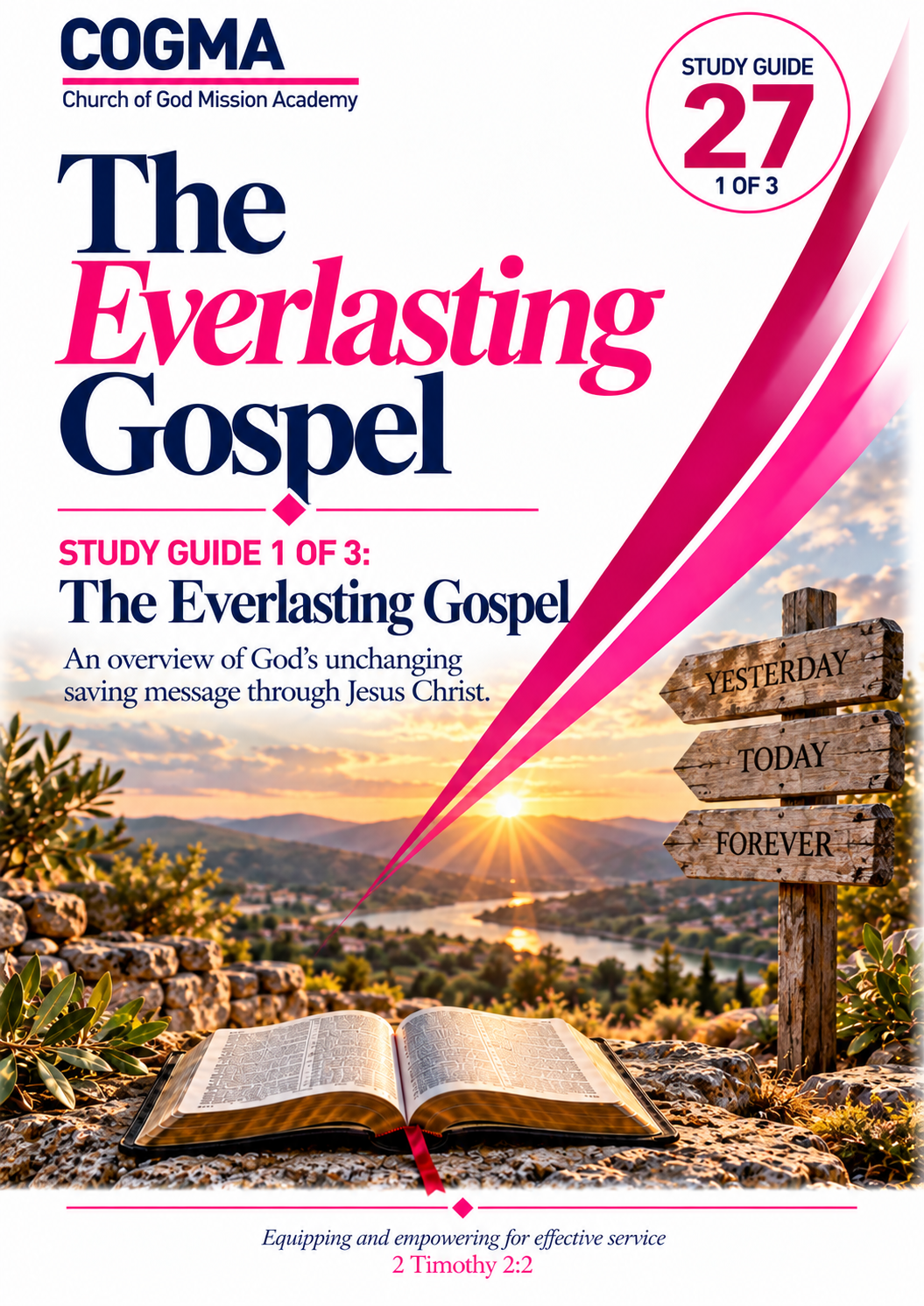
- JESUS CHRIST THE SAME YESTERDAY, TODAY, AND FOR EVER
- ONE SAVIOUR, ONE WAY, ONE GOSPEL
- WHAT THE EVERLASTING GOSPEL ACCOMPLISHES
- GUARDING THE UNCHANGING GOSPEL
- CONCLUSION: ONE EVERLASTING GOSPEL
Important Points
- COGMA does not claim to be infallible or the authority.
- Infallibility and authority belong only to God and His Word.
COGMA therefore strongly advises that you prayerfully study the content of each Study Guide with the heart of a Berean (Acts 17:10–12).
Contact and Links
Website: cogma.com.au
Email: admin@cogma.org.au
Radio COGMA: radiocogma.com
YouTube: youtube.com/@COGMAChannel
PREFACE
The Gospel is the good news of God’s saving purpose revealed in Jesus Christ. It is not a message that began only when Jesus walked upon the earth, nor is it a message that changes from one generation to another. Scripture describes it as the everlasting Gospel because the saving purpose of God has always centred in the same Person.
John wrote in Revelation 14:6:
“And I saw another angel fly in the midst of heaven, having the everlasting gospel to preach unto them that dwell on the earth, and to every nation, and kindred, and tongue, and people,”
The words “the everlasting gospel” give us the foundation for this module. There is not one Gospel for the Old Testament, another for the New Testament, and another for the final period of time. There is one Gospel because there is one Saviour, and Jesus Christ remains the centre of God’s saving purpose from beginning to end.
Before Jesus Christ was manifested in the flesh, God’s purpose was already pointing towards Him. The sacrifices, promises and prophetic pictures looked forward to the reality that would be revealed in Jesus Christ. Noah preached righteousness, Abraham believed God, and Scripture says that the Gospel was preached beforehand unto Abraham. What they saw in promise has now been revealed in fulfilment.
This does not mean that people before Calvary possessed the same New Covenant experience that came at Pentecost. The Gospel Day began when Jesus Christ came as Spirit to dwell within His people.
But the saving purpose towards which the earlier promises pointed was never different. God was not developing competing ways of salvation. His purpose was always moving towards Jesus Christ.
The previous module examined the problem of sin, personal responsibility and the freedom Jesus Christ gives. We now turn from the problem to the good news itself.
Why is the Gospel called everlasting? Why is it preached? What does it accomplish? How should it be proclaimed to those who need salvation?
These questions will guide this module. We will see that the Gospel does more than provide religious information. It reveals the sinner’s true condition, calls people to repentance, and directs them to the One who gives spiritual life.
The Gospel is powerful because its reality is found in Jesus Christ. He is not simply one subject within the message; He is the way, the truth and the life to whom the Gospel directs every soul.
As we begin, one truth must remain before us: the Gospel has not changed because Jesus Christ has not changed. From promise to fulfilment, from the beginning of time to its end, there is one saving message and one Saviour.
The everlasting Gospel is all Jesus.
Personal Response
Key Truth
How was God's saving purpose centred on Jesus Christ before the Gospel was fully revealed?
Personal Reflection
Have you thought of the Gospel as a late change in God's plan? Explain what is clearer now.
Action Step
Use one verse to explain to someone why Christ has always been central to God's saving purpose.
INTRODUCTION: WHAT IS THE EVERLASTING GOSPEL?
When John saw the message going to every nation, kindred, tongue and people, he described it with a remarkable expression: “the everlasting gospel.” Those words immediately tell us something important. The Gospel is not temporary, local or limited to one period of history. It belongs to the unchanging saving purpose of God revealed through Jesus Christ.
John wrote in Revelation 14:6:
“And I saw another angel fly in the midst of heaven, having the everlasting gospel to preach unto them that dwell on the earth, and to every nation, and kindred, and tongue, and people,”
The Gospel is everlasting because its centre does not change. Jesus Christ is not one Saviour for one generation and then replaced by another message for another age.
Scripture says in Hebrews 13:8:
“Jesus Christ the same yesterday, and to day, and for ever.”
This gives us an important foundation. The Gospel proclaimed in the New Testament did not suddenly appear without any connection to what God had already revealed. From the beginning, God’s saving purpose pointed towards Jesus Christ. The promises, sacrifices, types and prophetic declarations prepared the way for the One in whom salvation would be fully revealed.
Paul makes this especially clear when speaking about Abraham. Paul wrote in Galatians 3:6-8:
“Even as Abraham believed God, and it was accounted to him for righteousness. Know ye therefore that they which are of faith, the same are the children of Abraham. And the scripture, foreseeing that God would justify the heathen through faith, preached before the gospel unto Abraham, saying, In thee shall all nations be blessed.”
Notice the expression: “preached before the gospel unto Abraham.” The Gospel therefore did not begin as a completely new message after Calvary. Abraham received the promise beforehand, while the full reality to which that promise pointed would later be revealed in Jesus Christ.
Peter gives us the same principle when he speaks of Christ as the Lamb foreordained before the foundation of the world. Peter wrote in 1 Peter 1:18-20:
“Forasmuch as ye know that ye were not redeemed with corruptible things, as silver and gold, from your vain conversation received by tradition from your fathers; But with the precious blood of Christ, as of a lamb without blemish and without spot: Who verily was foreordained before the foundation of the world, but was manifest in these last times for you,”
The saving work of Jesus Christ was not an emergency plan introduced after humanity sinned. He was “foreordained before the foundation of the world.” What God later revealed openly in Jesus Christ had already been present in His purpose from the beginning.
This helps us understand the relationship between promise and fulfilment. Noah did not possess the New Covenant experience of Christ dwelling within as Spirit. Abraham did not live after Pentecost. Yet the saving purpose towards which they looked was the same purpose now revealed in Jesus Christ.
The difference was not another Saviour or another Gospel, but the stage of revelation and fulfilment. The Gospel is therefore both ancient in promise and present in fulfilment. Before Jesus Christ was manifested in the flesh, the message pointed forward. In the Gospel Day, the same saving purpose is proclaimed in the Person who has now come and in whom the promises find their reality.
This also explains why the Gospel cannot be reduced to a set of doctrines, a religious programme or a method of persuasion. The Gospel is good news because Jesus Christ is the answer to humanity’s need. He came to save, to give life and to destroy the works of the devil. The message directs every soul to Him.
As we continue through this Study Guide, we will trace this everlasting Gospel from promise to fulfilment. We will see that its message has always pointed to one Saviour, one way of salvation and one divine purpose.
The Gospel is everlasting because Jesus Christ is unchanging.
Personal Response
Key Truth
Why can the Gospel be everlasting when the New Covenant began at a particular time?
Personal Reflection
Which part of that difference was unclear to you before? Explain.
Action Step
Read Revelation's words about the everlasting Gospel with one promise about Christ and write how they belong together.
THE EVERLASTING GOSPEL OF REVELATION 14:6
The expression “the everlasting gospel” is found in one of the great prophetic scenes of Revelation. John sees the Gospel being proclaimed without restriction to one nation, language or period of history. The message reaches the whole world because the saving purpose revealed in Jesus Christ is for all people.
John wrote in Revelation 14:6:
“And I saw another angel fly in the midst of heaven, having the everlasting gospel to preach unto them that dwell on the earth, and to every nation, and kindred, and tongue, and people,”
Several important truths are contained in this one verse.
The Gospel Is Everlasting
John does not simply call it the Gospel. He calls it “the everlasting gospel.”
The Greek word translated everlasting is AIONIOS. It carries the meaning of everlasting or eternal. In Revelation 14:6, the Gospel is therefore presented as an enduring message, not a temporary arrangement that God later replaces.
This is important because people sometimes divide Scripture in a way that creates different saving messages for different groups or periods. But Revelation does not speak of several gospels. John sees “the everlasting gospel.”
Its permanence rests upon the Person at its centre. The writer of Hebrews said in Hebrews 13:8:
“Jesus Christ the same yesterday, and to day, and for ever.”
Jesus Christ does not change. Therefore, the saving purpose centred in Him does not change.
Before He was manifested in the flesh, Scripture pointed forward to Him. When He came, the promised Saviour stood among humanity in genuine flesh. In the Gospel Day, He is proclaimed as the One in whom the promises have found their fulfilment.
The revelation becomes clearer, but the centre never changes.
The Gospel Is for All People
Revelation 14:6 also shows the universal reach of the Gospel. John says that it is preached “to every nation, and kindred, and tongue, and people.” The Gospel does not belong to one race, culture or earthly nation. God’s saving purpose reaches all humanity.
This truth had already been revealed in the promise given to Abraham. Paul wrote in Galatians 3:8:
“And the scripture, foreseeing that God would justify the heathen through faith, preached before the gospel unto Abraham, saying, In thee shall all nations be blessed.”
Notice how the language agrees with Revelation. Abraham was promised blessing that would reach “all nations.” Revelation shows the everlasting Gospel going to “every nation.”
The scope has always been wider than one natural people. Jesus Christ is the Saviour for Jew and Gentile alike. There is not one Gospel for Israel and another for the nations. All are called to the same Saviour.
The Gospel Was Not Invented by the Church
The Church did not create the Gospel. The apostles did not invent it, and later religious movements cannot redefine it. The Gospel belongs to God’s eternal saving purpose.
Peter wrote in 1 Peter 1:20 concerning Jesus Christ:
“Who verily was foreordained before the foundation of the world, but was manifest in these last times for you,”
The word “foreordained” takes us back before the visible manifestation of Jesus Christ. God’s saving purpose was already established.
This means that Calvary was not God correcting a plan that had failed. Jesus Christ was not introduced because God suddenly needed another way to deal with humanity. The Redeemer was already at the centre of God’s purpose.
He was later “manifest”, but He was not later invented.
Promise Became Fulfilment
This distinction helps us understand why the Gospel can be everlasting while the New Covenant has a definite beginning. Before Jesus Christ came in the flesh, the Gospel existed in promise. Men and women believed what God had revealed to them and looked towards what He would accomplish.
The New Covenant reality itself was still to come. At Pentecost, Jesus Christ came as Spirit to dwell within His people. The Gospel Day began, and what had been promised beforehand entered its New Covenant fulness.
The Gospel therefore moves through Scripture from promise → revelation → fulfilment. But through every stage, the Person at the centre remains the same.
The Gospel Cannot Be Replaced
If the Gospel is everlasting, no later religious system has authority to replace it, improve it or add another way of salvation beside it.
Paul gave a serious warning concerning any altered gospel. Paul wrote in Galatians 1:8:
“But though we, or an angel from heaven, preach any other gospel unto you than that which we have preached unto you, let him be accursed.”
The Gospel cannot be changed simply because culture changes. It cannot be reshaped to accommodate human tradition, religious preference or popular opinion. The message remains centred in Jesus Christ.
Revelation 14:6 therefore gives us more than a title for this module. It gives us a controlling truth. There is one Gospel. It reaches every people. It rests upon God’s eternal purpose. It was promised before Jesus Christ was manifested in flesh, and it is now proclaimed in its fulfilled reality.
The Gospel is everlasting because the Saviour at its centre is everlasting.
Personal Response
Key Truth
Why can no other message replace the Gospel of Jesus Christ?
Personal Reflection
Have you treated a religious custom as though it could save? Explain what you now understand.
Action Step
Compare one familiar religious claim with a verse that points to Christ as Saviour.
PURPOSED BEFORE THE FOUNDATION OF THE WORLD
The everlasting Gospel did not begin as a response to an unexpected problem. When sin entered human experience, God did not have to search for a remedy that had never before existed in His purpose. Scripture shows that Jesus Christ was already at the centre of God’s saving plan before the foundation of the world.
Peter wrote in 1 Peter 1:18-20:
“Forasmuch as ye know that ye were not redeemed with corruptible things, as silver and gold, from your vain conversation received by tradition from your fathers; But with the precious blood of Christ, as of a lamb without blemish and without spot: Who verily was foreordained before the foundation of the world, but was manifest in these last times for you,”
Peter makes an important distinction. Jesus Christ was “foreordained before the foundation of the world,” but He was “manifest in these last times.” His manifestation in genuine humanity took place in time, but God’s saving purpose in Him was already established.
The Redeemer Was Not an Afterthought
This protects us from thinking of salvation as though God’s first plan failed and Jesus Christ became a second plan. The Gospel does not present Calvary as an emergency measure. The Redeemer was already central to the purpose of God.
Peter describes Him as “a lamb without blemish and without spot.” Long before Jesus Christ was visibly manifested, Scripture contained sacrifices, promises and prophetic pictures that pointed towards Him. A shadow is not the substance. It points beyond itself to something greater.
The sacrifices of the Old Covenant could not become the final answer for sin because the final answer was never an animal, a ceremony or an earthly system. The reality was Jesus Christ.
The Reality Came Before the Shadow in God’s Purpose
This helps us understand biblical typology correctly. In history, the type may appear before the antitype is manifested, but in the purpose of God the reality is not created by the shadow. The shadow exists because it points towards the reality.
Paul described the Law in this way in Galatians 3:24-25:
“Wherefore the law was our schoolmaster to bring us unto Christ, that we might be justified by faith. But after that faith is come, we are no longer under a schoolmaster.”
The schoolmaster had a purpose, but it was not the destination. The Law directed people towards Jesus Christ. When the reality came into view, the temporary order could not be treated as though it were greater than the Person to whom it pointed.
This is why the Old Covenant must be understood in relation to Jesus Christ. Its sacrifices, priesthood, ceremonies and prophetic patterns were not separate saving realities competing with Him. They prepared the way and pointed forward.
The Scriptures Testified of Jesus Christ
Jesus Himself told the religious leaders that the Scriptures pointed towards Him.
Jesus said in John 5:39:
“Search the scriptures; for in them ye think ye have eternal life: and they are they which testify of me.”
At that time, the Scriptures available to those hearers were the writings we now call the Old Testament. Jesus said that those Scriptures testified of Him.
This means that we should not read the Old Testament as though it tells one saving story while the New Testament begins an unrelated one. The promises, patterns and prophetic pictures must be read with Jesus Christ at the centre.
Promise Before Manifestation
Before Jesus Christ came in flesh, people received promise. They did not possess the fulfilled New Covenant experience that came through Him. They did not have Jesus Christ dwelling within them as Spirit in the New Covenant reality established at Pentecost. Nevertheless, the promise they received pointed towards the same Saviour.
This distinction is important. We must neither make the Old Covenant equal to the New Covenant nor imagine that God had a different Saviour for those who lived before Christ was manifested. The stages of revelation were different, but the saving purpose remained centred in one Person.
What was promised beforehand was later manifested. What was shown in type was later revealed in reality. What the prophets looked towards came into view through Jesus Christ.
Jesus Christ Is the Reality
This gives us a simple way to understand the movement of Scripture:
promise → shadow → manifestation → fulfilment.
The movement does not lead towards a religious institution or a new set of ceremonies. It leads towards Jesus Christ.
The purpose of biblical study is not simply to become skilled at identifying types, symbols and prophetic patterns. Those things have value only when they lead us to the reality.
The everlasting Gospel rests upon a saving purpose older than every human religious system. Before there was an Old Covenant priesthood, before there was a tabernacle, before there was a written Law, the Redeemer was already central to God’s purpose.
Peter’s words therefore give us great confidence. Jesus Christ was not added later because something had gone wrong beyond God’s knowledge. He was “foreordained before the foundation of the world.”
The Gospel is everlasting because God’s saving purpose has always been centred in Him.
Before the shadow appeared, the reality was already in the purpose of God: Jesus Christ.
Personal Response
Key Truth
How do earlier promises and signs find their fulfilment in Jesus Christ?
Personal Reflection
Have you stopped at an earlier sign without looking to Christ? Explain.
Action Step
Read one earlier promise and explain how it directs you to Jesus Christ.
ONE GOSPEL FROM THE BEGINNING
If the Gospel is everlasting, it cannot be confined to one short period of history. The New Testament gives the Gospel its clearest proclamation because Jesus Christ has now been manifested and the New Covenant has been established, but the saving purpose of God did not begin there. From the beginning, Scripture points towards one Saviour and one way of salvation.
Before Jesus Christ was manifested in flesh, He was the promised Saviour. In the Gospel Day, He is the revealed and present Saviour. The stage of revelation changed, but the Person at the centre did not change.
The writer of Hebrews said in Hebrews 13:8:
“Jesus Christ the same yesterday, and to day, and for ever.”
That statement reaches backwards, speaks to the present and continues forward. Jesus Christ is not changed by the passing of time, and the saving purpose centred in Him is not replaced by another message.
The Gospel Was Preached Before Calvary
Paul makes this especially clear when he writes about Abraham. Abraham lived long before the earthly ministry of Jesus Christ, yet Paul deliberately uses the word gospel when describing the promise he received.
Paul wrote in Galatians 3:6-8:
“Even as Abraham believed God, and it was accounted to him for righteousness. Know ye therefore that they which are of faith, the same are the children of Abraham. And the scripture, foreseeing that God would justify the heathen through faith, preached before the gospel unto Abraham, saying, In thee shall all nations be blessed.”
The expression is unmistakable: “preached before the gospel unto Abraham.” Paul does not describe Abraham as belonging to an unrelated saving message. The promise given to him was part of the same Gospel purpose later revealed openly through Jesus Christ.
Abraham did not possess the completed New Covenant experience. He lived before Calvary and before Pentecost. Yet the promise he believed pointed towards the same saving reality that believers now know in fulfilment.
Promise and Fulfilment Belong to the Same Gospel
This distinction helps us avoid two opposite errors. We must not pretend that Old Testament believers already possessed everything that came with the New Covenant, but neither should we divide the Bible into competing ways of salvation.
Before fulfilment, there was promise. Before the reality was openly manifested, there were shadows, types and prophetic declarations. When Jesus Christ came, He did not introduce a different Saviour; He revealed the One towards whom the earlier promises had already been pointing.
This is why the Gospel is everlasting. Its proclamation became clearer as God’s purpose unfolded, but its centre remained unchanged.
Noah Preached Righteousness
The same principle reaches back beyond Abraham. Peter describes Noah as “a preacher of righteousness.”
Peter wrote in 2 Peter 2:5:
“And spared not the old world, but saved Noah the eighth person, a preacher of righteousness, bringing in the flood upon the world of the ungodly;”
Scripture does not give us a detailed transcript of Noah’s preaching, so we should not invent one. What Scripture does tell us is that Noah proclaimed righteousness and acted by faith upon the Word God had given him.
The Gospel has always called people towards the right way of God. Noah lived before the Law of Moses and before the prophets, yet the saving purpose of God had not changed. The One who would later say, “I am the way,” was already the reality towards which God’s purpose was moving.
Jesus Christ Is the Way Throughout Scripture
Jesus said in John 14:6:
“Jesus saith unto him, I am the way, the truth, and the life: no man cometh unto the Father, but by me.”
Jesus did not say that He was one way among several. He is the way. This truth reveals the Person who has always stood at the centre of God’s saving purpose.
Noah could only proclaim the truth God had revealed to him. Abraham could only believe the promise God had given him. The prophets could only speak as they were moved by God. But all these streams of revelation were moving towards the same fulfilment in Jesus Christ.
The Message Became Clearer, Not Different
As Scripture progresses, God’s saving purpose becomes clearer. What was seen in promise is later seen in fulfilment. What was shown in shadow is later revealed in the Person.
This is why greater revelation must never be mistaken for a different Gospel. The Gospel did not change because more of God’s purpose became visible. The revelation became clearer because the promised Saviour had come.
In the Old Testament, people looked forward to what God would accomplish. In the New Covenant, we proclaim what has now been fulfilled through Jesus Christ. The direction of sight is different, but the centre is the same.
One Saving Purpose From Beginning to End
There has never been a time when humanity needed a different answer from the one found in Jesus Christ. Covenants and historical conditions have changed, but God’s saving purpose has always moved towards Him and now finds its fulfilment in Him.
This gives unity to the whole Bible. From beginning to end, Scripture progressively reveals the one purpose of God centred in Jesus Christ.
The everlasting Gospel is therefore not simply a message that will last forever from this point onward. It is the Gospel rooted in God’s saving purpose from the beginning, revealed through promise, proclaimed through faith, and brought into fulfilment in Jesus Christ.
One Gospel. One Saviour. One saving purpose from beginning to end.
Personal Response
Key Truth
What joins God's promises before Christ with the Gospel made known in Him?
Personal Reflection
How does one saving purpose affect your trust in God's Word?
Action Step
Choose one promise and one verse about Christ, and explain their connection.
THE GOSPEL IN THE DAYS OF NOAH
Because the Gospel is everlasting, we find its saving principles operating long before the New Testament. Noah provides an important example. He lived in a world marked by widespread wickedness, yet God had not left humanity without light, truth or a message of righteousness.
Peter described Noah in 2 Peter 2:5:
“And spared not the old world, but saved Noah the eighth person, a preacher of righteousness, bringing in the flood upon the world of the ungodly;”
Noah was not simply a builder of an ark. Scripture calls him “a preacher of righteousness.” God had given him truth to believe, obey and proclaim to the people of his generation.
Noah Found Grace
Genesis describes the darkness of Noah’s time very clearly.
Moses wrote in Genesis 6:5-8:
“And GOD saw that the wickedness of man was great in the earth, and that every imagination of the thoughts of his heart was only evil continually. And it repented the LORD that he had made man on the earth, and it grieved him at his heart. And the LORD said, I will destroy man whom I have created from the face of the earth; both man, and beast, and the creeping thing, and the fowls of the air; for it repenteth me that I have made them. But Noah found grace in the eyes of the LORD.”
The contrast is striking. Wickedness had become great, but “Noah found grace.” Even in a dark generation, the grace of God was present.
Grace is therefore not an idea that suddenly appeared in the New Testament. God’s dealings with Noah already show that salvation depends upon God’s mercy and upon receiving and responding to His Word.
Paul later wrote in Ephesians 2:8:
“For by grace are ye saved through faith; and that not of yourselves: it is the gift of God:”
Noah’s experience does not give us the completed New Covenant experience described by Paul, but the principle is consistent. God speaks, grace is extended, His Word must be believed, and faith responds in obedience.
Noah Believed and Obeyed God’s Word
The book of Hebrews explains the faith that governed Noah’s response.
The writer said in Hebrews 11:7:
“By faith Noah, being warned of God of things not seen as yet, moved with fear, prepared an ark to the saving of his house; by the which he condemned the world, and became heir of the righteousness which is by faith.”
Noah had not yet seen the flood, but he believed what God had said. His faith was not simply intellectual agreement. He acted upon the Word he had received.
This gives us an important Gospel principle. Faith does not treat God’s Word as information that may be accepted or ignored without consequence. Noah believed God strongly enough to order his life according to what God had revealed.
The same principle remains today. The Gospel confronts us with the Word of God and calls for a response. Hearing alone is not the same as believing. True faith receives what God says and responds accordingly.
Personal Response
Key Truth
What did Noah's obedient faith show about responding to God's Word?
Personal Reflection
Is there a truth you understand but have delayed obeying? Explain.
Action Step
Choose one clear step of obedience and begin it this week.
Noah Preached Righteousness
Peter does not tell us everything Noah preached, so we should be careful not to invent a message that Scripture does not record. What the Bible does tell us is sufficient: Noah was “a preacher of righteousness.”
Righteousness concerns what is right before God. Noah’s generation had chosen a way contrary to God, while Noah received and followed the way God revealed.
This points us towards the words Jesus would later speak in John 14:6:
“Jesus saith unto him, I am the way, the truth, and the life: no man cometh unto the Father, but by me.”
Jesus Christ is the ultimate reality of the right way. Noah did not possess the fulness of revelation that came through Jesus Christ, but the truth he proclaimed could not lead in another direction. God’s saving purpose has always moved towards the same Person.
The light available in Noah’s day was not as full as the light now given in the Gospel Day, yet people were responsible for the truth God had made known to them.
Christ Worked Through the Spirit
Peter gives another important principle concerning how God spoke in earlier times.
Peter wrote in 2 Peter 1:21:
“For the prophecy came not in old time by the will of man: but holy men of God spake as they were moved by the Holy Ghost.”
The message did not originate in human imagination. God worked through those who spoke His Word.
This helps prepare us for Peter’s later statement concerning Christ preaching to the people of Noah’s generation by the Spirit. That Scripture requires careful examination and will be considered more fully when we study why the Gospel is preached. For now, the important truth is that Christ was not absent from God’s saving purpose before His manifestation in flesh.
God was revealing truth, calling people to righteousness and working through those who responded to His Word. The same saving purpose would later be revealed with greater clarity in Jesus Christ.
The Gospel Is Not Complicated
Noah’s experience also teaches us something about the simplicity of saving faith. He did not need to understand every doctrine that would later be revealed in Scripture. He needed to believe the Word God had given him and respond to it.
The same principle remains important. A person does not need complete theological knowledge before responding to the Gospel. The Gospel calls people to believe God, turn from the wrong way and receive the salvation He provides.
Noah lived long before Calvary and Pentecost, but his life demonstrates principles that remain throughout the everlasting Gospel: grace, faith, righteousness, obedience and response to the Word of God. The revelation has become far clearer in Jesus Christ, but God’s saving purpose has not changed.
The God who spoke to Noah has now revealed the fulness of His saving purpose in Jesus Christ.
Personal Response
Key Truth
Why must repentance and trust in Christ remain clear in the Gospel?
Personal Reflection
Have added rules or religious words made the Gospel less clear to you? Explain.
Action Step
Explain the Gospel to someone in simple words that keep Jesus Christ at the centre.
THE GOSPEL PREACHED BEFOREHAND TO ABRAHAM
Abraham gives us one of the clearest biblical proofs that the Gospel did not begin only after Jesus Christ was manifested in the flesh. Paul deliberately tells us that the Gospel was preached beforehand to Abraham. The message came in promise, but the promise was already pointing towards the saving purpose that would be fulfilled in Jesus Christ.
Paul wrote in Galatians 3:6-9:
“Even as Abraham believed God, and it was accounted to him for righteousness. Know ye therefore that they which are of faith, the same are the children of Abraham. And the scripture, foreseeing that God would justify the heathen through faith, preached before the gospel unto Abraham, saying, In thee shall all nations be blessed. So then they which be of faith are blessed with faithful Abraham.”
Paul’s language is important. He does not say simply that Abraham received a promise which later became unrelated to the Gospel. He says that Scripture “preached before the gospel unto Abraham.”
Abraham Believed God
The Gospel calls for faith, and Abraham provides an early example of that response. Paul says that “Abraham believed God, and it was accounted to him for righteousness.”
Abraham did not possess the completed New Covenant revelation that we possess today. He did not live after Calvary or Pentecost, but he believed what God had revealed to him. Faith responded to the light that had been given.
This principle remains throughout Scripture. God speaks, and faith receives His Word. The amount of revelation may increase as God’s purpose unfolds, but genuine faith always rests upon what God has said.
The Promise Reached All Nations
The Gospel promise given to Abraham was never intended to remain confined to his natural descendants. Paul says that Scripture foresaw that God would justify the heathen through faith and therefore declared: “In thee shall all nations be blessed.”
This agrees perfectly with the everlasting Gospel of Revelation 14:6, which is proclaimed to “every nation, and kindred, and tongue, and people.” The same universal purpose is visible in both Scriptures.
God’s saving purpose was never intended to produce separate ways of salvation for different races. The promise to Abraham looked beyond natural Israel towards the blessing that would reach all people through Jesus Christ.
Paul later makes the centre of that promise clear. He wrote in Galatians 3:16:
“Now to Abraham and his seed were the promises made. He saith not, And to seeds, as of many; but as of one, And to thy seed, which is Christ.”
The promise therefore comes to its fulfilment in one Person: Jesus Christ.
God Would Provide the Sacrifice
Another important moment in Abraham’s life occurred when God tested him concerning Isaac. Abraham was commanded to offer his son, but God stopped him and provided a ram in Isaac’s place.
Moses wrote in Genesis 22:13-14:
“And Abraham lifted up his eyes, and looked, and behold behind him a ram caught in a thicket by his horns: and Abraham went and took the ram, and offered him up for a burnt offering in the stead of his son. And Abraham called the name of that place Jehovahjireh: as it is said to this day, In the mount of the LORD it shall be seen.”
The ram was provided by God. Abraham named the place Jehovahjireh, directing attention to what the Lord Himself would provide.
This expression is sometimes used mainly in relation to material provision, finances or personal needs. Yet its immediate biblical setting is sacrifice. Abraham had said that God would provide, and on the mountain God provided the sacrifice.
That event pointed beyond itself.
The Shadow Pointed to Jesus Christ
The ram caught in the thicket was not the final answer for sin. It belonged to a prophetic picture pointing forward to the true sacrifice.
Abraham saw the pattern: God would provide. Jesus later spoke of Abraham seeing His day.
Jesus said in John 8:56:
“Your father Abraham rejoiced to see my day: and he saw it, and was glad.”
Abraham did not possess every detail that would later be revealed concerning Jesus Christ, but his faith was looking towards what God would accomplish. The promise, the sacrifice and the blessing of the nations all pointed forward.
The reality was Jesus Christ.
The Gospel Was Present in Promise
This helps us understand what Paul means when he says that the Gospel was preached beforehand to Abraham. Abraham was not preaching the complete New Testament message after the manner of the apostles. He lived before the manifestation of Jesus Christ in genuine humanity and before the New Covenant was established.
But the saving purpose revealed to him belonged to the same Gospel. The promise to Abraham said that all nations would be blessed. Paul identifies the promised Seed as Christ. The sacrifice on Mount Moriah showed that God Himself would provide.
Jesus later said that Abraham rejoiced to see His day. These are not disconnected religious ideas. They form part of one unfolding revelation.
Promise Became Reality in Jesus Christ
Abraham looked forward, while we now look back upon what has been fulfilled. He received promise; we see the Person. He saw the shadow; we know the reality. He believed what God would provide; we proclaim the One who has come.
This is why the Gospel is everlasting. The message has unfolded through history, but its centre has never changed. The Gospel preached beforehand to Abraham finds its fulfilment in Jesus Christ.
The blessing promised to all nations is found in Him.
Personal Response
Key Truth
How did God's promise become a present reality in Jesus Christ?
Personal Reflection
What difference does fulfilled promise make to your confidence in Him?
Action Step
Use one promise and its fulfilment to explain why you trust Christ.
SHADOWS POINTED FORWARD TO JESUS CHRIST
The everlasting Gospel can be seen throughout the Old Testament in promise, type and shadow. God did not reveal every detail at once, but He repeatedly placed pictures within Scripture that pointed forward to the One who would eventually be manifested in flesh. Those pictures were never intended to become the final reality.
A shadow exists because there is something real behind it. In the same way, biblical types and shadows direct our attention beyond themselves towards Jesus Christ.
The Law Was a Schoolmaster
Paul explains the purpose of the Old Covenant Law by describing it as a schoolmaster.
Paul wrote in Galatians 3:24-25:
“Wherefore the law was our schoolmaster to bring us unto Christ, that we might be justified by faith. But after that faith is come, we are no longer under a schoolmaster.”
The schoolmaster had an important purpose, but it was not the destination. Its purpose was “to bring us unto Christ.”
This helps us understand the relationship between the Old Covenant and the everlasting Gospel. God gave Israel laws, sacrifices, ceremonies and other outward requirements for their appointed time. Yet these things were never intended to replace the Saviour. They directed attention towards what God would accomplish through Jesus Christ.
When the reality came, the schoolmaster had completed its work of pointing forward.
The Type Points to the Reality
A biblical type is an earlier person, event, object or arrangement that points towards a greater spiritual reality. The type appears first in history, but the reality towards which it points already exists in the purpose of God.
This is why Peter could say that Jesus Christ was “foreordained before the foundation of the world.” The sacrifices did not create the idea of Jesus Christ as the Redeemer. They existed because God’s saving purpose was already centred in Him.
The shadow does not produce the reality. The reality gives meaning to the shadow.
The First Sacrifices Pointed Forward
From the earliest chapters of Scripture, God begins to reveal the need created by sin. After Adam and Eve’s disobedience, God made them coats of skins. This provides an early picture of God providing a covering after sin. As Scripture develops, the sacrificial pattern becomes clearer through innocent animals, blood and sacrifice, all pointing forward to Jesus Christ. Innocent animals are offered, blood is shed, and sacrifices become part of the Old Covenant order.
Peter directs us beyond every animal sacrifice to Jesus Christ.
Peter wrote in 1 Peter 1:18-19:
“Forasmuch as ye know that ye were not redeemed with corruptible things, as silver and gold, from your vain conversation received by tradition from your fathers; But with the precious blood of Christ, as of a lamb without blemish and without spot:”
The true value was never found in the animal itself. The animal pointed beyond itself towards Jesus Christ, “a lamb without blemish and without spot.”
Personal Response
Key Truth
How did the first sacrifices point forward to a greater answer to sin?
Personal Reflection
Have you relied on an outward act while neglecting the Saviour it points toward? Explain.
Action Step
Read a verse about sacrifice and name the truth about Christ that it helps you see.
Abraham Saw God Provide
We have already considered Abraham upon Mount Moriah. When Isaac was to be offered, God provided a ram in his place. Abraham called that place Jehovahjireh.
The significance of that event is greater than the immediate provision of an animal. The picture points towards God providing the sacrifice.
Abraham saw the shadow. Jesus Christ is the reality.
This is why Jesus could later say in John 8:56:
“Your father Abraham rejoiced to see my day: and he saw it, and was glad.”
Abraham did not possess the complete revelation that would later be given, but what he saw directed his faith forward.
The Scriptures Testify of Jesus Christ
Jesus Himself gave us the controlling principle for reading the Old Testament Scriptures.
Jesus said in John 5:39:
“Search the scriptures; for in them ye think ye have eternal life: and they are they which testify of me.”
Those words are extremely important. Jesus was speaking about Scriptures that had already been written before the New Testament existed. He said that those Scriptures testified of Him.
The purpose of studying the types, sacrifices and prophetic pictures is therefore not simply to become knowledgeable about ancient Israel. We must ask where those things are directing us.
Jesus tells us the answer: they testify of Him.
Promise Was Moving Towards Fulfilment
The Old Testament therefore contains a movement towards something greater. The sacrifice points forward. The schoolmaster points forward. The promise points forward. The prophetic picture points forward.
They were not competing ways of salvation. They were different ways in which God prepared people to recognise the saving reality that would be revealed in Jesus Christ.
This does not mean that those living under the Old Covenant possessed the full New Covenant experience. They did not yet possess Christ dwelling within them as Spirit in the reality established at Pentecost. The shadow must not be confused with the fulfilment.
But neither should the shadow be separated from the reality towards which it pointed.
Do Not Stop at the Shadow
This principle remains important for us today. It is possible to become so interested in Old Testament ceremonies, sacrifices and prophetic patterns that we stop at the picture instead of reaching the Person.
The purpose of the shadow is fulfilled when it brings us to Jesus Christ. Paul said that the schoolmaster was “to bring us unto Christ.” Jesus said that the Scriptures “testify of me.” Peter said that Christ was foreordained before the foundation of the world and later manifested.
The testimony is consistent. The everlasting Gospel was present in promise and shadow because Jesus Christ was already central to the purpose of God.
The shadow had value because it pointed towards Him. The type had meaning because the reality was coming.
When the reality appeared, the message became clearer than ever:
Jesus Christ is the fulfilment towards which the shadows were pointing.
Personal Response
Key Truth
Why must a sign of salvation lead us to Christ Himself?
Personal Reflection
Is there a ceremony or tradition that has drawn your attention away from Him? Explain.
Action Step
When you next discuss that sign, explain how it points to Jesus Christ.
JESUS CHRIST THE SAME YESTERDAY, TODAY, AND FOR EVER
The everlasting Gospel rests upon an unchanging Saviour. Scripture reveals God’s saving purpose progressively, but the Person at the centre does not change. Jesus Christ is not one Saviour for one period and another kind of Saviour for another.
The writer of Hebrews said in Hebrews 13:8:
“Jesus Christ the same yesterday, and to day, and for ever.”
These words reach across the whole course of God’s saving purpose. Jesus Christ is the same yesterday, He is the same today, and He remains the same for ever.
The Saviour Does Not Change
Human circumstances change. Nations rise and fall. Religious systems appear and disappear. People may understand truth more clearly in one period and obscure it in another.
But Jesus Christ does not change.
This is one reason the Gospel itself cannot continually change according to human opinion or culture. If the Gospel is centred in an unchanging Person, its essential saving message must remain unchanged. The Gospel may be proclaimed in different languages and to people living in very different cultures, but the Saviour being proclaimed remains the same.
Jesus Christ Was Present in God’s Purpose From the Beginning
We have already seen that Peter described Jesus Christ as being “foreordained before the foundation of the world.” His manifestation in flesh occurred at an appointed time, but His place in God’s saving purpose did not begin then.
Jesus Himself spoke of His existence before Abraham.
Jesus said in John 8:58:
“Jesus said unto them, Verily, verily, I say unto you, Before Abraham was, I am.”
Abraham lived centuries before the earthly ministry of Jesus, yet Jesus declared, “Before Abraham was, I am.” The One manifested in genuine humanity was not a man whose existence began at Bethlehem. He is the eternal God revealed through flesh.
This helps us understand why the Gospel can be everlasting. Its centre is eternal.
The Old Testament Pointed to the Same Jesus Christ
The Old Testament did not point towards a different Saviour. Its promises and prophetic declarations were moving towards Jesus Christ.
Isaiah wrote in Isaiah 9:6:
“For unto us a child is born, unto us a son is given: and the government shall be upon his shoulder: and his name shall be called Wonderful, Counsellor, The mighty God, The everlasting Father, The Prince of Peace.”
The promised child would be called “The mighty God” and “The everlasting Father.” The prophecy directs us towards the One who would later be manifested in flesh.
The New Testament does not replace that revelation with another God. It reveals more clearly the One towards whom the prophets were already pointing.
Yesterday, Today and For Ever
The words of Hebrews 13:8 give us a simple framework.
Yesterday, Jesus Christ was already central to God’s purpose. The promises, sacrifices and prophetic pictures pointed towards Him.
Today, He is the revealed Saviour. The promised One has come, the New Covenant has been established, and Jesus Christ now dwells within those who are born again as Spirit.
For ever, He remains the same. There will not come another Saviour who replaces Him or another Gospel that makes Him unnecessary.
The Gospel begins, continues and ends with Jesus Christ.
Greater Light Must Reveal the Same Person
As understanding increases, we may see truths in Scripture more clearly. But greater light can never mean moving beyond Jesus Christ.
If a teaching claims to be new light but reduces the place of Jesus Christ, it has moved in the wrong direction. Greater understanding must reveal Him more clearly, not replace Him with human systems, traditions or religious personalities.
The everlasting Gospel therefore gives us a fixed centre by which every message may be tested. Does it lead us to Jesus Christ? Does it preserve His sufficiency? Does it agree with the Word that reveals Him?
The Gospel does not change with the age because Jesus Christ does not change with the age. From the promises of the Old Testament, through His manifestation in flesh, into the Gospel Day and onward to the end of time, the centre remains the same.
Jesus Christ the same yesterday, and to day, and for ever.
Personal Response
Key Truth
Why must clearer teaching about salvation agree with God's earlier promises?
Personal Reflection
Has a claim of new spiritual light made you overlook what Scripture already says about Christ?
Action Step
Test one such claim against an earlier promise and a verse about Jesus.
ONE SAVIOUR, ONE WAY, ONE GOSPEL
The everlasting Gospel has one centre because God has provided one Saviour. Scripture does not present different saving ways for different peoples or different periods of history. The revelation of God’s purpose became clearer through time, but the answer towards which that revelation pointed was always Jesus Christ.
Jesus made this unmistakably clear in John 14:6:
“Jesus saith unto him, I am the way, the truth, and the life: no man cometh unto the Father, but by me.”
Jesus did not describe Himself as one possible way. He said, “I am the way.” The everlasting Gospel therefore cannot be separated from the Person of Jesus Christ.
Jesus Christ Is the Way
Throughout this Study Guide, we have seen that Noah preached righteousness, Abraham received the Gospel beforehand, and the Old Testament shadows pointed towards a coming reality. Jesus now tells us what that reality is.
The way is not ultimately a religious system, a law, a ceremony or a human organisation. The way is a Person. This explains how the Gospel was present in promise before Jesus Christ was manifested in flesh.
People did not yet possess the full New Covenant revelation, but God’s saving purpose was already directing humanity towards the same way. Jesus Christ has always been the centre of that purpose.
The Gospel Does Not Offer Competing Saviours
Paul said that Scripture “preached before the gospel unto Abraham.” The promise given to Abraham reached forward to the same Jesus Christ proclaimed by the apostles.
Paul wrote in Galatians 3:8:
“And the scripture, foreseeing that God would justify the heathen through faith, preached before the gospel unto Abraham, saying, In thee shall all nations be blessed.”
The blessing was not restricted to one natural people. It would reach “all nations.” Revelation later shows the everlasting Gospel being preached to “every nation, and kindred, and tongue, and people.”
This is one continuous saving purpose.
God did not establish one Saviour for the Jewish people and another for the Gentiles. Neither did He establish one saving message before Jesus Christ and an unrelated message afterward. The revelation progressed, but the saving centre remained one.
The Same Saviour Through Every Period
The writer of Hebrews gives us the reason this unity can be maintained.
Hebrews 13:8 says:
“Jesus Christ the same yesterday, and to day, and for ever.”
If Jesus Christ remains the same, there cannot be a succession of competing saviours. Yesterday points us back through God’s revealed purpose. Today speaks to the present reality of salvation. For ever assures us that no later message will make Jesus Christ unnecessary.
The everlasting Gospel therefore has continuity because the Saviour Himself has continuity. The circumstances surrounding humanity have changed. Covenants have changed. The amount of revelation available has increased. But the central saving purpose has remained fixed in Jesus Christ.
God Desires People to Come to Salvation
The Gospel is universal in its invitation because God’s saving desire extends to humanity.
Peter wrote in 2 Peter 3:9:
“The Lord is not slack concerning his promise, as some men count slackness; but is longsuffering to us-ward, not willing that any should perish, but that all should come to repentance.”
The Gospel therefore calls people to respond. God has provided the way, but people must hear, believe and turn towards Him. This is why the everlasting Gospel must be preached. There is one way of salvation, and humanity needs to hear that way proclaimed.
The message is not that every person is automatically saved. The message is that God has provided salvation in Jesus Christ and calls people to repentance and faith.
One Way Does Not Mean One Earthly Religious System
When we say there is one way, we must be careful not to confuse Jesus Christ with a human religious organisation. No denomination can claim to be the way. No movement, minister, creed or institution can take the place that belongs to Jesus Christ.
Jesus did not say, “This organisation is the way.”
He said:
“I am the way.”
The Church belongs to Him. The Gospel belongs to Him. Salvation is found in Him. Any religious system that moves the believer’s confidence away from Jesus Christ has moved away from the centre of the everlasting Gospel.
The Gospel Brings Us to the Person
This gives us a simple test for everything called Gospel preaching: Does it ultimately bring people to Jesus Christ?
The Gospel must certainly teach truth. It must reveal sin, call people to repentance and explain the need for salvation. But none of these subjects is the final destination.
The destination is the Person.
Jesus Christ is the way because there is no other route to God apart from Him. He is the truth because every saving truth finds its meaning and fulfilment in Him. He is the life because spiritual life is not produced by human effort; it is found in Him.
The everlasting Gospel therefore has one message running through the whole of Scripture.
One Saviour.
One way.
One Gospel.
And at the centre of them all stands Jesus Christ.
Personal Response
Key Truth
Why does the Gospel bring people to a living Saviour rather than a system?
Personal Reflection
Have you depended on a religious identity more than on Jesus Christ? Explain.
Action Step
Tell someone what trusting Christ means beyond belonging to a group.
WHAT THE EVERLASTING GOSPEL ACCOMPLISHES
The everlasting Gospel is not simply information about Jesus Christ. It carries the saving purpose of God into the lives of those who hear and believe. The Gospel reveals humanity's need, directs people to the Saviour, and brings them into the life that Jesus Christ came to give.
Jesus said in John 10:10:
“The thief cometh not, but for to steal, and to kill, and to destroy: I am come that they might have life, and that they might have it more abundantly.”
Jesus describes His purpose in terms of life. He did not come simply to make people more religious or to improve the old life through outward effort. He came that people might have life, and have it more abundantly.
Jesus Christ Came to Destroy the Works of the Devil
John gives another direct statement concerning the purpose of Jesus Christ.
John wrote in 1 John 3:8:
“He that committeth sin is of the devil; for the devil sinneth from the beginning. For this purpose the Son of God was manifested, that he might destroy the works of the devil.”
The words are clear: “For this purpose.” Jesus Christ was manifested to destroy the works of the devil. The Gospel therefore cannot be reduced to a message that leaves people under the dominion from which Christ came to deliver them.
The previous module examined sin in detail, so we do not need to repeat that teaching here. What matters is the connection between the Gospel and the purpose of Jesus Christ. The good news announces that the One who destroys the works of the devil has come.
The Gospel Brings Life Where There Was Death
Paul describes the condition of the unsaved as being “dead in sins,” and then describes the work of God in making them alive.
Paul wrote in Ephesians 2:4-5:
“But God, who is rich in mercy, for his great love wherewith he loved us, Even when we were dead in sins, hath quickened us together with Christ, (by grace ye are saved;)”
The word “quickened” means made alive. Salvation is therefore more than pardon while the person remains unchanged. God brings the spiritually dead into life.
That life is found in Jesus Christ. The Gospel calls people out of separation from God and into living relationship with Him. This is why the Gospel must always lead beyond religious form to the Person.
The Gospel Brings Freedom From Sin
Paul also describes the result of salvation in Romans 6:22:
“But now being made free from sin, and become servants to God, ye have your fruit unto holiness, and the end everlasting life.”
Notice the order. The believer is “made free from sin,” becomes a servant to God, bears fruit unto holiness, and has everlasting life as the end.
This freedom is not produced by human determination. The Gospel does not tell people to save themselves by trying harder. At the new birth, Jesus Christ comes to dwell within the believer as Spirit. His life within becomes the source of spiritual life, holiness and obedience.
The believer receives the Person.
The Gospel Does Not Leave the Believer Powerless
Jude gives a beautiful expression of the keeping power of God.
Jude wrote in Jude 1:24:
“Now unto him that is able to keep you from falling, and to present you faultless before the presence of his glory with exceeding joy,”
The Gospel does not announce a Saviour who can forgive but cannot keep. The same Jesus Christ who saves is able to sustain those who belong to Him.
This does not remove personal responsibility or the possibility of turning away. Scripture still calls believers to faithfulness, watchfulness and obedience. But the Christian life is not built upon helplessness. Jesus Christ is present within His people.
His indwelling life is the believer's strength.
The Gospel Brings the Remedy, Not Only the Diagnosis
The Gospel must reveal the true condition of those who are without God. Without that revelation, there can be no genuine repentance. But the Gospel does not stop with judgment.
It brings the remedy. The purpose of the Gospel is not simply to tell people that they are lost. It directs them to the One who saves.
It does not only expose darkness. It brings people to the Light. It does not only identify spiritual death. It announces life in Jesus Christ.
This is what makes the Gospel good news. The everlasting Gospel has one saving purpose from beginning to end: to bring people out of sin and spiritual death into the life God has provided in Jesus Christ.
He makes those who were dead alive. He makes people free from sin. And He dwells within those who are born again.
The Gospel accomplishes what it proclaims because its power and reality are found in Jesus Christ.
Personal Response
Key Truth
Why must the Gospel offer Christ's remedy for sin as well as expose sin?
Personal Reflection
Have you spoken about wrongdoing without pointing to the life Christ gives? Explain.
Action Step
In one conversation, explain both the need for salvation and the answer in Christ.
GUARDING THE UNCHANGING GOSPEL
Because the Gospel is everlasting, it must also be guarded. A message that comes from God cannot be reshaped according to human preference, religious tradition or changing culture. The Gospel may be preached in different places and languages, but its saving truth must remain the same because Jesus Christ remains the same.
Paul warned the Galatian believers that the Gospel could be distorted. Paul wrote in Galatians 1:6-9:
“I marvel that ye are so soon removed from him that called you into the grace of Christ unto another gospel: Which is not another; but there be some that trouble you, and would pervert the gospel of Christ. But though we, or an angel from heaven, preach any other gospel unto you than that which we have preached unto you, let him be accursed. As we said before, so say I now again, If any man preach any other gospel unto you than that ye have received, let him be accursed.”
Paul’s warning is strong because the Gospel is not ours to redesign.
Another Gospel Is a Perverted Gospel
Paul speaks of “another gospel,” but immediately says, “Which is not another.” A changed Gospel is not simply an alternative version of the same saving message. It is a perversion of the Gospel of Christ.
A message may use Christian language, speak about Jesus and quote Scripture, yet still distort the Gospel if it changes what the Word of God teaches about salvation. The test is not popularity, tradition or the approval of religious people. The test is the Word of God.
The Gospel Must Still Call People to Repentance
One way the Gospel can be weakened is by removing the need for repentance. Scripture does not present salvation as simply adding Jesus to a life that remains unchanged.
Peter wrote in 2 Peter 3:9:
“The Lord is not slack concerning his promise, as some men count slackness; but is longsuffering to us-ward, not willing that any should perish, but that all should come to repentance.”
God’s desire that people be saved does not remove repentance. His longsuffering gives opportunity for repentance.
The Gospel reveals the need for salvation and calls people to turn towards God. It does not condemn for the sake of condemnation, but neither does it hide the truth about sin simply to make the message easier to receive. The good news is good because there is a real remedy.
The Gospel Must Not Make Peace With Sin
The previous module established that Jesus Christ came to save His people from their sins and that the born-again believer receives a new life in Him. We do not need to repeat that teaching here, but it must remain part of the Gospel we proclaim.
Paul wrote in Romans 6:22:
“But now being made free from sin, and become servants to God, ye have your fruit unto holiness, and the end everlasting life.”
The Gospel does not leave people where it finds them. Jesus Christ saves, makes alive and brings those who believe into a new relationship with God.
Scripture Remains the Plumb Line
Religious teaching can change. Traditions can become deeply established. Ideas can be repeated so often that they begin to feel unquestionable.
But repetition does not make something true.
Every Gospel message must remain subject to Scripture. We must be willing to test what we have received and what we have been taught. The authority does not rest in a denomination, movement, minister or historical tradition. The authority rests in the Word of God.
Jesus Christ Remains the Centre
Guarding the Gospel is not simply protecting a list of doctrines. It is keeping Jesus Christ at the centre of the saving message. Paul called it “the gospel of Christ.”
The Gospel must reveal why humanity needs salvation, call people to repentance and faith, and direct them to the One who gives life. It must never replace Jesus Christ with ceremony, organisation, human effort or another spiritual experience.
The everlasting Gospel does not need to be improved. It needs to be faithfully proclaimed.
The Gospel remains true when it remains centred in Jesus Christ and governed by His Word.
Personal Response
Key Truth
What remains the same from God's first promise to the Gospel preached today?
Personal Reflection
What has become clearer to you about the one Saviour?
Action Step
Use a verse to explain why Jesus Christ must remain central when you speak of salvation.
CONCLUSION: ONE EVERLASTING GOSPEL
Throughout this Study Guide, we have followed one great truth through Scripture: there is one everlasting Gospel because there is one unchanging Saviour.
John saw “the everlasting gospel” being proclaimed to every nation, kindred, tongue and people. The Gospel is not limited to one race, one generation or one period of history. Its saving purpose reaches from the promises of the earliest Scriptures to the fulfilled reality now revealed in Jesus Christ.
Before Jesus Christ was manifested in flesh, He was already central to the purpose of God. Peter said that He was “foreordained before the foundation of the world.” Noah preached righteousness. Abraham believed God, and Scripture says that the Gospel was preached beforehand unto him. The sacrifices, promises, types and shadows all pointed forward towards the same reality.
That reality is Jesus Christ.
The Old Testament did not provide a competing Saviour or another way of salvation. It prepared the way for the One who would come. The revelation became clearer as God’s purpose unfolded, until the promised Saviour was manifested and the shadows gave way to the reality.
Jesus said in John 14:6:
“Jesus saith unto him, I am the way, the truth, and the life: no man cometh unto the Father, but by me.”
There has never been another way.
The Gospel also accomplishes something real. Jesus came that people might have life. He was manifested to destroy the works of the devil. Those who were dead in sins can be made alive, and those who are born again are brought into a new life in Him.
This life is not produced by human determination or by trying to imitate Jesus from the outside. Jesus Christ comes to dwell within the born-again believer as Spirit. His indwelling life becomes the source of spiritual life, holiness and obedience.
Because the Gospel is everlasting, it must not be changed. Paul warned against “another gospel” because any message that alters the saving truth revealed in Jesus Christ is no longer the Gospel that was given.
Culture may change. Religious systems may change. Human traditions may change. But the Gospel does not change because Jesus Christ does not change.
The writer of Hebrews said in Hebrews 13:8:
“Jesus Christ the same yesterday, and to day, and for ever.”
That is the foundation upon which the everlasting Gospel stands. From promise to fulfilment, from the beginning of time to its end, God’s saving purpose remains centred in one Person.
One Gospel. One Saviour. One way.
The everlasting Gospel is Jesus Christ.
Personal Response
Key Truth
How do God's promise, Christ's coming, and the Gospel to every nation fit together?
Personal Reflection
Which truth here should change the way you trust or speak about Christ? Explain.
Action Step
Write one clear sentence about the everlasting Gospel and use it in a conversation.
SUBMISSION TO COGMA FOR APPRAISAL
Instructions
Complete this section after you have finished the Study Guide. It must be completed online. The link to the online form that you must complete and submit is located at the bottom of this Study Guide.
Your answers should reflect your understanding, your personal response, and how you intend to live by the truth you have studied.
Answer honestly and be specific.
1. Main Truth
How do the promise to Abraham, Revelation's everlasting Gospel, and Jesus Christ show that God's saving purpose has always had one Saviour? Explain why this matters today.
2. Understanding
Why can the Gospel be everlasting while the New Covenant began at a particular time? Explain how promise and fulfilment belong together in Christ.
3. Personal Reflection
Have you trusted a tradition or ceremony as though it could bring you to God? Explain what has changed in your understanding of the one Saviour.
4. Response to Truth
What do Noah's obedience and Abraham's trust show you about responding to God's Word? Explain a truth you understand but have delayed obeying.
5. Action Step
What specific Gospel claim will you test by Scripture this week while keeping repentance and Jesus Christ central? Say which verse you will read and when.
6. Early Response
Have you already tested a claim about the Gospel by reading Scripture while keeping repentance and Jesus Christ central? If yes, briefly explain what you did or what changed. If not, explain what prevented you from beginning.
7. Ongoing Practice
What will help you continue to read Old Testament promises and signs as pointing to Christ? Explain how you will avoid treating an earlier sign as the completed saving reality.
8. Doctrinal Clarity
How do Christ's foreordination, the Law's role, and His coming in flesh show one saving purpose? Explain why God did not need to devise a new Saviour after an earlier plan failed.
9. Living the Truth
If someone says every age or religion has its own saving way, how will you explain the one Saviour? Use a verse and explain why the Gospel reaches every nation.
10. Final Response
Bring together God's eternal purpose, His promises, and their fulfilment in Christ. What is clearer to you now, and how will this change the way you trust or speak of the Gospel?
You must submit your answers to the above 10 questions ONLINE.
Use the link below for your final submission after finishing this Study Guide. Answer honestly and be specific.
Would you prefer a printable copy?