
Search results will appear as highlighted text.
Quick Navigation
INTRODUCTIONRULES OF BIBLE PROPHECYTHE GAP PERIOD THEORY — A FALSE TEACHINGBACKGROUND TO DANIEL’S SEVENTY WEEKS PROPHECYDANIEL’S HOLY CITY AND THE PURPOSE OF THE PROPHECYSUMMARYSUBMISSION TO COGMA FOR APPRAISAL
INTRODUCTION
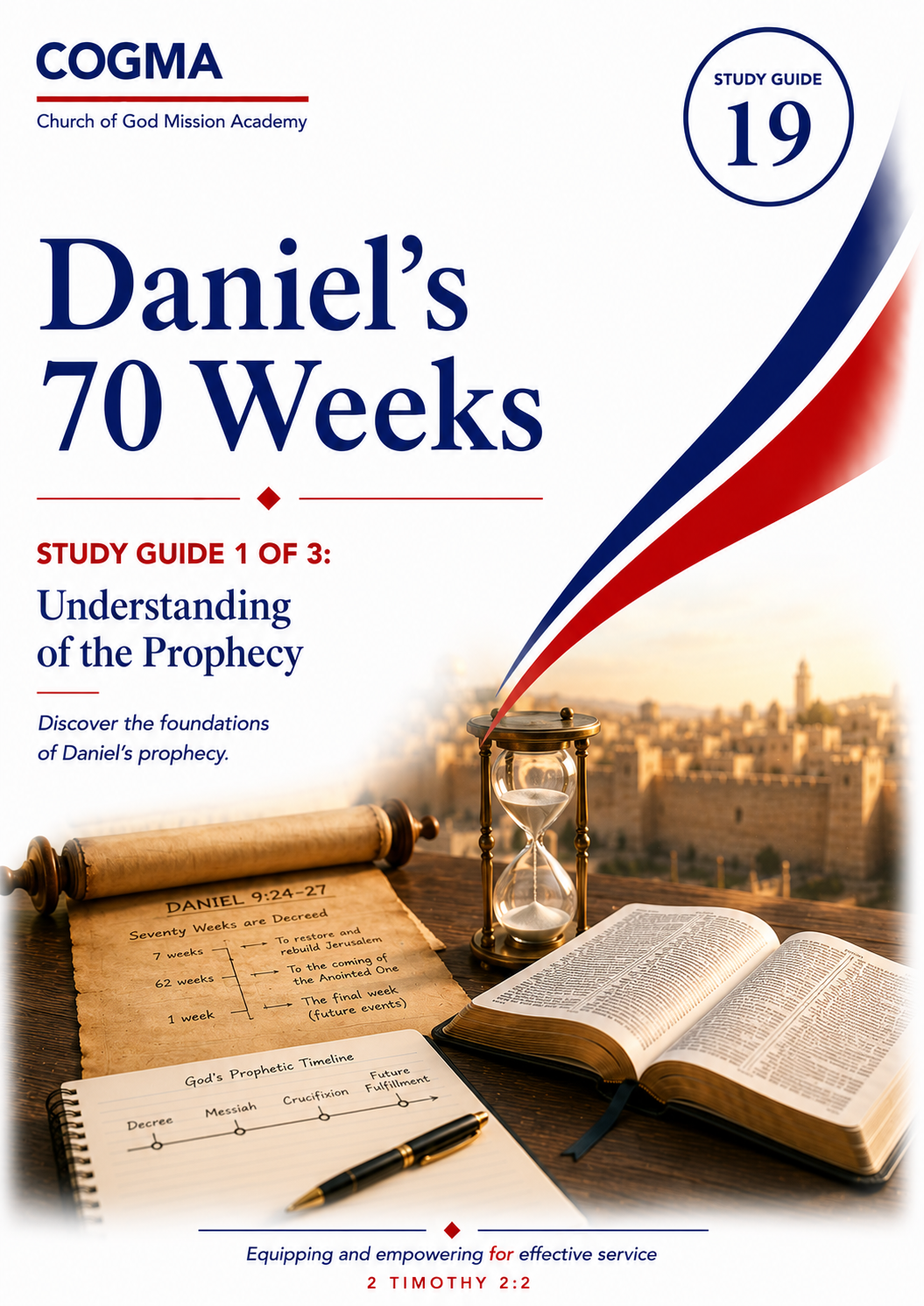
This study guide focuses on the prophecy of Daniel’s seventy weeks. Through this study, you will gain insights into both the principle and purpose of prophecy and understand the precise fulfilment of Daniel’s prophecy in 34 A.D.
As you advance in your studies with COGMA, it is essential to critically evaluate the beliefs previously taught to you by various denominations, sects, and groups you have been or are currently involved with. Weigh these teachings against what the Bible states.
Our studies have highlighted the significance of allowing the Bible to interpret itself, a concept known as the “Golden Rule”. When individuals introduce their own interpretations, it often leads to confusion and an over-reliance on those personal interpretations.
The Golden Rule
Allow the Bible to interpret itself!
For example, some erroneously advocate for a “gap period” between the 69th and 70th week of Daniel’s prophecy, despite the lack of biblical evidence to support this view.
An impartial reading of the prophecy reveals no such gap period. A discerning reader will notice that each week in the prophecy follows the previous one seamlessly, without any interruption.
Daniel 9:24–27 states:
“Seventy weeks are determined upon thy people and upon thy holy city, to finish the transgression, and to make an end of sins, and to make reconciliation for iniquity, and to bring in everlasting righteousness, and to seal up the vision and prophecy, and to anoint the most Holy. Know therefore and understand, that from the going forth of the commandment to restore and to build Jerusalem unto the Messiah the Prince shall be seven weeks, and threescore and two weeks: the street shall be built again, and the wall, even in troublous times. And after threescore and two weeks shall Messiah be cut off, but not for himself: and the people of the prince that shall come shall destroy the city and the sanctuary; and the end thereof shall be with a flood, and unto the end of the war desolations are determined. And he shall confirm the covenant with many for one week: and in the midst of the week he shall cause the sacrifice and the oblation to cease, and for the overspreading of abominations he shall make it desolate, even until the consummation, and that determined shall be poured upon the desolate.”
Our study of this prophecy begins with understanding the nature and purpose of prophecy.
Personal Response
Key Truth
What does the “Golden Rule” of biblical interpretation mean to you, and why is it important for studying Daniel’s prophecy?
Personal Reflection
Have you encountered teachings about a “gap period” or a future tribulation? How has this study prompted you to re-examine those ideas?
Action Step
Identify one specific step you will take to apply the Golden Rule in your own Bible study this week.
RULES OF BIBLE PROPHECY
Authentication — The Purpose of Prophecy
The purpose of all prophecy is to authenticate Jesus Christ. Jesus said concerning all scriptures:
John 5:39 states:
Search the scriptures; for in them ye think ye have eternal life: and they are they which testify of me.
The focus of prophecy lies in its validation after fulfilment, rather than in the prediction. This validation in God’s Word strengthens your faith and encourages unwavering trust in Jesus Christ, particularly during challenging times.
Consider Paul’s situation. Despite the Holy Spirit forewarning him about upcoming bonds and afflictions, he remained steadfast and continued to trust God each day.
Acts 20:22–24 states:
And now, behold, I go bound in the spirit unto Jerusalem, not knowing the things that shall befall me there: Save that the Holy Ghost witnesseth in every city, saying that bonds and afflictions abide me. But none of these things move me, neither count I my life dear unto myself, so that I might finish my course with joy, and the ministry, which I have received of the Lord Jesus, to testify the gospel of the grace of God.
It is important to understand that biblical prophecy’s primary role is to authenticate the Word of God and Jesus Christ. Avoid being misled by those who promote personal prophecies as predictors of the future, which is comparable to sorcery and astrology, both forms of witchcraft.
Jesus, in Matthew 6, taught us that we cannot foresee the future. Instead, we should seek God and His righteousness today. Our daily life should be guided by the light of Christ, trusting in Him fully, recognising that God’s path is always the superior choice.
Personal Response
Key Truth
In your own words, what is the primary purpose of biblical prophecy, as shown by Jesus’ statement in John 5:39?
Personal Reflection
How does Paul’s example in Acts 20 encourage you when you face difficult or uncertain circumstances?
Action Step
Write down one area of your life where you need to trust God more fully today, and commit to placing that area before Him in prayer.
Timespans — Understanding Prophetic Timespans
Bible prophecies often provide timespans rather than exact dates. They typically foretell future conditions or events that signify their beginning and end, but the exact start date remains unknown until it has been fulfilled.
In Daniel’s seventy weeks prophecy, the timespan is specified, but not the start and end dates. Daniel received clear conditions in his vision that mark the beginning and end of this prophetic period. Thus, the initiation of Daniel’s prophecy can only be identified once the conditions completing the seventy weeks have occurred.
This principle is captured in the phrase: “YOU MUST KNOW THE END BEFORE YOU CAN IDENTIFY THE BEGINNING.”
i.
Example One: The False Prediction of Christ’s Return
In the 20th century, numerous false prophets inaccurately predicted Jesus Christ’s return in 1988, basing their prediction on the fig tree parable found in Matthew 24. They erroneously linked this parable to Israel’s declaration of independence in 1948, anticipating a return within 40 years.
This 40-year timeframe was derived from an interpretation of Genesis 1:28, where a biblical generation is approximately 40 years. When the prediction failed in 1988, they falsely manipulated a generation by extending the years. These predictions have been conclusively disproved as of 2024, some 76 years after 1948.
When studying the Bible, it is crucial to analyse the context, the time period, and the audience addressed. Understanding the original listeners’ perspectives before applying the scripture to modern life and circumstances is essential.
ii.
Jesus’ Prophecies to His Disciples
A thorough examination of Matthew 24, Mark 13, and Luke 21 shows that Jesus was speaking to His disciples in 31 A.D., predicting events within their generation, such as the destruction of the Jewish temple in 70 A.D.
If these false prophets had understood that prophecy serves to validate events and cannot be confirmed until its conditions are met, they would have refrained from making such unfounded predictions.
iii.
Interpreting Prophecy Correctly
Understanding and interpreting prophecy requires knowing both its start and end dates, which can only be confirmed after the fulfilment of its conditions or predictions. It is essential to allow the Bible to interpret prophecy for you. As stated by Peter:
2 Peter 1:21 states:
For the prophecy came not in old time by the will of man: but holy men of God spake as they were moved by the Holy Ghost.
Following the Golden Rule — “the Bible always interprets the Bible” — is crucial for harmoniously fitting Daniel’s prophecy of seventy weeks with the scriptures.
iv.
The Importance of Words in Prophecy
In the first module, “Study for Approval,” you learned about the significance of words. The disciples asked Jesus about the “end of the world” in Matthew 24:3. Here, “world” is translated from the Greek word AION, meaning age. This differs from KOSMOS in Matthew 24:21, referring to the literal world or universe. In Matthew 24:14, “world” is translated from OIKOUMENE, indicating the “known world,” specifically the Roman Empire at that time.
v.
Transition from the Old to the New Covenant
Jesus and His disciples lived under the Old Testament laws of Moses. This age ended on Pentecost, marked by Jesus’ return as promised in John 14. However, God allowed a transition period for the Jews to move from Moses’ law to the New Covenant. This period concluded with the destruction of the Jewish temple in 70 A.D.
vi.
Example Two: The Great Tribulation
Using the study rules — context, time period, and the audience to whom Jesus is speaking — it is relatively straightforward to identify what the “great tribulation” is.
The final week leading to the crucifixion of our Lord Jesus Christ commences in Matthew 21 with His triumphant and final entry into Jerusalem and concludes with His death and burial in Matthew 27. This significant event occurred during the month of Nisan in the year 31 A.D.
In Matthew 22, Jesus finds Himself in the temple, imparting teachings and facing challenges from the Pharisees and Sadducees who sought to trick Him and bring accusations against Him. Unable to find fault and counter Jesus’ wisdom, they eventually depart.
In the subsequent chapter, Jesus remains in the temple, addressing not only the multitude but also His disciples. In His discourse, He unveils the hypocrisy of the scribes and Pharisees and delivers seven “woes” or judgements upon them. Jesus ends His address with these words:
Matthew 23:36 states:
Verily I say unto you, All these things shall come upon this generation.
vii.
Which Generation?
The crucial question arises: which generation is He referring to? It is evident that Jesus is speaking of the generation of people present and listening to Him in 31 A.D.
Matthew 23:38 states:
Behold, your house is left unto you desolate.
Considering that the “house” of the New Covenant symbolises the church of God, a spiritual entity, the “house” of the Old Covenant people pertains to the physical temple of God in Jerusalem, the very subject of Jesus’ reference in Matthew 24. Hence, in Matthew 23, Jesus conveys that within the span of one generation, the temple in Jerusalem, representing the “presence of God,” would be rendered desolate.
viii.
Jesus’ Prophecies on the Mount of Olives
As we transition to Matthew 24, we find Jesus having left the temple and the multitude, now positioned on the Mount of Olives. It is at this juncture that His disciples approach Him, seeking an explanation of His words from Matthew 23.
The disciples posed three significant questions to Jesus:
- “Tell us, when will these things be?”
- “What is the sign of your coming?”
- “When is the end of the world?”
These three questions are covered in greater detail in the module “Rightly Dividing the Truth.”
ix.
The Three Questions Answered
Jesus initiates His response by foretelling the destruction of the temple and its buildings, an event that unfolded in 70 A.D. at the hands of the Roman army, addressing the first question. The second question pertains to the return of Christ, which occurred on the day of Pentecost approximately fifty-two days later. The sign that authenticated His return is the indwelling Spirit in believers.
The third question, concerning the “end of the world,” does not refer to the end of the literal world (KOSMOS), but rather the conclusion of the age (AION). Jesus and His disciples lived within the confines of the Old Covenant age. The New Covenant Age, also known as the Gospel Day, commenced on the day of Pentecost when the city of God, the New Jerusalem, descended from God out of Heaven.
Matthew 24:4 states:
And Jesus answered and said unto them, Take heed that no man deceive you.
Notice that Jesus addressed “them” — His disciples — cautioning them against deception. His words were not directed to individuals in your period of the Gospel Day.
Matthew 24:9 states:
Then shall they deliver you up to be afflicted, and shall kill you: and ye shall be hated of all nations for my name’s sake.
Jesus specifically identifies His disciples and outlines what would occur during their lives, leading to the temple’s destruction and the “great tribulation.” Among the twelve disciples, all but two met martyrdom.
Matthew 24:21 states:
For then shall be great tribulation, such as was not since the beginning of the world to this time, no, nor ever shall be.
x.
Historical Confirmation by Josephus
Josephus, a Jewish historian, chronicled the events in “Wars of the Jews,” shedding light on the siege of Jerusalem by the Roman army under Titus, where many perished due to starvation, diseases, and even cannibalism. Upon the Roman army’s conquest, most Jews were killed, with only those deemed useful to the Roman Empire spared.
Matthew 24:34 states:
Verily I say unto you, This generation shall not pass, till all these things be fulfilled.
Recognising that a biblical generation spans approximately 40 years, the fulfilment of “all these things” must have occurred between the crucifixion of Jesus Christ on the 14th of Nisan in 31 A.D. and the destruction of the Jewish temple in 70 A.D.
Personal Response
Key Truth
What is the key principle for identifying the start date of a biblical prophecy, as illustrated by Daniel’s seventy weeks?
Personal Reflection
How does understanding that Jesus was speaking directly to His disciples in Matthew 24 change the way you read that chapter?
Action Step
Choose one passage from Matthew 24 and practise applying the study rules of context, time period, and original audience. Write a brief note on what you find.
THE GAP PERIOD THEORY — A FALSE TEACHING
What Is the Gap Period Theory?
Many are falsely taught that a “gap period” exists between the 69th and 70th week of Daniel’s prophecy. This gap period is described as the current church age, with the church existing now in this gap for over 2,000 years.
It is incorrectly taught that Daniel’s “time clock” stopped at the end of the 69th week, coinciding with the ascension of Jesus Christ in Acts chapter 1, and that it will restart at the beginning of the 70th week with Christ’s literal return to rapture believers and initiate the great tribulation.
Additionally, it is falsely asserted that while believers enjoy the marriage supper during the 70th week, those left on earth will face God’s wrath. As explained in the previous lesson, when Jesus prophesied the “great tribulation” in Matthew 24, He was addressing those present at the time and referring to the impending destruction of the temple and Jerusalem by the Roman army in 70 A.D. Jesus was not speaking directly to us in our current time within the Gospel Day.
The Marriage of Christ and the Church
The marriage of Christ and the church is a present reality and not something destined for the future. Paul revealed this truth in his letter to the Romans when addressing his Jewish brethren who had been married to the Law.
Romans 7:4 states:
Wherefore, my brethren, ye also are become dead to the law by the body of Christ; that ye should be married to another, even to him who is raised from the dead, that we should bring forth fruit unto God.
Paul makes it clear that born-again believers are married to Jesus Christ as a present-day reality. The book of Revelation, which reveals Jesus Christ throughout the Gospel Day, is a symbolic book that underscores the reality of the marriage between Christ and the church.
Revelation 21:2 states:
And I John saw the holy city, new Jerusalem, coming down from God out of heaven, prepared as a bride adorned for her husband.
That holy city, new Jerusalem, according to the twelfth chapter of Hebrews, is the church of Jesus Christ. Further reading in the twenty-first chapter of Revelation elaborates on this:
Revelation 21:9–10 states:
And there came unto me one of the seven angels which had the seven vials full of the seven last plagues, and talked with me, saying, Come hither, I will shew thee the bride, the Lamb’s wife. And he carried me away in the spirit to a great and high mountain, and shewed me that great city, the holy Jerusalem, descending out of heaven from God.
i.
Hebrew Custom and Prophetic Days
In Hebrew custom, after a marriage ceremony, there was a feast of seven days, with intimate relationships beginning on the first day. This is a type pointing to the seven prophetic days of the Gospel Day, during which the church, the Jerusalem from above, is fruitful from its very beginning. On the day of Pentecost, more than 3,000 souls were birthed into the kingdom.
Galatians 4:26 states:
But Jerusalem which is above is free, which is the mother of us all.
Paul spoke of this marital relationship between Christ and the church as a great mystery when he compared it to the literal marriage of a husband and wife.
Ephesians 5:31–32 states:
For this cause shall a man leave his father and mother, and shall be joined unto his wife, and they two shall be one flesh. This is a great mystery: but I speak concerning Christ and the church.
Personal Response
Key Truth
What does the Bible teach about when the marriage of Christ and the church took place, and how does this refute the gap period theory?
Personal Reflection
Does understanding the church as the “New Jerusalem” already wed to Christ change how you see your present relationship with God? In what way?
Action Step
Spend time this week reading Revelation 21 slowly, noting the imagery of the bride and the city. Record one insight you gain about the present reality of the church.
The Present Reality of the Marriage
Denying the present reality of the marriage between Christ and the church implies that believers are not legitimate sons and daughters of God. However, the Bible contradicts this denial.
Ephesians 2:19 states:
Now therefore ye are no more strangers and foreigners, but fellowcitizens with the saints, and of the household of God.
i.
The Marriage Supper
Many have been taught to believe in a literal marriage supper in the heaven of God during a future tribulation period. This is completely false, as the marriage has already taken place and the supper continues throughout the Gospel Day. This is not a literal or physical supper, but a spiritual one.
1 Corinthians 10:21 states:
Ye cannot drink the cup of the Lord, and the cup of devils: ye cannot be partakers of the Lord’s table, and of the table of devils.
John 6:51 states:
I am the living bread which came down from heaven: if any man eat of this bread, he shall live for ever: and the bread that I will give is my flesh, which I will give for the life of the world.
Both Job and Jeremiah personified the supper:
Job 23:12 states:
Neither have I gone back from the commandment of his lips; I have esteemed the words of his mouth more than my necessary food.
Jeremiah 15:16 states:
Thy words were found, and I did eat them; and thy word was unto me the joy and rejoicing of mine heart.
The marriage supper is a spiritual reality, representing the intimate relationship between Christ and the church, a relationship that has existed since the morning time of the Gospel Day. This will be covered in more detail in the module on the New Testament Church.
The Church Is Already One with Christ
If we accept that the church of God is our mother, then reading John’s first epistle, where he tells us we are the legitimate sons and daughters of God, logically leads us to the conclusion that Christ and the church are already united.
1 John 3:2 states:
Beloved, now are we the sons of God, and it doth not yet appear what we shall be: but we know that, when he shall appear, we shall be like him; for we shall see him as he is.
It is important to note that God has no illegitimate children. To suggest otherwise would be to imply that He is a spiritual fornicator and, by extension, a sinner. For a more detailed explanation, please refer to the “The New Testament Church” module.
Furthermore, the idea that the church exists in a prophetic “gap period” outside the realm of time is not accurate. The true church has been present and a home for the redeemed since the day of Pentecost in 31 A.D., as confirmed in Acts 2.
Personal Response
Key Truth
In your own words, explain why the teaching of a future gap period is inconsistent with what Paul teaches in Romans 7:4 and Ephesians 2:19.
Personal Reflection
What did this lesson reveal about the nature of the Lord’s supper and your present relationship with Christ?
Action Step
Identify one false teaching about a future gap period or rapture that you have previously encountered. Write a brief biblical response to it, using the scriptures from this lesson.
BACKGROUND TO DANIEL’S SEVENTY WEEKS PROPHECY
The Historical Setting
Daniel himself was taken into captivity as a child in 606 BC and remained in Babylon even during the reign of the Medo-Persian Empire. There is no recorded instance of Daniel returning to Jerusalem at the conclusion of the prophesied seventy-year captivity. In fact, Daniel rose to the position of second-in-command under Darius in the Medo-Persian Empire, as described in Daniel chapter 6.
When reading the book of Daniel, it is essential to note that the first six chapters follow a chronological order, detailing the history of Daniel’s captivity by the Babylonians and his subsequent years under the rule of Darius the Mede and Cyrus the Persian. The remaining six chapters, however, are not presented in chronological order and focus on various visions received by Daniel. It is also worth noting that the book of Daniel is often considered a companion to the book of Revelation.
The Background to the Prophecy
In the first year of Darius’s reign, Daniel gains insight from the writings of the prophet Jeremiah that the captivity of Israel is drawing to a close.
Daniel 9:2 states:
In the first year of his reign I Daniel understood by books the number of the years, whereof the word of the LORD came to Jeremiah the prophet, that he would accomplish seventy years in the desolations of Jerusalem.
While in prayer and contemplation regarding the end of the captivity, Daniel has a vision in which Gabriel appears to him.
Daniel 9:21–22 states:
Yea, whiles I was speaking in prayer, even the man Gabriel, whom I had seen in the vision at the beginning, being caused to fly swiftly, touched me about the time of the evening oblation. And he informed me, and talked with me, and said, O Daniel, I am now come forth to give thee skill and understanding.
From the studies conducted in the module “The Language of the Bible,” it is clear that all visions in the Bible are presented in symbolic language and should not be interpreted literally. When Gabriel communicated with Daniel, it was not a physical appearance but rather a message conveyed through a vision.
i.
Gabriel as a Man
It is worth noting that Gabriel is described as a man, a human being, and not as a celestial angelic being, as some false teachings suggest. In the vision, the man Gabriel informs Daniel that he would receive the skill and understanding needed to interpret the vision.
What follows is then what is commonly referred to as “Daniel’s Seventy Weeks.” Subsequently, approximately two years later, Daniel comes to understand that the fulfilment of this vision is set for a distant future time.
Daniel 10:1 states:
In the third year of Cyrus king of Persia a thing was revealed unto Daniel, whose name was called Belteshazzar; and the thing was true, but the time appointed was long: and he understood the thing, and had understanding of the vision.
The literal version of this verse clarifies that Daniel was troubled concerning the prophecy of the seventy weeks.
Daniel 10:1 (LITV) states:
In the third year of Cyrus king of Persia, a thing was revealed to Daniel, whose name was called Belteshazzar. And the thing was true, and a great conflict. And he understood the thing and had understanding of the vision.
ii.
Why Was Daniel Troubled?
An essential question arises: “Why was Daniel troubled and conflicted?” The answer is provided in the subsequent passage.
Daniel 10:14 states:
Now I am come to make thee understand what shall befall thy people in the latter days: for yet the vision is for many days.
Daniel understood that his people had a set timeframe decreed by God, and beyond this designated period, they would face a significant change in their status as God’s people. Specifically, they would be cut off as God’s people.
Daniel 9:24 states:
Seventy weeks are determined upon thy people and upon thy holy city, to finish the transgression, and to make an end of sins, and to make reconciliation for iniquity, and to bring in everlasting righteousness, and to seal up the vision and prophecy, and to anoint the most Holy.
The critical question that arises is: “Who are Daniel’s people?” and “Who are the ‘thy people’?”
Personal Response
Key Truth
Why is it significant that Gabriel is described as a man in the vision, and what does this tell us about interpreting visions in Scripture?
Personal Reflection
How does Daniel’s personal distress and prayer in Daniel 9 and 10 speak to your own experience of seeking God in uncertain times?
Action Step
Read Daniel 9:1–19 slowly this week as a model of intercessory prayer. Note one element of Daniel’s prayer that you will incorporate into your own prayer life.
Daniel’s People
At the time of its writing around 536 BC, Daniel’s people referred to the Old Testament literal Israel, and the city of Jerusalem was considered the holy city. In this context, Daniel understood that the “seventy prophetic weeks” mentioned in Daniel 9:24 exclusively pertained to literal Israel.
Furthermore, Daniel understood that at the culmination of this prophecy, his people, Israel, would no longer maintain their exclusive status as God’s chosen people. The Hebrew word for “determined” used in this context is CHATHAK, which means “to be cut off.”
Romans 11:20 states:
Well; because of unbelief they were broken off, and thou standest by faith. Be not highminded, but fear:
Romans 11:21 states:
For if God spared not the natural branches, take heed lest he also spare not thee.
The natural branches represent the descendants of Jacob, the literal Old Testament people of Israel, while the “engrafted branches” symbolise the Gentiles. According to what the Bible says in Paul’s letter to the Romans, Daniel’s people were indeed cut off, aligning with the prophecy of Daniel’s seventy weeks.
i.
Erroneous Teachings
It is essential to address the erroneous teachings found among certain Protestant and Pentecostal denominations and sects, which suggest that natural Israel will have a second chance to be restored as God’s people in the future. This notion is not supported by what the Bible says.
ii.
Jesus’ Teaching to Nicodemus
When Nicodemus, a Jewish Pharisee, approached Jesus to inquire about the kingdom of God, Jesus emphasised the requirement of being born again.
John 3:3 states:
Jesus answered and said unto him, Verily, verily, I say unto thee, Except a man be born again, he cannot see the kingdom of God.
John 3:7 states:
Marvel not that I said unto thee, Ye must be born again.
Since Calvary and the sacrifice of our Lord Jesus Christ, there is now only one way into the kingdom of God for both Jews and Gentiles: “YOU MUST BE BORN AGAIN.” Salvation under the New Covenant is not contingent upon one’s natural birthplace or country; it is open to “whosoever will believe in Christ.”
Romans 1:16 states:
For I am not ashamed of the gospel of Christ: for it is the power of God unto salvation to every one that believeth; to the Jew first, and also to the Greek.
iii.
One Body in Christ
The Bible’s message is clear: salvation is through faith in Jesus Christ, and there is no alternative path for Jews or Gentiles.
1 Corinthians 12:13 states:
For by one Spirit are we all baptized into one body, whether we be Jews or Gentiles, whether we be bond or free; and have been all made to drink into one Spirit.
There is only one body of Christ for the Jew and the Gentile to make one people, the children of God.
Ephesians 2:13–14 states:
But now in Christ Jesus ye who sometimes were far off are made nigh by the blood of Christ. For he is our peace, who hath made both one, and hath broken down the middle wall of partition between us;
Under the law of Moses, the Jewish people were commanded to maintain separation from the Gentile people, even refraining from eating or fellowship with them. However, this long-standing division was completely transformed under the New Covenant through the redemptive work of the Cross.
Ephesians 2:15 states:
Having abolished in his flesh the enmity, even the law of commandments contained in ordinances; for to make in himself of twain one new man, so making peace;
Through the Cross, Jesus made of “twain,” namely, the believing Jew and Gentile, creating a singular new entity — the body of Christ — with Himself as its Head.
Personal Response
Key Truth
What does CHATHAK (“to be cut off”) tell us about God’s purposes for Old Testament Israel, and what replaced that covenant relationship?
Personal Reflection
How does the truth that there is “one body” for both Jew and Gentile affect the way you relate to other believers from different backgrounds?
Action Step
Memorise Romans 1:16 this week. Write it out in your own words and consider: am I living as someone who is not ashamed of the gospel?
DANIEL’S HOLY CITY AND THE PURPOSE OF THE PROPHECY
Daniel’s Holy City
In Daniel’s time, around 536 BC, the holy city was indeed Jerusalem, and the temple of Solomon was where the presence of God resided. Whenever Daniel prayed, he would open his windows and kneel facing Jerusalem.
Daniel 6:10 states:
Now when Daniel knew that the writing was signed, he went into his house; and his windows being open in his chamber toward Jerusalem, he kneeled upon his knees three times a day, and prayed, and gave thanks before his God, as he did aforetime.
i.
The True and Spiritual Jerusalem
From your studies in the upcoming module “The New Testament Church,” you will come to realise that the significance of literal Jerusalem in Palestine is no longer relevant. It served as a symbol or type that pointed to the reality of the true and spiritual Jerusalem.
Hebrews 12:22 states:
But ye are come unto mount Sion, and unto the city of the living God, the heavenly Jerusalem, and to an innumerable company of angels,
This is the church of God, the church of Jesus Christ, as the next verse says:
Hebrews 12:23 states:
To the general assembly and church of the firstborn, which are written in heaven, and to God the Judge of all, and to the spirits of just men made perfect,
Paul once again confirms that the church of God is an assembly of both believing Jews and Gentiles. The true and living city of God is not a physical place but a spiritual one. It is that city that came down from God out of Heaven on the day of Pentecost in 31 A.D.
Revelation 21:2 states:
And I John saw the holy city, new Jerusalem, coming down from God out of heaven, prepared as a bride adorned for her husband.
ii.
The True Jew and Israel
When you follow the Golden Rule and allow the Bible to interpret itself, all confusion is swept away. In the book of Romans, Paul teaches that being a natural or literal Jew is no longer relevant or “special” under the New Covenant. Simply being born a literal Jew does not automatically make one a member of the family of God.
Romans 2:28–29 states:
For he is not a Jew, which is one outwardly; neither is that circumcision, which is outward in the flesh: But he is a Jew, which is one inwardly; and circumcision is that of the heart, in the spirit, and not in the letter; whose praise is not of men, but of God.
Under the New Covenant, the term “Jews” refers to all who are born again through faith in Jesus Christ as their Saviour. Similarly, Old Testament literal Israel no longer holds a special status as a nation or people under the New Covenant. Just like the people of all other nations, they too must be born again during the Gospel Day.
Romans 9:6–8 states:
Not as though the word of God hath taken none effect. For they are not all Israel, which are of Israel: Neither, because they are the seed of Abraham, are they all children: but, In Isaac shall thy seed be called. That is, They which are the children of the flesh, these are not the children of God: but the children of the promise are counted for the seed.
This underscores that the true children of God are those who are born of the promise, not merely of physical lineage.
Personal Response
Key Truth
What does it mean that the heavenly Jerusalem has replaced the literal Jerusalem as the holy city of God?
Personal Reflection
How does the truth of Romans 2:28–29 — that a true Jew is one inwardly — challenge or confirm your understanding of your own identity in Christ?
Action Step
Reflect on what it means to be a child of promise rather than a child of the flesh. Write a brief personal statement of what this means for your life in Christ.
The Purpose of Daniel’s Prophecy
From the introduction of this study guide, it is evident that the purpose of prophecy is to authenticate Jesus Christ and His Word. As you delve into the subsequent study guides in this module, you will come to understand that each of these seven purposes was indeed fulfilled in Christ at His first and literal coming approximately 2,000 years ago.
i.
To Finish the Transgression
Jesus Christ accomplished the purpose of finishing the transgression by offering Himself as a sacrifice, thus addressing the transgressions of humanity.
ii.
To Make an End of Sins
Through His death and resurrection, Jesus made an end of sins by providing a path to forgiveness and redemption.
iii.
To Make Reconciliation for Iniquity
Reconciliation for iniquity was achieved through Christ’s atoning sacrifice, which restored the relationship between God and humanity.
iv.
To Bring in Everlasting Righteousness
Everlasting righteousness was brought in by Jesus, who, through His perfect life and sacrificial death, imparted righteousness to those who believe in Him.
v.
To Seal Up the Vision and Prophecy
By fulfilling the prophecies concerning the Messiah, Jesus sealed up the vision and prophecy, confirming their accuracy and divine origin.
vi.
To Anoint the Most Holy
Foreshadowing Christ is the anointing for His divine purpose, which Jesus received for His public ministry at the river Jordan. Importantly, Jesus was not anointed to make Him holy, but to anoint the Most Holy.
vii.
To Confirm the Covenant
Lastly, Jesus confirmed the covenant through His life, death, and resurrection, establishing a new covenant between God and His people.
Personal Response
Key Truth
Of the seven purposes fulfilled in Daniel’s prophecy, which one stands out most to you as an expression of Christ’s work, and why?
Personal Reflection
How does seeing that all seven purposes of Daniel’s prophecy were fulfilled at Christ’s first coming strengthen your confidence in the authority of Scripture?
Action Step
Choose one of the seven purposes and write a brief paragraph explaining, in your own words, how it was fulfilled in Jesus’ life, death, or resurrection.
SUMMARY
This study guide has introduced the prophecy of Daniel’s seventy weeks, highlighting the principle and purpose of prophecy and its fulfilment in 34 A.D. It has encouraged students to critically evaluate their previous teachings and align them with the Bible’s statements, advocating the Golden Rule of letting the Bible interpret itself.
Purpose and Principle of Prophecy
- The prophecy aims to authenticate Jesus Christ and His Word, not just to predict the future but to validate it after its fulfilment.
- Emphasis is placed on the principle known as the Golden Rule in biblical interpretation: allowing the Bible to interpret itself to avoid confusion from personal interpretations.
Daniel’s Seventy Weeks
- The prophecy describes a period of seventy weeks determined for Daniel’s people (literal Israel) and the holy city (Jerusalem).
- Each week in the prophecy follows seamlessly without interruption, refuting the concept of a gap period between the 69th and 70th week.
- The historical context involves Israel’s captivity by Babylon and the subsequent period under Medo-Persian rule.
Interpretation of Prophecy
- Correct interpretation requires knowing both the start and end dates, confirmed only after the fulfilment of conditions described.
- The prophecy served to transition from the Old Covenant (literal Israel) to the New Covenant (spiritual Israel, the church of Jesus Christ).
Fulfilment in Jesus Christ
- The purposes outlined in the prophecy (to finish transgression, make an end of sins, bring in everlasting righteousness) were fulfilled through Jesus’ life, death, and resurrection.
- Jesus confirmed the covenant and sealed the vision and prophecy, confirming their accuracy and divine origin.
False Teachings Addressed
- Misinterpretations, such as the gap theory and the literal marriage supper in heaven, are refuted by scriptural evidence.
- The church is not in a gap period but has been visible and active since the day of Pentecost in 31 A.D.
Role of the Church
- The church is described as the light of the world, embodying Christ’s teachings and serving as a beacon of hope and truth.
- The mission involves preaching the gospel and living out its teachings through actions.
Personal Response
Key Truth
Having studied the introduction to Daniel’s seventy weeks, what is the single most important truth you will carry forward from this study guide?
Personal Reflection
Looking back over the four lessons, what has changed or deepened in your understanding of the relationship between prophecy, Israel, and the church?
Action Step
Write a brief personal commitment statement: how will you continue to apply the Golden Rule of biblical interpretation in your ongoing study of the Bible?
SUBMISSION TO COGMA FOR APPRAISAL
Instructions
Complete this section after you have finished the Study Guide. It must be completed online. The link to the online form that you must complete and submit is located at the bottom of this Study Guide.
Your answers should reflect your understanding, your personal response, and how you intend to live by the truth you have studied.
Answer honestly and be specific.
1. Main Truth
In your own words, what is the most important truth you have learned from this study guide about the purpose of prophecy and its fulfilment in Daniel’s seventy weeks?
2. Understanding
Explain what the Golden Rule of biblical interpretation means and why it is essential for correctly understanding Daniel’s seventy weeks prophecy.
3. Personal Reflection
What has this study guide revealed to you about your own understanding of Bible prophecy? What assumptions or previous teachings has it challenged?
4. Response to Truth
Which teaching in this study guide corrected or challenged your thinking most — the refutation of the gap period, the present reality of the marriage of Christ and the church, or the meaning of Daniel’s ‘thy people’? Explain why.
5. Action Step
Describe one specific and practical action you have taken or planned as a result of studying this material. Be as specific as possible about what you will do and when.
6. Early Response
Have you begun to apply the study rules of context, time period, and original audience to your own reading of Matthew 24 or Daniel 9? Yes / Not yet. What changed in your understanding, or what prevented you from doing so?
7. Ongoing Practice
What practice of biblical interpretation will you continue to develop as a result of this study — for example, identifying the original audience, tracing the fulfilment of prophecy, or applying the Golden Rule?
8. Doctrinal Clarity
Which doctrine do you now understand more clearly: the spiritual nature of the New Jerusalem and the church, the meaning of CHATHAK (“to be cut off”) in Daniel 9:24, or the one body of Christ for both Jew and Gentile? Explain in your own words.
9. Living the Truth
There is a difference between knowing that prophecy authenticates Jesus Christ and actually living with that confidence. What would it look like in your daily life to live as someone who fully trusts the authority and fulfilment of God’s Word?
10. Final Response
As you continue into the subsequent study guides on Daniel’s seventy weeks, what is one question, area of uncertainty, or personal growth point that you want to bring before God and explore further?
You must submit your answers to the above 10 questions ONLINE.
Use the link below for your final submission after finishing this Study Guide. Answer honestly and be specific.
Would you prefer a printable copy?