
Search results will appear as highlighted text.
Quick Navigation
PREFACEINTRODUCTION: THE MESSIAH HAS COMEUNDERSTANDING THE FOUR GOSPELSWHY DO WE NEED FOUR GOSPELS?MATTHEW: JESUS CHRIST THE PROMISED KINGMARK: JESUS CHRIST THE SERVANTLUKE: JESUS CHRIST THE SON OF MAN AND SAVIOURJOHN: JESUS CHRIST, THE LIVING WORD AND SON OF GODTHE GOSPELS WERE WRITTEN SO THAT WE MIGHT BELIEVECONCLUSION: THE ONE PROMISED HAS COMESUBMISSION TO COGMA FOR APPRAISAL
INSTRUCTIONS FOR THE STUDENT
My Study Plan
Preparing a Study Plan before starting this Study Guide will assist you in completing it within a designated timeframe. It also helps in developing the discipline required for studying God’s Word effectively.
Proverbs 16:3:
Commit thy works unto the LORD, and thy thoughts shall be established.
My Study Guide Journal
Keep a record as you progress through your Study Guide, including the Personal Responses for each section, for future reference and goal setting.
Content
- PREFACE
- INTRODUCTION: THE MESSIAH HAS COME
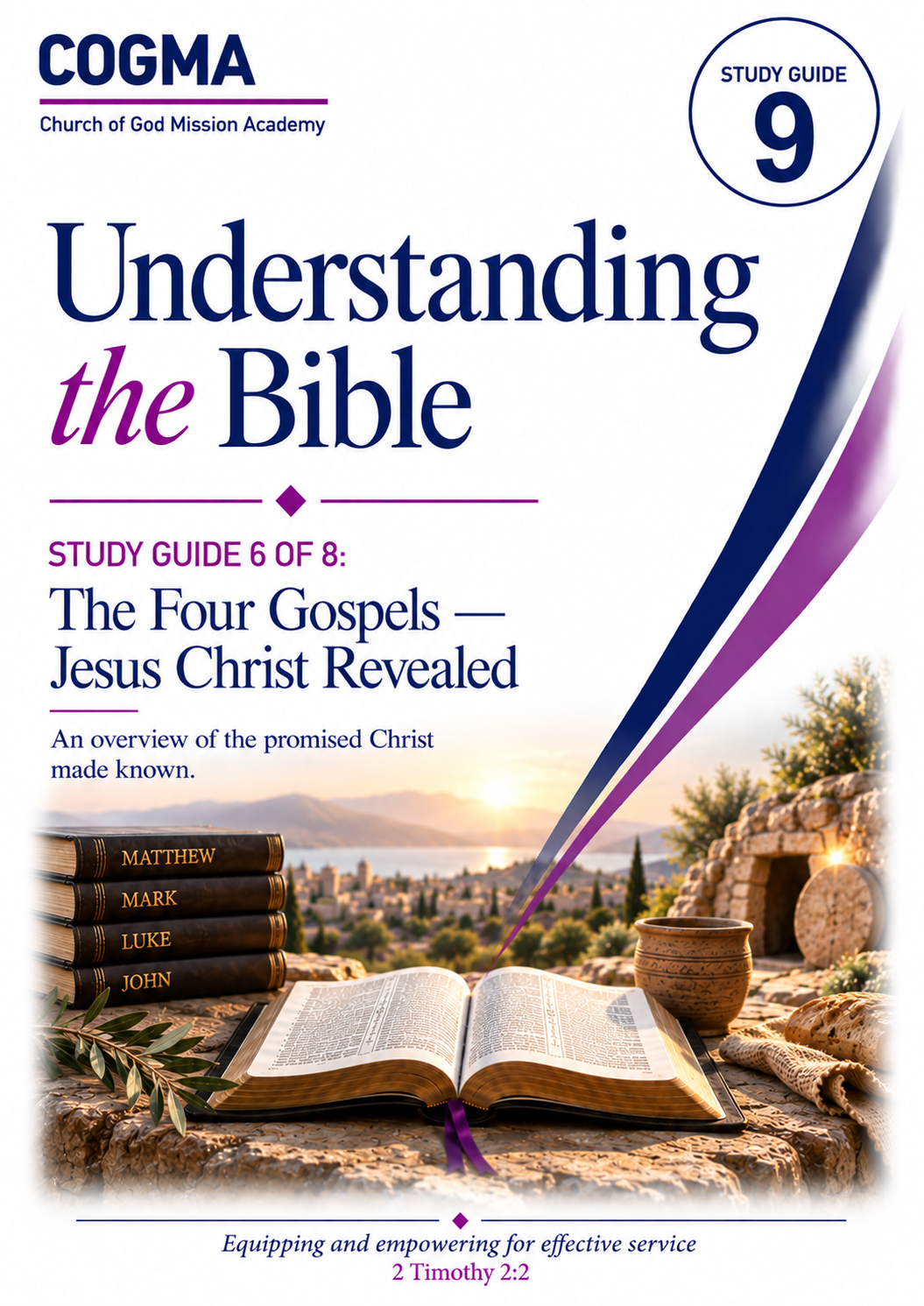
- UNDERSTANDING THE FOUR GOSPELS
- WHY DO WE NEED FOUR GOSPELS?
- MATTHEW: JESUS CHRIST THE PROMISED KING
- MARK: JESUS CHRIST THE SERVANT
- LUKE: JESUS CHRIST THE SON OF MAN AND SAVIOUR
- JOHN: JESUS CHRIST, THE LIVING WORD AND SON OF GOD
- THE GOSPELS WERE WRITTEN SO THAT WE MIGHT BELIEVE
- CONCLUSION: THE ONE PROMISED HAS COME
Important Points
- COGMA does not claim to be infallible or the authority.
- Infallibility and authority belong only to God and His Word.
COGMA therefore strongly advises that you prayerfully study the content of each Study Guide with the heart of a Berean (Acts 17:10–12).
Contact and Links
Website: cogma.com.au
Email: admin@cogma.org.au
Radio COGMA: radiocogma.com
YouTube: youtube.com/@COGMAChannel
PREFACE
The previous Study Guide brought us to the close of the Old Testament, where the prophets repeatedly pointed forward to the coming Messiah. We now enter the New Testament and turn to the four books that declare the fulfilment of that expectation: Matthew, Mark, Luke and John.
These books are known as the Gospels. The word Gospel means Good News, and the message of these books is that the One promised through the Law, the Prophets and the Psalms has come.
Each Gospel presents Jesus Christ from a distinctive perspective. Matthew especially presents Him as the promised King and Messiah. Mark emphasises Him as the Servant who came to minister and give His life. Luke presents Him as the Son of Man who came to seek and save the lost. John places particular emphasis upon His divine identity and the spiritual life found in Him.
The first three books, Matthew, Mark and Luke, are often called the Synoptic Gospels because they present a broadly similar view of many events in the life and ministry of Jesus. John is different in style and emphasis, giving special attention to who Jesus Christ is and why believing in Him brings life.
The four accounts do not compete with one another. Together they provide a fuller and harmonious testimony concerning the birth, ministry, teaching, miracles, death and resurrection of Jesus Christ.
The Gospels are not intended to record every event that occurred during His earthly life. Rather, they preserve the testimony necessary for us to understand who Jesus is, what He accomplished and why His coming changed everything.
As we study these four books, our attention must therefore remain firmly upon Jesus Christ. The prophets had said that the Messiah would come. The Gospels now declare: He has come.
Personal Response
Key Truth
Why do four Gospel witnesses direct attention to the promised Jesus Christ?
Personal Reflection
Has your view of Jesus been shaped by one account while neglecting the others?
Action Step
Read one event in two Gospels and note what each witness shows about Him.
INTRODUCTION: THE MESSIAH HAS COME
The Old Testament repeatedly looked forward to the coming of the Messiah. The Law, the Prophets and the Psalms contained promises, patterns and prophecies that prepared God's people for the One who was to come.
The four Gospels bring us to the great turning point in the biblical story. What had been promised now begins to be fulfilled in Jesus Christ.
The message is no longer simply; The Messiah is coming. The Gospel message now declares: The Messiah has come.
The Meaning of Gospel
The word Gospel means Good News. Matthew, Mark, Luke and John record the good news concerning Jesus Christ, His ministry, His teaching, His works, His death and His resurrection.
The Good News did not appear without preparation. For centuries, the Scriptures had been pointing forward towards Christ.
Isaiah wrote in Isaiah 61:1-3:
“The Spirit of the Lord GOD is upon me; because the LORD hath anointed me to preach good tidings unto the meek; he hath sent me to bind up the brokenhearted, to proclaim liberty to the captives, and the opening of the prison to them that are bound; To proclaim the acceptable year of the LORD, and the day of vengeance of our God; to comfort all that mourn; To appoint unto them that mourn in Zion, to give unto them beauty for ashes, the oil of joy for mourning, the garment of praise for the spirit of heaviness; that they might be called trees of righteousness, the planting of the LORD, that he might be glorified.”
Centuries later, Jesus read from this prophecy and declared in Luke 4:21:
“And he began to say unto them, This day is this scripture fulfilled in your ears.”
That statement captures the importance of the Gospels. Promise had become fulfilment.
Jesus Fulfilled What Had Been Written
Near the end of His earthly ministry, Jesus explained that the Old Testament Scriptures had been speaking concerning Him.
Jesus said in Luke 24:44:
“And he said unto them, These are the words which I spake unto you, while I was yet with you, that all things must be fulfilled, which were written in the law of Moses, and in the prophets, and in the psalms, concerning me.”
Jesus therefore stands at the centre of the biblical story. The Books of the Law prepared the foundation, the Historical Books carried the story forward, the Wisdom Books taught God's people how to live before Him, and the Prophets increasingly directed attention towards the coming Messiah.
The Gospels now introduce us to that Messiah personally.
A Better Covenant Was Coming
The coming of Jesus Christ also brought the fulfilment of God's promise concerning a better covenant.
The writer of Hebrews wrote in Hebrews 8:6:
“But now hath he obtained a more excellent ministry, by how much also he is the mediator of a better covenant, which was established upon better promises.”
The Gospels therefore record far more than the life of an important religious teacher. They introduce the One through whom God's promised salvation and New Covenant would be fulfilled.
Jesus came to accomplish what the Law and the Prophets had anticipated.
Four Accounts, One Jesus Christ
Matthew, Mark, Luke and John each present the life and ministry of Jesus from a particular perspective. Their emphasis and selection of events may differ, but their testimony centres upon the same Person.
Together they help us understand:
- Who Jesus Christ is;
- Why He came;
- What He taught;
- What He accomplished;
- Why we must believe and follow Him.
As we enter the four Gospels, we are therefore entering the part of Scripture where centuries of expectation become visible fulfilment.
The promised Messiah has come. Jesus Christ now stands at the centre of the story.
Personal Response
Key Truth
Why does the coming of the Messiah turn earlier promise into fulfilment?
Personal Reflection
What promise about Jesus has become clearer to you?
Action Step
Find one prophetic promise and its Gospel fulfilment this week.
UNDERSTANDING THE FOUR GOSPELS
The first four books of the New Testament are Matthew, Mark, Luke and John. Together they are known as the Gospels because they proclaim the Good News of Jesus Christ.
Although all four books centre upon the same Person, they do not present every event in exactly the same way. Each writer selects particular events, teachings and details in order to emphasise important truths concerning the identity and ministry of Jesus Christ. Understanding these differences helps us appreciate why four Gospel accounts were preserved.
The Synoptic Gospels
The first three books, Matthew, Mark and Luke, are commonly called the Synoptic Gospels. The word synoptic carries the idea of seeing together or presenting a general view of the same subject.
Matthew, Mark and Luke contain many of the same events and often follow a broadly similar order. They frequently record:
- The ministry of John the Baptist;
- The baptism of Jesus;
- His teaching in Galilee;
- His miracles;
- The calling of the disciples;
- His journey towards Jerusalem;
- His suffering, death and resurrection.
This does not mean the three books are identical. Each writer has his own emphasis and purpose, but the overall pattern of Jesus' ministry is often similar.
John Has a Different Emphasis
The Gospel of John differs noticeably from Matthew, Mark and Luke. John does not repeat many events found in the Synoptic Gospels, but instead gives particular attention to the identity of Jesus Christ and the spiritual meaning of His words and works.
John uses expressions such as:
- “the bread of life”;
- “the light of the world”;
- “the door”;
- “the good shepherd”;
- “the resurrection, and the life”;
- “the way, the truth, and the life”;
- “the true vine.”
These expressions help the reader understand not only what Jesus did, but who He is. John also begins his Gospel differently from the others because he does not begin with a genealogy or the birth of Jesus, but with the Word.
John wrote in John 1:1:
“In the beginning was the Word, and the Word was with God, and the Word was God.”
John therefore immediately directs attention towards the divine identity of Jesus Christ. This emphasis upon who Jesus is continues throughout the Gospel.
The Gospels Are Not Complete Biographies
The Gospels do not attempt to record everything Jesus said and did during His earthly ministry. John openly acknowledges that many other signs were performed that were not included in his written account.
John wrote in John 20:30:
“And many other signs truly did Jesus in the presence of his disciples, which are not written in this book:”
The Gospel writers therefore selected particular events because those events served the purpose of their testimony. John explains that purpose in the following verse.
John wrote in John 20:31:
“But these are written, that ye might believe that Jesus is the Christ, the Son of God; and that believing ye might have life through his name.”
The Gospels were therefore written to produce more than historical knowledge. They were written so that people might believe and have life through the name of Jesus Christ.
Four Witnesses to One Christ
Each Gospel contributes a particular emphasis. Matthew strongly presents Jesus as the promised King and Messiah, repeatedly connecting His life with Old Testament prophecy, while Mark presents Jesus as the Servant, emphasising His actions, ministry and willingness to give His life for others.
Luke presents Jesus as the Son of Man, giving a carefully ordered account and emphasising salvation reaching both Jew and Gentile. John presents Jesus as the Son of God and places special emphasis upon His divine identity and the spiritual life found in Him.
These perspectives do not divide Jesus into different persons or conflicting portraits. They help us see the same Jesus Christ from different angles and together provide a fuller testimony concerning Him.
One Harmonious Testimony
The four Gospels therefore work together, even though each writer gives particular attention to different aspects of the life and ministry of Jesus. Matthew may emphasise kingship, Mark may emphasise service, Luke may emphasise humanity, and John may emphasise divine identity.
Yet all four testify concerning Jesus Christ. Together they reveal the One who was promised in the Old Testament, who came into the world, taught with authority, performed mighty works, gave His life and rose again.
As we continue through each Gospel individually, we should keep this principle before us. Four writers present four perspectives, but their testimony centres upon one Lord: Jesus Christ.
Personal Response
Key Truth
Why do the four Gospels select events rather than record everything Jesus did?
Personal Reflection
Do you read them to learn who Jesus is and why He came?
Action Step
Read one Gospel account and identify what it calls you to believe.
WHY DO WE NEED FOUR GOSPELS?
The four Gospels all testify concerning Jesus Christ, yet each writer presents His life and ministry with a particular emphasis. This helps us understand why the New Testament contains four Gospel accounts rather than only one.
The writers came from different backgrounds and addressed different audiences. Their individual perspectives do not contradict one another, but work together to provide a fuller picture of who Jesus Christ is and what He came to accomplish.
We can think of the four accounts as different notes forming one harmonious chord. Each contributes something distinctive, but together they present one Jesus Christ.
Different Writers and Different Backgrounds
The Gospel writers are traditionally understood to have come from very different backgrounds. These differences help us understand why each Gospel has its own character and emphasis.
Matthew was a Jewish tax collector who became one of Jesus' disciples.
Mark, also known as John Mark, was a young Jewish man associated with Peter, Paul and Barnabas.
Luke was a physician and is generally understood to have been a Gentile. He later travelled with Paul and also wrote the book of Acts.
John was a fisherman, the son of Zebedee and brother of James. He became one of the twelve disciples of Jesus.
i.Matthew Presents the Promised King
Matthew's Gospel has a strong Jewish emphasis and repeatedly connects Jesus with Old Testament prophecy. It presents Him particularly as the promised King and Messiah.
Zechariah wrote in Zechariah 9:9:
“Rejoice greatly, O daughter of Zion; shout, O daughter of Jerusalem: behold, thy King cometh unto thee: he is just, and having salvation; lowly, and riding upon an ass, and upon a colt the foal of an ass.”
Matthew later connects this prophecy directly with Jesus.
Matthew wrote in Matthew 21:4-5:
“All this was done, that it might be fulfilled which was spoken by the prophet, saying, Tell ye the daughter of Sion, Behold, thy King cometh unto thee, meek, and sitting upon an ass, and a colt the foal of an ass.”
Matthew therefore continually shows that the promised Messiah had arrived. The King foretold by the prophets had come.
ii.Mark Presents the Servant
Mark's Gospel is traditionally associated particularly with a Roman audience. Its emphasis is strongly active, presenting Jesus as the One who came to serve.
Jesus said in Mark 10:45:
“For even the Son of man came not to be ministered unto, but to minister, and to give his life a ransom for many.”
This verse captures an important theme within Mark. Jesus possessed great authority and performed mighty works, yet He did not come seeking earthly position or human honour.
He came to minister and serve others. Ultimately, He came “to give his life a ransom for many.”
Personal Response
Key Truth
How can different writers give a fuller witness to the same Lord?
Personal Reflection
Have differences among the Gospel accounts troubled you before examining them closely?
Action Step
Compare one event in two Gospels before deciding how their details fit.
iii.Luke Presents the Son of Man
Luke's Gospel is associated particularly with a Greek audience and presents Jesus strongly as the Son of Man. Luke places considerable emphasis upon Jesus coming to seek and save those who were lost.
Jesus said in Luke 19:10:
“For the Son of man is come to seek and to save that which was lost.”
Luke's account shows that the salvation brought through Jesus Christ was not limited to one natural nation. The Gospel reaches beyond Jewish boundaries because Jesus came to seek and save the lost.
iv.John Presents the Son of God
John's Gospel has a more universal emphasis and speaks directly to people everywhere. John presents Jesus as the Son of God and gives particular attention to His divine identity and the spiritual life available through Him.
One of the best-known verses in Scripture is John 3:16:
“For God so loved the world, that he gave his only begotten Son, that whosoever believeth in him should not perish, but have everlasting life.”
Notice the breadth of the statement: “God so loved the world” and “whosoever believeth in him.” John therefore presents Jesus Christ as the One through whom spiritual life is offered to all who believe.
Jesus said in John 10:10:
“The thief cometh not, but for to steal, and to kill, and to destroy: I am come that they might have life, and that they might have it more abundantly.”
John's emphasis is therefore not only upon what Jesus did, but upon the life found in Him. Again and again, the Gospel directs us towards the identity of Jesus Christ and the spiritual life He gives.
Different Perspectives, One Lord
The four Gospel accounts can therefore be summarised broadly as follows:
- Matthew: Jesus Christ the promised King;
- Mark: Jesus Christ the Servant;
- Luke: Jesus Christ the Son of Man;
- John: Jesus Christ the Son of God.
These different emphases do not mean that Matthew presents a different Jesus from John or that Mark's Jesus is different from Luke's. Each writer is presenting the same Lord.
Matthew helps us understand how Jesus fulfils the promises concerning the Messiah, while Mark shows His life of service and sacrifice. Luke shows the Saviour reaching towards humanity, and John gives particular emphasis to His divine identity and the life found in Him.
The Languages Around the Gospel World
The world in which Jesus ministered contained different languages and cultures. At His crucifixion, the inscription placed above Him was written in Hebrew, Greek and Latin, reflecting important parts of the world surrounding Jerusalem.
Hebrew and Aramaic were closely connected with Jewish life, while Greek was widely used throughout the eastern Roman world in culture and commerce. Latin was particularly associated with Roman authority.
The Gospel accounts therefore entered a world shaped by different peoples, languages and cultures. Yet their message centred upon one Person: Jesus Christ.
A Fuller Picture of Jesus Christ
We do not need to choose one Gospel and ignore the others. Each account contributes something important, and together they help us understand more fully:
- His identity;
- His teaching;
- His works;
- His compassion;
- His authority;
- His service;
- His death;
- His resurrection.
Four Gospel writers give us four complementary perspectives, but their testimony is harmonious. There is one Jesus Christ, revealed through four Gospel accounts.
Personal Response
Key Truth
Why should a Gospel writer's audience and purpose guide how you read his account?
Personal Reflection
Which Gospel have you read without considering whom it first addressed?
Action Step
Read its opening and note what its writer wants readers to understand.
MATTHEW: JESUS CHRIST THE PROMISED KING
Approximate Historical Setting: The earthly ministry of Jesus Christ, c. A.D. 27-31
Approximate Date of Writing: c. A.D. 50-60
Place in the Biblical Story: Matthew presents Jesus Christ as the promised Messiah and King and repeatedly demonstrates that the Old Testament promises concerning Him had reached their fulfilment.
Matthew is the first Gospel and the opening book of the New Testament. It contains twenty-eight chapters and is traditionally associated with Matthew, also called Levi, a tax collector who became one of the twelve disciples of Jesus.
Matthew provides an important bridge between the Old and New Testaments. The Old Testament had repeatedly announced that the Messiah was coming, and Matthew now begins to demonstrate that the promised One had arrived.
From Promise to Fulfilment
One of the strongest features of Matthew is his repeated connection between the life of Jesus and Old Testament prophecy. The Prophets had spoken of the Messiah, and Matthew repeatedly shows those prophecies being fulfilled.
This is why expressions such as “that it might be fulfilled” appear throughout the Gospel. Matthew does not present Jesus as someone who appeared without preparation or connection to what God had previously revealed.
He continually places the events of Jesus' life within the larger Scriptural story. The movement is therefore from promise to coming to fulfilment.
Matthew Begins With Abraham and David
Matthew opens with a genealogy. The very first verse immediately connects Jesus with two of the most important figures in Israel's history.
Matthew wrote in Matthew 1:1:
“The book of the generation of Jesus Christ, the son of David, the son of Abraham.”
Jesus is identified as “the son of David” and “the son of Abraham.” Abraham had received promises concerning his seed, while David had received promises concerning his house and kingdom.
Matthew therefore begins by placing Jesus Christ within the line through which those promises had been carried. The genealogy is not simply a list of names, but establishes that the Gospel is continuing a story already begun in the Old Testament.
The first words of Matthew are therefore already pointing towards fulfilment. The promises given across earlier generations are now being brought together in Jesus Christ.
Jesus Christ the Son of David
The title “Son of David” is especially important because it connects Jesus with the promised royal line. David had been Israel's great king, and the prophets had spoken of a coming ruler connected with his house.
Matthew repeatedly presents Jesus within this royal setting. The Gospel does not simply tell us that Jesus descended from David, but shows that He is the promised King towards whom the earlier promises had been pointing.
This is one reason Matthew gives such prominence to the language of kingship. The Old Testament expectation of a coming King is no longer only future because the King has come.
Personal Response
Key Truth
Why does Matthew begin with Abraham and David when presenting Jesus as King?
Personal Reflection
How does the promised line change the way you understand Jesus' arrival?
Action Step
Read Matthew's opening and trace one promise it brings to mind.
“King of the Jews”
Matthew also records that Jesus was recognised from the beginning in connection with kingship. When the wise men arrived in Jerusalem, their question concerned the King who had been born.
Matthew wrote in Matthew 2:1-2:
“Now when Jesus was born in Bethlehem of Judaea in the days of Herod the king, behold, there came wise men from the east to Jerusalem, Saying, Where is he that is born King of the Jews? for we have seen his star in the east, and are come to worship him.”
Their question is striking: “Where is he that is born King of the Jews?” Jesus did not gradually become the King because people later gave Him a title. Matthew presents the language of kingship from the beginning of the Gospel.
Herod was sitting upon an earthly throne, yet another King had been born. The contrast between human rule and the true Messiah therefore begins immediately.
Matthew Repeatedly Connects Jesus With Prophecy
Matthew frequently quotes or refers to the Old Testament as he records the life of Jesus. This is one of the major characteristics of the Gospel, and events surrounding Jesus are repeatedly presented as fulfilments of things spoken earlier through the prophets.
This helps the reader understand that Jesus Christ is not separate from the Old Testament story. The Law, the Prophets and the promises had been directing attention towards Him.
Matthew's Gospel therefore continually asks the reader to look back at what was promised and then look at Jesus Christ to see the fulfilment. The earlier promise and its fulfilment belong to one continuing revelation.
The Promised King Comes in Humility
Zechariah had foretold the coming King. Matthew later records the fulfilment of that prophecy when Jesus entered Jerusalem.
Zechariah wrote in Zechariah 9:9:
“Rejoice greatly, O daughter of Zion; shout, O daughter of Jerusalem: behold, thy King cometh unto thee: he is just, and having salvation; lowly, and riding upon an ass, and upon a colt the foal of an ass.”
Matthew wrote in Matthew 21:4-5:
“All this was done, that it might be fulfilled which was spoken by the prophet, saying, Tell ye the daughter of Sion, Behold, thy King cometh unto thee, meek, and sitting upon an ass, and a colt the foal of an ass.”
The promised King came, but He did not enter Jerusalem displaying the pride normally associated with earthly rulers. He came “meek,” revealing something important about the nature of His kingship.
Jesus was indeed the promised King, but His kingdom could not be understood according to human ideas of political power. His kingship pointed towards something greater than an earthly throne.
Jesus Was More Than an Earthly King
Matthew's presentation of Jesus does not stop with the title King. The Gospel also records Peter's important confession concerning His identity.
Jesus asked His disciples in Matthew 16:15-16:
“He saith unto them, But whom say ye that I am? And Simon Peter answered and said, Thou art the Christ, the Son of the living God.”
This is one of the central questions of the Gospel: Who is Jesus? Peter answers that He is “the Christ, the Son of the living God.”
The word Christ identifies Jesus as the Messiah. Matthew therefore presents Jesus not simply as another ruler in David's natural line, but as the promised Christ whose identity reaches far beyond ordinary human kingship.
Matthew Records the Sayings of Jesus
Matthew also preserves many of the teachings and sayings of Jesus. For this reason, the Gospel has sometimes been associated especially with the sayings of Jesus.
Jesus teaches concerning the kingdom, righteousness, prayer, forgiveness, discipleship and the way God's people should live. His words occupy a major place in the Gospel because the coming of the King also brings the teaching of the King.
Jesus does not simply demonstrate power, but also speaks with authority. Matthew therefore helps us understand both who Jesus is and what Jesus taught.
The King calls people to do more than recognise His title. He calls them to hear His words and live according to them.
Matthew and the Kingdom
The language of the kingdom appears repeatedly throughout Matthew. This is fitting because the Gospel presents Jesus as King, yet the kingdom He proclaimed was not simply the restoration of an earthly political government.
His teaching continually directs attention towards the spiritual rule of God. This becomes important when we consider the expectations surrounding the Messiah.
Many people looked for national deliverance and political restoration, but Jesus came bringing something greater. His kingdom concerned the rule of God in the lives of people and the salvation He had come to accomplish.
Matthew therefore helps move the reader from an earthly expectation of kingship towards the greater reality found in Jesus Christ. The promised King had come, but His kingdom was greater than the political kingdom many expected.
The Messiah Was Rejected
Matthew does not present the coming of the promised King as though everyone immediately recognised and received Him. Jesus faced increasing opposition as religious leaders challenged Him and questioned His authority.
Eventually He was rejected and crucified, yet this did not mean that God's purpose had failed. The same Gospel that presents Jesus as King also records His suffering and death.
The Messiah had come, but His work involved far more than taking an earthly throne. He came to accomplish salvation, and His suffering formed part of that saving purpose.
Death Did Not End the Gospel Story
Matthew's Gospel does not conclude with the crucifixion. It continues to the resurrection, showing that the One who had been rejected and crucified rose again.
This is essential to Matthew's presentation of Jesus Christ because the Gospel is not simply the story of a teacher whose life ended in death. The promised Messiah lives, and death did not defeat Him.
The King had come and His work had been accomplished. His resurrection confirms that rejection and death could not bring God's purpose to an end.
Matthew's Distinctive Testimony
Matthew presents several important truths concerning Jesus Christ. Together they establish the distinctive testimony of the Gospel:
- Jesus Christ is the promised Messiah;
- He is the Son of David;
- He is the promised King;
- His coming fulfils Old Testament prophecy;
- He teaches with authority;
- His kingdom is greater than earthly political rule;
- He is the Christ, the Son of the living God;
- His suffering, death and resurrection form part of God's saving purpose.
Matthew stands at the beginning of the New Testament as a powerful bridge from expectation to fulfilment. The Old Testament had said that the King was coming, and Matthew now declares that the King has come.
The Gospel therefore invites us to do more than study the fulfilment of prophecy. It calls us to recognise the Person in whom those promises are fulfilled, because Jesus Christ is the promised King and Messiah.
Personal Response
Key Truth
How do Jesus' teaching, rejection, death, and resurrection belong to His kingship?
Personal Reflection
Which part of Matthew's picture of the kingdom has challenged your view of power?
Action Step
Read one saying of Jesus about the kingdom and consider your response.
MARK: JESUS CHRIST THE SERVANT
Approximate Historical Setting: The earthly ministry of Jesus Christ, c. A.D. 27-31
Approximate Date of Writing: c. A.D. 50-60
Place in the Biblical Story: Mark presents Jesus Christ as the mighty Messiah who came not to be served, but to serve and to give His life for others.
Mark is the second Gospel and contains sixteen chapters. It is traditionally associated with John Mark, a young Jewish man who was connected with Peter and who later travelled with Paul and Barnabas.
Mark's Gospel is different in style from Matthew. Matthew gives considerable attention to Old Testament fulfilment and the teachings of Jesus, while Mark moves quickly through the events of Jesus' ministry and places strong emphasis upon what He did.
Again and again, Jesus is seen teaching, healing, delivering, travelling, serving and responding to the needs of people around Him. Mark presents Jesus continually in action.
Mark and the Ministry of Peter
John Mark had a close association with the apostle Peter, and the Gospel has sometimes been described as “Peter's Gospel.” Its direct and active style has been connected with Peter's preaching and eyewitness testimony concerning Jesus.
Mark was also associated with Paul and Barnabas during missionary work. He therefore belonged to the generation that personally knew those who had walked with Jesus and carried the Gospel into the wider world.
His account presents Jesus with urgency and movement. Events often follow one another rapidly as the reader is repeatedly shown Jesus teaching, travelling, healing and serving.
Mark Begins With the Ministry of John the Baptist
Unlike Matthew and Luke, Mark does not begin with the birth or childhood of Jesus. Instead, he begins with the ministry of John the Baptist, who prepared the way before Christ.
Mark wrote in Mark 1:1-3:
“The beginning of the gospel of Jesus Christ, the Son of God; As it is written in the prophets, Behold, I send my messenger before thy face, which shall prepare thy way before thee. The voice of one crying in the wilderness, Prepare ye the way of the Lord, make his paths straight.”
The opening verse immediately identifies the subject as “the gospel of Jesus Christ, the Son of God.” Mark therefore begins directly with the appearance of the promised Messiah and the messenger sent before Him.
The period of waiting is ending, and Jesus Christ is entering His public ministry. Mark quickly moves the reader into the work that Jesus came to accomplish.
Jesus Christ the Servant
One verse captures the character of Mark's Gospel especially well. Jesus explained both the nature and purpose of His ministry.
Jesus said in Mark 10:45:
“For even the Son of man came not to be ministered unto, but to minister, and to give his life a ransom for many.”
The word minister carries the thought of serving. Jesus did not come seeking human honour or demanding that others satisfy His personal ambitions. He came to serve.
This is especially remarkable because Mark also presents Jesus as possessing extraordinary authority. He has authority over sickness and unclean spirits, speaks with authority and even demonstrates authority over nature.
Yet the One possessing such authority uses His life in service to others. Mark therefore gives us a powerful picture of true greatness: authority and service belong together in Jesus Christ.
Personal Response
Key Truth
How does Mark show Jesus serving while carrying divine authority?
Personal Reflection
Which act of Jesus' service most challenges the way you serve others?
Action Step
What quiet act of service will you offer this week?
A Gospel Filled With Action
Mark records many of the miracles of Jesus. People are healed, unclean spirits are cast out, the sick are restored, storms are calmed and the hungry are fed.
These works demonstrate the power of Jesus, but they also reveal His compassion. Again and again, His power is directed towards people who are suffering or in need.
Mark wrote in Mark 1:40-42:
“And there came a leper to him, beseeching him, and kneeling down to him, and saying unto him, If thou wilt, thou canst make me clean. And Jesus, moved with compassion, put forth his hand, and touched him, and saith unto him, I will; be thou clean. And as soon as he had spoken, immediately the leprosy departed from him, and he was cleansed.”
Notice the words “moved with compassion.” Jesus was not performing miracles simply to attract attention. His power was joined with compassion for people.
Mark therefore shows us not only what Jesus could do, but also something of the heart with which He ministered. Power and compassion are seen together in Jesus Christ.
Jesus Had Authority
From the beginning of His ministry, people recognised that Jesus taught differently from many religious teachers around them. His words carried an authority that astonished those who heard Him.
Mark wrote in Mark 1:22:
“And they were astonished at his doctrine: for he taught them as one that had authority, and not as the scribes.”
Jesus did not simply repeat religious opinions. He spoke with authority, and that authority was also demonstrated through His works.
When He commanded unclean spirits, they obeyed. When He spoke to the wind and sea, they became calm. When He called people to follow Him, their lives changed.
Mark therefore continually places the reader before an important question: Who is this Man? The answer becomes increasingly clear as the Gospel progresses.
“Whom Say Ye That I Am?”
The question of Jesus' identity becomes especially clear in Mark 8. Jesus first asked what others were saying about Him and then brought the question directly to His disciples.
Mark wrote in Mark 8:27-29:
“And Jesus went out, and his disciples, into the towns of Caesarea Philippi: and by the way he asked his disciples, saying unto them, Whom do men say that I am? And they answered, John the Baptist: but some say, Elias; and others, One of the prophets. And he saith unto them, But whom say ye that I am? And Peter answereth and saith unto him, Thou art the Christ.”
Many people had opinions about Jesus. Some thought He was John the Baptist, others thought He was Elijah, and others regarded Him as one of the prophets.
Peter, however, declared: “Thou art the Christ.” This confession marks an important point in the Gospel because Jesus is not simply a miracle worker, teacher or prophet. He is the Christ, the promised Messiah.
The Messiah Would Suffer
After the disciples recognised Jesus as the Christ, Mark increasingly directs attention towards what Jesus had come to accomplish. The Messiah would suffer, be rejected and die.
This was difficult for the disciples to understand because their expectations concerning the Messiah did not naturally include suffering and death. Yet Jesus' mission could not be understood only in terms of visible power and miracles.
Jesus had already explained in Mark 10:45 that He came “to minister, and to give his life a ransom for many.” His service would therefore ultimately lead to the giving of His life.
Jesus did not serve people only by healing their bodies or meeting immediate needs. He came to give Himself, and His suffering and death belonged to the purpose for which He came.
The Servant Life of Jesus in His Followers
Jesus revealed the servant heart throughout His earthly life. The disciples sometimes argued about position and greatness, but Jesus repeatedly redirected them away from self-promotion and towards service.
True discipleship therefore cannot be built upon the desire to be honoured above others. Jesus Christ now dwells within the born-again believer by His Spirit, and His servant life within should be expressed through the way we serve others.
This gives Mark's presentation of Jesus a very practical meaning. We do not attempt to reproduce the life of Jesus through human imitation. We learn His Word, follow Him and allow His indwelling life to govern the way we serve.
The One with the greatest authority became the greatest servant. His life within His people should produce humility and a willingness to serve rather than a desire for position.
Jesus Gave His Life
The second half of Mark increasingly moves towards Jerusalem, suffering and the cross. Jesus knew what awaited Him, yet He continued towards the fulfilment of His purpose.
The miracles had revealed His power, His teaching had revealed His authority, and His compassion had revealed His heart. His death would now reveal the depth of His self-giving service.
Mark therefore does not allow us to define Jesus only by His miracles. The mighty Messiah is also the suffering Servant, and He came “to give his life a ransom for many.”
Death Was Not the End
Like Matthew, Mark does not leave Jesus in the grave. The Gospel testimony continues to the resurrection of the One who had served, suffered and given His life.
The cross was therefore not the defeat of God's purpose. Jesus had faithfully accomplished the work for which He came, and death did not have the final word.
His service led through suffering and death, but the Gospel declares His resurrection. The Servant who gave His life lives again.
Mark's Distinctive Testimony
Mark's Gospel presents several important truths concerning Jesus Christ. Together they establish its distinctive emphasis:
- Jesus Christ is the Son of God;
- He is the promised Christ;
- He speaks and acts with authority;
- His miracles reveal both power and compassion;
- He came to minister rather than seek human honour;
- His mission led towards suffering and death;
- He gave His life as a ransom for many;
- His followers are also called to lives of service;
- His death was followed by resurrection.
Matthew has shown us Jesus Christ the promised King, while Mark now shows us Jesus Christ the Servant. These are not opposing pictures because the King Himself serves.
The One possessing great authority willingly gives Himself for others. Mark therefore presents one of the great truths of the Gospel: the greatness of Jesus Christ is seen not only in what He could command, but also in what He willingly gave.
Personal Response
Key Truth
Why did the suffering Servant give His life rather than avoid rejection?
Personal Reflection
How does His example affect your willingness to serve when it costs you?
Action Step
Read Mark's account of Jesus giving His life and name one response it calls for.
LUKE: JESUS CHRIST THE SON OF MAN AND SAVIOUR
Approximate Historical Setting: The earthly ministry of Jesus Christ, c. A.D. 27-31
Approximate Date of Writing: c. A.D. 60-61
Place in the Biblical Story: Luke provides an orderly account of the life, ministry, death and resurrection of Jesus Christ and presents Him as the Son of Man who came to seek and save the lost.
Luke is the third Gospel and contains twenty-four chapters. It is traditionally associated with Luke, whom Paul identifies as “the beloved physician.”
Unlike Matthew and John, Luke was not one of the twelve disciples. He became closely associated with Paul and also wrote the book of Acts, which continues the story beyond the earthly ministry of Jesus into the life and work of the early Church.
Luke's Gospel therefore forms an important part of a larger account. His Gospel tells us about Jesus Christ, while Acts continues with the spread of the Gospel after His resurrection.
Luke the Beloved Physician
Paul refers to Luke in Colossians 4:14:
“Luke, the beloved physician, and Demas, greet you.”
Luke's background as a physician distinguishes him from the other Gospel writers. Matthew had been a tax collector, Mark was a young Jewish man associated with Peter, and John had been a fisherman.
Luke is generally understood to have been a Gentile, making him distinctive among the New Testament writers. His Gospel therefore contributes another perspective to the fourfold testimony concerning Jesus Christ.
Matthew especially presents Jesus in connection with Jewish prophecy and the promised King, while Mark emphasises Jesus as the Servant. Luke places particular emphasis upon Jesus as the Son of Man and upon the salvation He came to bring.
Luke Wrote to Theophilus
Both Luke and Acts are addressed to Theophilus. Luke begins by carefully explaining why he wrote his account.
Luke wrote in Luke 1:1-4:
“Forasmuch as many have taken in hand to set forth in order a declaration of those things which are most surely believed among us, Even as they delivered them unto us, which from the beginning were eyewitnesses, and ministers of the word; It seemed good to me also, having had perfect understanding of all things from the very first, to write unto thee in order, most excellent Theophilus, That thou mightest know the certainty of those things, wherein thou hast been instructed.”
These opening verses are extremely important because Luke tells us his purpose directly. He wanted to set the events “in order,” draw upon what had been delivered by “eyewitnesses,” provide an account based upon careful understanding and give Theophilus certainty concerning what he had been taught.
Luke was therefore not writing a collection of religious rumours. He deliberately sought to provide an orderly account of the things believed among the followers of Jesus Christ.
Personal Response
Key Truth
Why did Luke carefully set out an account of Jesus for Theophilus?
Personal Reflection
What does Luke's care in gathering testimony add to your confidence in the Gospel?
Action Step
Read Luke's opening and one event, then note what his account establishes.
Eyewitness Testimony Was Important
Luke explains that the events he records had been delivered by those who were “from the beginning eyewitnesses, and ministers of the word.” Luke himself was not presented as an eyewitness of the entire earthly ministry of Jesus, but his introduction shows that eyewitness testimony formed an important foundation for his account.
It has traditionally been believed that Luke gathered information from people who had personally known Jesus and witnessed the events he records. This helps us understand the careful character of the Gospel.
Luke wanted his reader to understand that these events had been witnessed and could be carefully considered. His goal was not simply to tell an interesting story, but to establish confidence concerning Jesus Christ.
“That Thou Mightest Know the Certainty”
Luke's purpose is especially clear in the final words of his introduction: “That thou mightest know the certainty of those things, wherein thou hast been instructed.” The word certainty is important because the Gospel message was not intended to remain uncertain or vague.
Luke wanted Theophilus to understand clearly what had happened and why those events mattered. The same principle helps us understand the value of the Gospel today.
We are not reading disconnected stories about a distant religious figure. We are reading a carefully arranged testimony concerning Jesus Christ, intended to establish certainty concerning what has been proclaimed.
Jesus Christ the Son of Man
One of Luke's important emphases is the title “Son of Man.” This title directs attention towards the genuine humanity of Jesus Christ.
Jesus entered human life and lived among people. He experienced the conditions of human existence and ministered personally to those around Him.
Yet Luke does not present His humanity as separating Him from His divine identity. The Gospel shows the promised Messiah entering fully into human experience in order to accomplish salvation.
The title Son of Man is therefore closely connected with His mission. Jesus Himself explained that mission clearly.
Jesus said in Luke 19:10:
“For the Son of man is come to seek and to save that which was lost.”
This single verse gives us one of the clearest summaries of Luke's Gospel. Jesus came with a purpose: He came to seek and to save that which was lost.
Jesus Came to Seek
The word seek shows that the movement begins with Jesus Christ. Lost humanity did not first discover the way back to God through its own wisdom, but Jesus came seeking the lost.
This gives Luke's Gospel a strong emphasis upon the compassion and saving purpose of Christ. The Son of Man did not remain distant from the people who needed Him.
He came among them, spoke to them and ministered to them. His coming itself demonstrates God's purpose to reach those who were lost.
Jesus Came to Save
Jesus did not come only to identify the lost condition of humanity. He came “to save that which was lost.”
The Gospel is therefore more than instruction about morality, and Jesus is more than an example of good behaviour. Luke presents Him as the Saviour.
His ministry moves towards the purpose for which He came, including His suffering, death and resurrection. The Son of Man who sought the lost also accomplished the work necessary for salvation.
This is why Luke's account cannot be reduced to the teachings or miracles of Jesus. Everything ultimately belongs within His greater saving mission.
Salvation Reaches Beyond One Nation
Luke's Gospel also emphasises that the salvation brought through Jesus Christ reaches beyond the Jewish nation. Matthew has a strong Jewish emphasis and repeatedly demonstrates that Jesus is Israel's promised Messiah, while Luke makes especially clear that the saving work of Christ concerns all humanity.
Jesus is not presented as the possession of one natural people. He came to save the lost, including both Jew and Gentile.
Luke's perspective therefore prepares naturally for the book of Acts, where the Gospel moves increasingly beyond Jerusalem and into the wider world. The salvation revealed in Jesus Christ was not intended to remain confined within national boundaries.
An Orderly Account of Jesus Christ
Luke's opening statement helps us appreciate the organisation of his Gospel. He wrote that his purpose was “to write unto thee in order,” showing his concern to give the reader a connected account.
Luke does not simply gather isolated sayings or miracles. He leads the reader carefully through the story of Jesus Christ so that His identity and saving mission can be understood.
The account includes:
- His coming;
- His ministry;
- His teaching;
- His saving purpose;
- His death;
- His resurrection.
The result is a Gospel that gives the reader a connected understanding of who Jesus is and why He came. Luke's orderly account continually directs attention towards the Son of Man who came to save.
Luke and Acts Belong Together
Luke also wrote the book of Acts, and the two books naturally connect. Luke tells the story of Jesus Christ during His earthly ministry, while Acts continues with the Gospel being carried forward through the early Church.
Together they provide a continuous movement from the ministry of Jesus into the spread of the Gospel. Luke therefore occupies an important place within the New Testament story.
His Gospel establishes the identity and saving mission of Christ, and Acts then shows the message of Christ going outward. The two books belong together as parts of one continuing account.
The Son of Man Who Saves
Luke's Gospel presents several important truths concerning Jesus Christ and the purpose of the book. Together they establish Luke's distinctive testimony:
- Luke was the beloved physician;
- He also wrote the book of Acts;
- His Gospel was addressed to Theophilus;
- He deliberately sought to provide an orderly account;
- Eyewitness testimony stood behind the events he recorded;
- His purpose was to provide certainty concerning Jesus Christ;
- He presents Jesus especially as the Son of Man;
- Jesus came to seek and save the lost;
- His salvation reaches beyond the Jewish nation to humanity more broadly;
- His Gospel records the life, death and resurrection of Jesus Christ.
Matthew has presented Jesus Christ the promised King, and Mark has shown us Jesus Christ the Servant. Luke now presents Jesus Christ the Son of Man and Saviour.
His message is summarised beautifully in the words of Jesus Himself: “For the Son of man is come to seek and to save that which was lost.” The One promised through the Old Testament did not come only to be observed or admired because He came to save.
Personal Response
Key Truth
How does Luke show that Jesus came to save people beyond one nation?
Personal Reflection
Have you assumed some people are too distant from God's saving purpose?
Action Step
Read one meeting with Jesus in Luke and note whom He welcomed or called.
JOHN: JESUS CHRIST, THE LIVING WORD AND SON OF GOD
Approximate Historical Setting: The earthly ministry of Jesus Christ, c. A.D. 27-31
Approximate Date of Writing: c. A.D. 80-90
Place in the Biblical Story: John presents Jesus Christ as the living Word, the Son of God and the One in whom everlasting life is found.
John is the fourth Gospel and contains twenty-one chapters. It is traditionally associated with John, the son of Zebedee and brother of James, one of the twelve disciples of Jesus. John is also associated with three New Testament epistles and the book of Revelation.
John's Gospel differs noticeably from Matthew, Mark and Luke. It does not repeat many of the events contained in the Synoptic Gospels, but instead gives particular attention to the identity of Jesus Christ and the spiritual meaning of His words and works.
John wants the reader to understand that Jesus is not simply a prophet, teacher or miracle worker. His Gospel continually brings us back to the deeper question: Who is Jesus Christ?
John Begins Before Bethlehem
Matthew begins with the genealogy of Jesus, Mark begins with John the Baptist, and Luke begins with the events surrounding the births of John the Baptist and Jesus. John reaches further back and begins with the Word.
John wrote in John 1:1-3:
“In the beginning was the Word, and the Word was with God, and the Word was God. The same was in the beginning with God. All things were made by him; and without him was not any thing made that was made.”
John immediately introduces Jesus through the title “the Word.” The Word is not presented simply as a spoken sentence or written message because John says plainly, “the Word was God.”
He then connects the Word with creation when he says, “All things were made by him.” The Gospel therefore begins by directing us beyond the earthly birth of Jesus towards His divine identity.
The Word Was Made Flesh
John then explains what happened when Jesus Christ came into the world.
John wrote in John 1:14:
“And the Word was made flesh, and dwelt among us, and we beheld his glory, the glory as of the only begotten of the Father, full of grace and truth.”
The One whom John identifies as the Word and as God was “made flesh.” This is central to understanding Jesus Christ because the eternal Word was revealed through genuine humanity.
John therefore brings together two truths that must remain together. Jesus Christ was genuinely human, and the one true God was revealed in Him.
The Gospel continually develops this truth as Jesus speaks and acts among the people. The humanity was real, and the God revealed through that humanity was real.
Personal Response
Key Truth
Why does John's Gospel begin before Jesus' birth in Bethlehem?
Personal Reflection
What does 'the Word was made flesh' help you understand about Jesus?
Action Step
Read John 1 and explain one truth about His identity.
John the Baptist Identified Jesus
John's Gospel quickly moves to the ministry of John the Baptist, who prepared the way before Christ. When John saw Jesus, he identified both the Person and the purpose of the One who had come.
John declared in John 1:29:
“The next day John seeth Jesus coming unto him, and saith, Behold the Lamb of God, which taketh away the sin of the world.”
This statement introduces another important part of Jesus' mission. He is not only the Word made flesh, but also “the Lamb of God, which taketh away the sin of the world.”
From the opening chapter, John therefore places before us both the identity and mission of Jesus Christ. The Word who was God had come in genuine humanity to accomplish salvation.
John Uses Spiritual Language
John frequently records Jesus using symbolic language to explain spiritual truth. Jesus describes Himself through expressions such as:
- The bread of life;
- The light of the world;
- The door;
- The good shepherd;
- The resurrection and the life;
- The way, the truth and the life;
- The true vine.
These expressions are not random titles. Each communicates something about who Jesus is and what the believer receives in Him.
Jesus does not simply give bread because He is the bread of life. He does not simply show a way because He is the way, and He does not simply teach truth because He is the truth.
Jesus does not simply speak about life because He is the life. John's Gospel therefore repeatedly directs the reader away from outward things towards the spiritual reality found in Jesus Christ Himself.
“I Am the Bread of Life”
One of these declarations appears in John 6:35:
“And Jesus said unto them, I am the bread of life: he that cometh to me shall never hunger; and he that believeth on me shall never thirst.”
Physical bread satisfies physical hunger for a time, but Jesus speaks of something greater. He presents Himself as the One who satisfies spiritual need.
The emphasis is upon coming to Him and believing upon Him. Again, the Gospel centres salvation and spiritual life upon the Person of Jesus Christ.
“I Am the Door”
Jesus also said in John 10:9:
“I am the door: by me if any man enter in, he shall be saved, and shall go in and out, and find pasture.”
The statement is direct because Jesus does not present Himself as one door among many. He says, “I am the door,” and then adds, “by me if any man enter in, he shall be saved.”
John continually presents Jesus as central to salvation. The answer is not religious knowledge, tradition or outward association, but Jesus Christ Himself.
Jesus Came That We Might Have Life
John gives strong emphasis to life throughout his Gospel. Jesus explains that giving life belongs to the purpose for which He came.
Jesus said in John 10:10:
“The thief cometh not, but for to steal, and to kill, and to destroy: I am come that they might have life, and that they might have it more abundantly.”
Notice the purpose: “I am come that they might have life.” Jesus did not come simply to improve an outward religious system because He came to give life.
This theme runs throughout John's Gospel and reaches an important expression in the new birth. The life Jesus gives is spiritual life.
Ye Must Be Born Again
John records Jesus' conversation with Nicodemus concerning the necessity of the new birth. Jesus made clear that entrance into the kingdom required something more than natural birth or outward religious standing.
Jesus said in John 3:3:
“Jesus answered and said unto him, Verily, verily, I say unto thee, Except a man be born again, he cannot see the kingdom of God.”
Jesus was not speaking of another physical birth. He explained the spiritual nature of this birth more fully.
Jesus said in John 3:5-6:
“Jesus answered, Verily, verily, I say unto thee, Except a man be born of water and of the Spirit, he cannot enter into the kingdom of God. That which is born of the flesh is flesh; and that which is born of the Spirit is spirit.”
The Gospel therefore directs attention towards an inward spiritual work. A person must be “born again” and “born of the Spirit.”
This connects naturally with the great theme of life in John's Gospel. Jesus Christ does not simply reform the old life because He gives spiritual life through the new birth.
God So Loved the World
One of the best-known statements in John appears in John 3:16:
“For God so loved the world, that he gave his only begotten Son, that whosoever believeth in him should not perish, but have everlasting life.”
Again, the message is centred upon Jesus Christ. The verse speaks of God's love, the Son, believing and “everlasting life.”
The scope is also important because the promise concerns “whosoever believeth in him.” The Gospel is not limited to one natural nation, but the offer of life reaches to all who believe.
Jesus and the “I AM”
John also records several important occasions when Jesus uses the expression “I AM.” These statements form an important part of John's presentation of His identity.
One of the strongest appears in John 8:58:
“Jesus said unto them, Verily, verily, I say unto you, Before Abraham was, I am.”
Jesus does not simply say that He existed before Abraham. He declares, “Before Abraham was, I am,” continuing the testimony with which John began the Gospel: “the Word was God.”
Jesus Christ is therefore not presented simply as a man whose existence began at Bethlehem. The One who appeared in genuine humanity is the eternal God revealed to us.
“I Am the Way, the Truth, and the Life”
Jesus later made another declaration that brings several of John's major themes together.
Jesus said in John 14:6:
“Jesus saith unto him, I am the way, the truth, and the life: no man cometh unto the Father, but by me.”
Jesus identifies Himself as the way, the truth and the life. The Gospel therefore continually brings the reader back to Christ Himself.
Truth is not separated from Him, and life is not separated from Him. The way to God is not separated from Him because the believer's confidence is centred upon Jesus Christ.
The True Vine
Jesus also used the imagery of a vine to explain spiritual dependence and life.
Jesus said in John 15:1:
“I am the true vine, and my Father is the husbandman.”
A branch cannot possess life independently of the vine. In the same way, spiritual life cannot exist independently of Jesus Christ.
John's language continually moves the reader towards relationship rather than outward religious practice. The believer's life is found in Christ.
John's Gospel Does Not Record Everything
John openly tells us that he did not record everything Jesus did. He selected particular signs and events because they served the purpose for which his Gospel was written.
John wrote in John 20:30-31:
“And many other signs truly did Jesus in the presence of his disciples, which are not written in this book: But these are written, that ye might believe that Jesus is the Christ, the Son of God; and that believing ye might have life through his name.”
These verses explain why John selected the material he included. His purpose was not to produce an exhaustive record of every event, but “that ye might believe.”
John then explains what the reader is to believe: “that Jesus is the Christ, the Son of God.” He also explains the result: “that believing ye might have life through his name.”
This is one of the clearest statements of purpose anywhere in the Gospels. John's testimony is intended to bring the reader to faith in Jesus Christ and the life found in Him.
The Gospel Was Written So We Might Believe
John therefore selects signs, teachings, conversations and declarations that continually bring the reader towards faith in Jesus Christ. The miracles are not simply impressive events because John presents them as signs pointing beyond themselves towards the identity of the One performing them.
The central issue is therefore greater than asking whether Jesus performed miracles. The greater question is Who is Jesus Christ?
John's answer is consistent from beginning to end. He is the Word, the Christ, the Son of God, the bread of life, the door, the good shepherd, the resurrection and the life, the way, the truth and the life, and the true vine.
John also records the declaration of Jesus: “Before Abraham was, I am.” Each of these expressions contributes to the Gospel's continuing testimony concerning the identity of Jesus Christ.
John Reaches Back to Eternity and Forward to Life
John's Gospel therefore has a distinctive place among the four accounts. Matthew especially shows us Jesus Christ the promised King, Mark presents Jesus Christ the Servant, and Luke presents Jesus Christ the Son of Man and Saviour.
John gives particular attention to Jesus Christ the living Word and Son of God. These are not four different Christs, but four perspectives upon the same Lord.
John's great contribution is to bring the reader again and again to the identity of Jesus Christ and to the spiritual life found in Him. The Gospel begins by declaring that “the Word was God” and then tells us that “the Word was made flesh.”
John finally explains that these things were written so that we might believe “that Jesus is the Christ, the Son of God; and that believing ye might have life through his name.” The movement of the Gospel is therefore from the eternal Word, to the Word made flesh, to everlasting life through Jesus Christ.
That movement brings John's message into clear focus. Jesus Christ is the living Word, the one true God revealed through genuine humanity, and in Him is life.
Personal Response
Key Truth
Why did John choose signs and sayings that call readers to believe in Jesus?
Personal Reflection
Which claim of Jesus has most challenged or strengthened your faith?
Action Step
Read one sign with John's stated purpose in mind and note your response.
THE GOSPELS WERE WRITTEN SO THAT WE MIGHT BELIEVE
Matthew, Mark, Luke and John do not attempt to record every event in the earthly life of Jesus Christ. Instead, each writer selected particular events, teachings, miracles and conversations so that the reader could understand who Jesus is, why He came and what He accomplished.
The Gospels therefore give us far more than historical information. Their testimony calls us to believe in Jesus Christ and live according to the truth He revealed.
Not Everything Jesus Did Was Recorded
John makes clear that the written Gospel accounts contain only part of everything Jesus did during His earthly ministry. He explains that many other things could have been recorded.
John wrote in John 21:25:
“And there are also many other things which Jesus did, the which, if they should be written every one, I suppose that even the world itself could not contain the books that should be written. Amen.”
The four Gospels are therefore not exhaustive biographies. There were many words, conversations and actions of Jesus that were not preserved in the written record.
What has been recorded was carefully selected for a purpose. The Gospel writers give us the testimony necessary to understand the identity, ministry, death and resurrection of Jesus Christ.
John stated that purpose plainly when he explained that the things he recorded were written so that people might believe that Jesus is the Christ and have life through His name. The written record therefore continually directs the reader towards faith in Jesus Christ.
The Gospels Are Eyewitness Testimony
The Gospel accounts were not presented as myths or stories invented generations later. They arose from the testimony of those who had seen Jesus, heard His teaching and witnessed His works.
Peter later wrote in 2 Peter 1:16:
“For we have not followed cunningly devised fables, when we made known unto you the power and coming of our Lord Jesus Christ, but were eyewitnesses of his majesty.”
Peter's statement is direct because he says, “we have not followed cunningly devised fables.” He then explains the basis of his testimony: “but were eyewitnesses of his majesty.”
Luke likewise explained that the material he received had come from those who were “from the beginning eyewitnesses, and ministers of the word.” The Gospel writers wanted their readers to understand that the message concerning Jesus Christ was grounded in real events that had been witnessed.
The Gospels Reveal Who Jesus Christ Is
The four accounts repeatedly bring the reader to the question of Jesus' identity. Each Gospel gives particular emphasis to an important aspect of who He is.
Matthew shows Him as the promised King and Messiah, while Mark shows Him as the Servant who came to minister and give His life. Luke presents Him as the Son of Man who came to seek and save the lost, while John especially reveals Him as the Son of God and the living Word.
These different emphases lead towards one conclusion: Jesus Christ is the One promised through the Scriptures. The Gospels were therefore not written simply so that we could admire what Jesus did, but so that we might recognise who He is.
Personal Response
Key Truth
Why were the Gospel accounts written so that readers might believe?
Personal Reflection
Are you reading Jesus' words as testimony that asks for a response?
Action Step
Choose one Gospel account and explain what it shows about who Jesus is.
The Gospels Reveal Why Jesus Came
The Gospel writers also explain the purpose of Christ's coming. Jesus came to serve, to seek and save the lost, to give life and to give His life as a ransom.
The story therefore moves continually towards His death and resurrection. His miracles, teaching and compassion are all important, but they belong within the greater purpose for which He came.
The Gospels lead us towards the saving work of Jesus Christ. His earthly ministry cannot be separated from the salvation He came to accomplish.
Believing Must Affect the Way We Live
The purpose of the Gospels is not fulfilled simply when we know facts about Jesus. A person may know that Jesus was born in Bethlehem, performed miracles, taught great truths, died and rose again, yet the Gospel calls for more than historical knowledge.
The testimony demands a response because Jesus called people to follow Him. Those who heard His teaching were expected to receive it and live according to it.
The Gospels therefore provide instruction concerning how believers should think, speak, serve, forgive, love and walk before God. To believe in Jesus Christ is not simply to agree that He once existed, but to receive the truth concerning Him and allow that truth to shape our lives.
The Gospel Accounts Continue to Guide Believers
The written Gospels allow succeeding generations to hear the teaching of Jesus and learn from His example. We can read His words, observe His compassion and see how He responded to suffering, hypocrisy, unbelief and human need.
We can also follow the events that led towards His death and resurrection. This is why the four Gospels remain central to understanding Christian life because they continually bring us back to Jesus Christ Himself.
Believers in the New Testament were sometimes described as followers of “the way.” That language is appropriate because Christianity was never intended to become only a collection of religious ideas.
Jesus said that He is the way, and those who believe in Him are called to walk according to His truth. The Gospel therefore concerns both what we believe about Jesus Christ and how that truth directs our lives.
Each Gospel Contributes Something Important
The four Gospel writers can be remembered through their distinctive emphases. Each account contributes to the fuller testimony concerning Jesus Christ.
| Gospel | Particular Emphasis |
|---|---|
| Matthew | Jesus Christ the promised King and Messiah |
| Mark | Jesus Christ the Servant |
| Luke | Jesus Christ the Son of Man and Saviour |
| John | Jesus Christ the Son of God and living Word |
These descriptions help us recognise the particular emphasis of each account, but they should never divide Jesus Christ into four separate pictures. The King is also the Servant, and the Son of Man is also the Son of God.
The One who walked among humanity is the living Word who was made flesh. The four accounts therefore complement one another and together give us a fuller understanding of the same Lord.
Read the Gospels to Know Jesus Christ
For someone beginning to read the New Testament, the Gospel of John can be especially helpful because it states its purpose clearly and gives strong attention to the identity of Jesus Christ. Yet all four Gospels should be read because each contributes something important to our understanding of Him.
The purpose is not simply to complete four books. The greater purpose is to know Jesus Christ through the testimony Scripture has preserved concerning Him.
Matthew, Mark, Luke and John therefore stand together as four witnesses proclaiming one great message: The Messiah promised in the Old Testament has come, and He is Jesus Christ.
These things have been written so that we might believe in Him, receive life through His name and follow His way. The testimony of the four Gospels therefore calls us beyond information to faith in Jesus Christ and a life shaped by His truth.
Personal Response
Key Truth
Why must belief in Jesus affect how a person lives?
Personal Reflection
What truth about His coming now asks for a change in your conduct?
Action Step
What one action will you take because of that truth?
CONCLUSION: THE ONE PROMISED HAS COME
The four Gospels bring us to the great fulfilment towards which the Old Testament had been moving. The Law, the Historical Books, the Wisdom writings and the Prophets all prepared the way for the coming of Jesus Christ.
The message had long been The Messiah is coming. Matthew, Mark, Luke and John now declare: The Messiah has come.
Four Gospels, One Jesus Christ
Each Gospel has helped us see Jesus Christ from a particular perspective. Together they provide four complementary witnesses to the same Lord.
Matthew presents Him as the promised King and Messiah, repeatedly showing how the Old Testament prophecies find their fulfilment in Him. Mark presents Him as the Servant, the One who possessed great authority yet came to minister and give His life for others.
Luke presents Him as the Son of Man and Saviour, who came to seek and save the lost and whose salvation reaches beyond one natural nation. John presents Him as the living Word and Son of God, placing particular emphasis upon His divine identity and the spiritual life found in Him.
These are not four different Christs. They are four perspectives that together give us a fuller understanding of Jesus Christ.
The Scriptures Pointed Towards Him
Jesus Himself explained that the Old Testament Scriptures had been speaking concerning Him. The promises and prophecies that came before were moving towards their fulfilment in Christ.
Jesus said in Luke 24:44:
“And he said unto them, These are the words which I spake unto you, while I was yet with you, that all things must be fulfilled, which were written in the law of Moses, and in the prophets, and in the psalms, concerning me.”
The Gospels therefore cannot be separated from what came before them. The promises to Abraham, the kingdom associated with David, the words of the Prophets and the hope of the Messiah all lead us towards Jesus Christ.
Written So That We Might Believe
The Gospel writers did not attempt to record everything Jesus said and did. They preserved the testimony necessary for us to understand who He is and why He came.
John stated the purpose clearly in John 20:31:
“But these are written, that ye might believe that Jesus is the Christ, the Son of God; and that believing ye might have life through his name.”
The proper response to the Gospels is therefore more than admiration because their testimony calls us to faith. We are called to believe in Jesus Christ, receive His words and follow His way.
The Centre of the Biblical Story
The four Gospels place Jesus Christ unmistakably at the centre of Scripture. He is the promised King and faithful Servant, the Son of Man who came to save, and the living Word made flesh.
He is the Christ, the Son of God. The Old Testament looked forward to His coming, and the Gospels record His appearing.
The great transition has therefore taken place: Promise has become fulfilment, and expectation has become revelation. The One who was promised has come, and His name is Jesus Christ.
Personal Response
Key Truth
How do four distinct Gospels bear one witness to the promised Christ?
Personal Reflection
Which truth about Jesus has become clearer through these witnesses?
Action Step
Read a verse from two Gospels and explain the shared witness they give.
SUBMISSION TO COGMA FOR APPRAISAL
Instructions
Complete this section after you have finished the Study Guide. It must be completed online. The link to the online form that you must complete and submit is located at the bottom of this Study Guide.
Your answers should reflect your understanding, your personal response, and how you intend to live by the truth you have studied.
Answer honestly and be specific.
1. Main Truth
How do the four Gospels together reveal Jesus Christ as the promised Messiah, King, servant, Son of Man, Saviour, living Word and Son of God? Explain why one Gospel alone would give a less complete witness.
2. Understanding
How do Matthew's account of the promised King and Mark's portrayal of the servant fit together rather than compete, and what do both reveal about Jesus' mission?
3. Personal Reflection
Which teaching about Jesus in Matthew, Mark, Luke or John most changes your understanding of who He is? Explain the belief or assumption it challenges.
4. Response to Truth
How should Jesus' compassion and concern for people in Luke and His service in Mark change the way you respond to someone you might otherwise overlook? Give a specific example.
5. Action Step
This week, serve one person in a practical way because Jesus is both the promised King and the servant shown in the Gospels. Whom will you serve, what will you do, and when will you begin?
6. Early Response
Have you already begun to serve one person in a practical way because of Jesus' example as the promised King and servant? If yes, briefly explain what you did or what changed. If not, explain what prevented you from beginning.
7. Ongoing Practice
What ongoing practice will help you read all four Gospels as complementary witnesses to one Jesus Christ and respond to Him with belief and obedience?
8. Doctrinal Clarity
How do John's claims that Jesus is the living Word and Son of God deepen Luke's presentation of Him as Son of Man and Saviour? Explain why both matter to the Gospel's call to believe.
9. Living the Truth
Where does your conduct need to reflect the Jesus revealed in the Gospels: the King in Matthew, the servant in Mark, the Saviour in Luke or the Son of God in John? Explain one real situation.
10. Final Response
Bring together Matthew's promised King, Mark's servant, Luke's Saviour for people beyond one nation, and John's living Word and Son of God. What has become clearer about Jesus Christ, and how will you respond to the call to believe and follow Him?
You must submit your answers to the above 10 questions ONLINE.
Use the link below for your final submission after finishing this Study Guide. Answer honestly and be specific.
Would you prefer a printable copy?