
Search results will appear as highlighted text.
Quick Navigation
INTRODUCTION
THE PURPOSE OF THE NEW TESTAMENT CHURCH
THE AMEN
IDENTIFYING THE NEW TESTAMENT CHURCH
WHAT IS THE CHURCH
THE CHURCH — BUILT ON CHRIST
JESUS IS THE DOOR
CHURCH OR CHURCHES
CONFUSION
JUST A THOUGHT
SUMMARY
SUBMISSION TO COGMA FOR APPRAISAL
INSTRUCTIONS FOR THE STUDENT
My Study Plan:
The book of Revelation reveals Jesus Christ and shows how God’s final Gospel Day is understood through spiritual prophecy. Preparing a Study Plan before starting this Study Guide will assist you in completing it within a designated timeframe. It also helps in developing the discipline required for studying God’s Word effectively.
Proverbs 16:3:
Commit thy works unto the LORD, and thy thoughts shall be established.
My Study Guide Journal
Keep a record as you progress through your Study Guide, including the “Personal Responses”, for each section for future reference and goal setting.
Content
- INTRODUCTION
- THE PURPOSE OF THE NEW TESTAMENT CHURCH MODULE
- THE AMEN
- IDENTIFYING THE NEW TESTAMENT CHURCH
- WHAT IS THE CHURCH
- THE CHURCH – BUILT ON CHRIST
- JESUS IS THE DOOR
- CHURCH OR CHURCHES
- CONFUSION
- JUST A THOUGHT
- SUMMARY
Important Points:
- COGMA does not claim to be infallible or the authority.
- Infallibility and authority belong only to God and His Word.
COGMA therefore strongly advises that you prayerfully study the content of each Study Guide with the heart of a Berean: “Acts 17:10-12”.
Contact and Links
Website: https://cogma.com.au/
Email: admin@cogma.org.au
Radio COGMA: https://radiocogma.com/
YouTube: https://www.youtube.com/@COGMAChannel
Facebook: https://www.facebook.com/profile.php?id=61585399471540
Introduction
In this Study Guide, titled "The New Testament Church," you will gain a clear understanding from the Bible about how to recognise God's church and ensure you are part of the church built by Jesus.
This Study Guide is crucial as it aids in distinguishing the true New Testament church from the numerous false religious groups that exist today.
The Importance of Diligent Study
You should take your time and be diligent as you work through the lessons in this Study Guide.
2 Timothy 2:15 says:
Give diligence to present yourself approved to God, a workman unashamed, rightly dividing the Word of Truth.
Paul warned the Corinthians about dangerous times ahead. He was not referring to worldly events but to the spiritual state of humanity and the misleading influence of false prophets and teachers. He described these deceivers as messengers of Satan.
2 Corinthians 11:13-15 says:
For such are false apostles, deceitful workers, transforming themselves into the apostles of Christ. And no marvel; for Satan himself is transformed into an angel of light. Therefore it is no great thing if his ministers also be transformed as the ministers of righteousness; whose end shall be according to their works.
Warnings from John
John, in his first letter, cautioned that numerous antichrists would emerge in the last age, known as the Gospel Day. These antichrists are religious adversaries of Jesus Christ aiming to divert new believers away from the church Jesus established towards imitations.
1 John 2:18 says:
Little children, it is a last hour, and as you heard that the antichrist is coming, even now many antichrists have risen up, from which you know that it is a last hour.
The Gospel Day has been marked by an ongoing spiritual battle between Jesus Christ with His church and Satan with his counterfeit. This is the reason this Study Guide is pivotal in helping you identify the true church.
Topics Covered
The lessons will cover various topics, including:
- The nature of the church Jesus founded
- Its establishment
- Its symbols
- New Jerusalem
- Membership
- Proper name
These questions will be addressed following the Golden Rule, with the Bible providing clear and straightforward answers that leave no room for dispute.
Symbolic Language
A significant portion of the New Testament church is depicted in symbolic language, necessitating a solid grasp of the Study Guide on "The Language of the Bible."
For instance, in John 15, Christ is symbolised as the Vine and the church members as branches, illustrating the relationship symbolically rather than literally. This symbolic language is used to paint a picture.
COGMA hopes this Study Guide marks a significant moment and reinforces the understanding that the Bible is a spiritual book requiring spiritual interpretation.
This Study Guide may challenge many, especially those with beliefs grounded in a literal interpretation of the Scriptures.
- Some may find the content confronting, viewing it as a critique of their church or denomination, but the aim is to convey what the Scriptures reveal about the single church Jesus established.
- For all who love God, this should be the only consideration, no matter how at first it may be challenging.
Trust in God's Word
As Paul declared in his letter to the Romans:
Romans 3:4 says:
God forbid: yea, let God be true, but every man a liar…
Personal Response
Key Truth
What is the main truth this introduction has shown you about the spiritual danger of false religious groups?
Personal Reflection
How has the introduction challenged your understanding of what it means to be part of the true church Jesus built?
Action Step
What is one specific action you will take to approach this Study Guide with greater openness to the Word of God?
The Purpose of the New Testament Church
The goal of this study is to identify the New Testament church as revealed by God and described in the Scriptures. This aim is not to start debates or arguments about which "church" is correct. Instead, it seeks to clarify the confusion surrounding the many groups and denominations that call themselves God's church.
This is particularly important considering that Jesus said He would build one church.
Matthew 16:18 says:
And I say also unto thee, That thou art Peter, and upon this rock I will build my church; and the gates of hell shall not prevail against it.
Paul, in the book of Ephesians, spoke of the church as being one body.
Ephesians 4:4 says:
There is one body, and one Spirit, even as ye are called in one hope of your calling;
The Greek word for "one" in this verse is HEIS, which means "the one and only." It means the absolute number one, a singular entity, and is not to be confused with the other Greek word MIA, meaning the "unity of one."
The Issue of Denominations
The Centre for the Study of Global Christianity estimates there are over 45,000 Christian denominations globally. Even within the "church of God," more than 50 splits have occurred from 1880 to 2001. This scenario does not reflect the unity spoken of by Jesus and Paul.
i.
Reasons for Divisions
Why are there so many denominations, splits, and schisms? Paul addresses the first divisions in the Corinthian church, highlighting envy, strife, and divisions as signs of carnality, leading people to follow man over Jesus Christ.
1 Corinthians 3:3-4 says:
For ye are yet carnal: for whereas there is among you envying, and strife, and divisions, are ye not carnal, and walk as men? For while one saith, I am of Paul; and another, I am of Apollos; are ye not carnal?
Paul points out that divisions within the Corinthians stem from a focus away from Christ, highlighting carnality as the root cause. This carnality often manifests through human-made rules, creeds, traditions, ordinances, and regulations concerning outward behaviour and dress.
H.M. Riggle, in 1913, stated: "Any creed larger than the Bible is too large, just as any creed smaller than the Bible is too small." He, like us, believed that God's revealed Word is sufficient and all godliness rests in Christ.
Paul emphasises that church growth is God's work, not that of human leaders.
1 Corinthians 3:7 says:
So then neither is he that planteth any thing, neither he that watereth; but God that giveth the increase.
Only God can increase the church, adding those He will save. True Christianity is based solely on Jesus Christ.
1 Corinthians 3:11 says:
For other foundation can no man lay than that is laid, which is Jesus Christ.
Reflection and Unity
This situation prompts us to consider how the world views the Christian community: as united or divided? It urges us to think about Christ's leadership and His ability to keep the church as one.
This Study Guide will demonstrate Christ's capability to maintain His church, showing that the church He established and leads still exists today.
This Study Guide aims to dispel confusion regarding Christ's church as revealed at COGMA and our beliefs and teachings.
- We recognise that amidst numerous divisions and splits, there are believers genuinely born again and living according to their understanding of faith.
- We also acknowledge that many good people may not agree with us, and they have the freedom to hold their views.
Andrew Byers, in 1921, in his book "Birth of a Reformation," stated that denying fellowship to anyone saved is sectarian behaviour, and that trying to monopolise all truth leads to becoming a sect, with truth moving beyond our grasp.
We encourage everyone studying this material to approach it with prayer and thoughtful consideration.
Personal Response
Key Truth
What does this lesson reveal about the true foundation of the church, and why is Christ alone sufficient as that foundation?
Personal Reflection
What has this section shown you about the danger of creeds, traditions, or man-made rules in your own understanding of faith?
Action Step
What is one specific step you will take to ensure your understanding of the church is shaped by Scripture rather than by denominational tradition?
The Amen
You may find it unusual to begin a study on the New Testament church with such a title. However, grasping the church's revelation requires understanding the unchangeable nature and absolute authority of Christ and His Word.
Confusion has led many into denominational and sectarian religious groups, where idolatry is practised under the guise of following Christ. These groups have created a conception of God that aligns more with their own imagination than with biblical truth.
Validating Jesus as the True Christ
As you have learnt from the studies so far, the Scriptures bear witness to and validate Jesus as the true Christ.
John 5:39 says:
Search the scriptures; for in them ye think ye have eternal life: and they are they which testify of me.
A frequently cited example that demonstrates this is the sign of Jonah. Jesus indicated that His body would spend three days and three nights in the grave as a sign to authenticate Himself as the true Messiah and Christ.
Despite this, the majority of religious groups that claim to follow Jesus Christ disregard this sign and instead celebrate Easter, a tradition rooted in pagan customs. Therefore, before delving deeper into the subject of Christ's church, it is crucial to lay a solid foundation.
Christ: The Centre of Christianity
Without Jesus, Christianity would not exist, nor would creation itself. He is the central figure around which everything else revolves. Just as the sun is the physical centre of our universe, Jesus Christ is the central figure of the church and kingdom He established and revealed on the day of Pentecost in 31 A.D. It all revolves around Him.
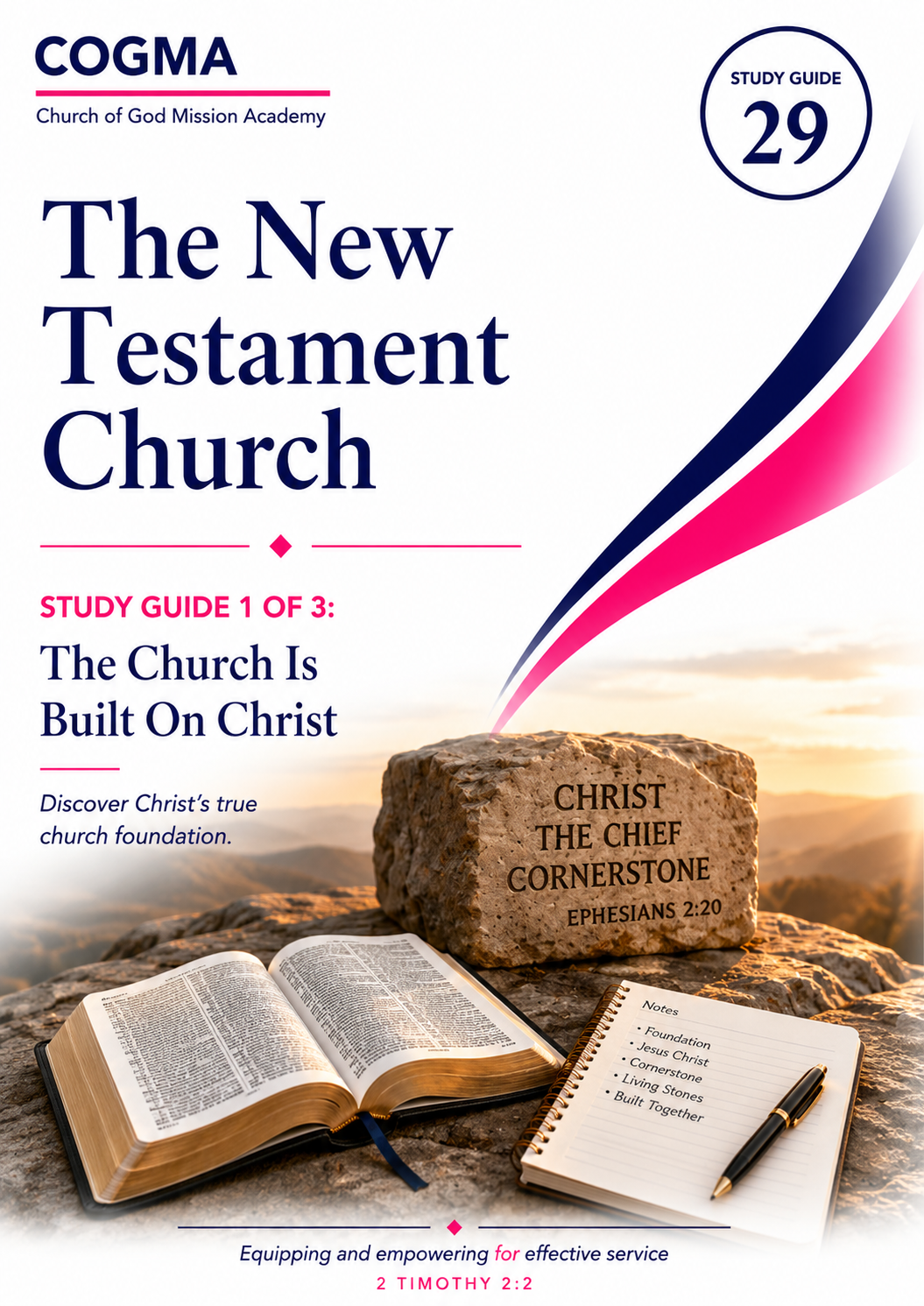
The church is built upon a solid foundation, with Christ Himself being the "chief cornerstone."
Isaiah prophesied concerning the day when Jesus Christ would be revealed:
Isaiah 28:16 says:
Therefore thus saith the Lord GOD, Behold, I lay in Zion for a foundation a stone, a tried stone, a precious corner stone, a sure foundation: he that believeth shall not make haste.
Traditionally, the cornerstone was the initial stone laid, serving as a reference for the building's alignment both horizontally and vertically.
Paul, referencing Isaiah, elaborates on this when he writes:
Ephesians 2:20 says:
And are built upon the foundation of the apostles and prophets, Jesus Christ himself being the chief corner stone;
Paul uses the imagery of a traditional building of his time, where the structure rests upon a stone foundation. Jesus Christ is likened to the first stone laid, determining the building's orientation and alignment.
Paul explains that the prophets and apostles serve as additional foundation stones, aligning with the "chief cornerstone," Jesus Christ. This signifies that both the Old Testament Scriptures and the New Testament writings are in harmony with Christ, without any contradictions.
Paul further states that followers of Christ and true Christianity are built upon this foundation, encompassing the Word of God from Genesis to Revelation.
It is no surprise, then, that there is a curse on anyone who alters the Word of God, as doing so would disrupt the foundation's alignment and integrity. Such alterations lead to the creation of man-made religious systems and beliefs that lack the presence of Christ, resulting in a god fashioned from human imagination.
The Plumbline
Amos, speaking of the day of Christ, said:
Amos 7:8 says:
And the LORD said unto me, Amos, what seest thou? And I said, A plumbline. Then said the Lord, Behold, I will set a plumbline in the midst of my people Israel: I will not again pass by them any more:
This "plumbline" represents the revelation of Jesus Christ, as He Himself declared in the Gospel of John.
John 14:6 says:
Jesus saith unto him, I am the way, the truth, and the life: no man cometh unto the Father, but by me.
Thus, it is essential to remember that true Christianity is centred around Jesus Christ. He remains the central message, as affirmed by the writer of Hebrews:
Hebrews 13:8 says:
Jesus Christ the same yesterday, and to day, and for ever.
This statement underscores the Bible's completeness, authenticity, and reliability from Genesis to Revelation, with the overarching message being that Jesus Christ is all we need. The gospel woven throughout the Bible is "all about Jesus." He is referred to as the "mighty God" and the "everlasting Father," highlighting the centrality and sufficiency of Christ in Christianity.
The message will always be Jesus. The revelation for this day is "all Jesus." Jesus Christ is all you need to lead and guide you into the full truth and understanding of Himself and His church. If you submit to His will, He will keep you free and prevent you from joining any man-made, earthly religious organisations.
Personal Response
Key Truth
What does it mean to you that Jesus is described as the "Amen" — the unchangeable, faithful witness — and how does this affect your confidence in His Word?
Personal Reflection
In what ways have you seen people, including yourself, build their faith on something other than the unchangeable foundation of Christ?
Action Step
What is one specific step you will take to ensure your faith rests more firmly on the unchanging truth of Christ rather than on tradition or human interpretation?
Paul's Timeless Warning
Paul issued a timeless warning in his letter to the Colossians.
Colossians 2:8 says:
Beware lest any man spoil you through philosophy and vain deceit, after the tradition of men, after the rudiments of the world, and not after Christ.
The Greek term for "spoil" is SULUGOGEO, implying to take something valuable as booty or loot. There is nothing more precious than your soul, for which Jesus sacrificed His life.
Paul indicates that through worldly desires, deceit, and tradition, some aim to lead you astray, stealing your precious soul away from Christ. Paul also teaches that putting your faith fully in Jesus not only completes you but also keeps you in His truth.
Colossians 2:10 says:
And ye are complete in him, which is the head of all principality and power:
The Greek word for "complete" is PLERES, meaning to be made full, whole, or perfect.
Jesus as the Amen
In the book of Revelation, addressing the Laodicean church, Jesus introduces Himself as the AMEN.
Revelation 3:14 says:
And unto the angel of the church of the Laodiceans write; These things saith the Amen, the faithful and true witness, the beginning of the creation of God;
In the context of the book of Revelation, this letter is relevant to our current era. It is a period where many people place their faith in worldly possessions and view God as a way to satisfy their material desires, overlooking the risk and state of their souls.
God, being a Spirit, places the utmost importance on the health and salvation of your soul. His Word is spiritual, just like He is.
John 6:63 says:
It is the spirit that quickeneth; the flesh profiteth nothing: the words that I speak unto you, they are spirit, and they are life.
Our belief and faith are fundamentally built on the principle that the words of Jesus are spiritual, thus eternal and unalterable.
In the Book of Revelation, the term "AMEN" is used similarly to "verily" as spoken by Jesus in the Gospels. Interestingly, "verily" translates to "AMEN" in Greek.
Paul echoes this sentiment in his second letter to the Corinthians, shedding light on its significance.
2 Corinthians 1:20 says:
For all the promises of God in him are yea, and in him Amen, unto the glory of God by us.
Paul's message implies that the words and truths of Christ are immutable. Despite living in a time period where truth and reality seem flexible, the Bible, the Word of God, remains steadfast. In the book of Revelation, Jesus affirms He alone is the "faithful and true witness," providing a sure foundation for all who place their faith in Him.
As you progress through this Study Guide, put your trust in the words of Jesus Christ over those of man or COGMA. Trust in the witness of the Holy Spirit, for you have an unction, an anointing to know all things.
1 John 2:27 says:
But the anointing which ye have received of him abideth in you, and ye need not that any man teach you: but as the same anointing teacheth you of all things, and is truth, and is no lie, and even as it hath taught you, ye shall abide in him.
Recognising that you have been chosen for a divine purpose, continue your studies with an openness to the unchanging truth of Christ.
Personal Response
Key Truth
What does this lesson reveal about the absolute and unchangeable authority of Christ and His Word in relation to the church?
Personal Reflection
What has this study shown you about the way you have previously understood the authority of Christ versus the authority of human tradition or teaching?
Action Step
What is one specific decision you will make to place Christ's unchanging Word above any man-made doctrine or tradition in your life?
Identifying the New Testament Church
With over 45,000 different denominations, sects, and groups all claiming to be God's church, finding the one true church Jesus claims as His own might seem challenging — especially when you consider that each might follow some element of truth from the Bible.
However, this complexity is resolved knowing that God is not the "author of confusion," as Paul wrote to the Corinthians.
1 Corinthians 14:33 says:
For God is not the author of confusion, but of peace, as in all churches of the saints.
Jesus Knows His Sheep
In the gospel of John, Jesus said that He knows His sheep by name and that His sheep know His voice. In chapter 15 of the same Gospel, Jesus said, "I am the true vine," suggesting there are other vines impersonating Him.
John 15:1 says:
I am the true vine, and my Father is the husbandman.
Jesus would be guilty of using idle words if there were no false vines. Instead, He uses symbolism and metaphorical language to paint a picture that reveals a spiritual reality.
John 15:5 says:
I am the vine, ye are the branches: He that abideth in me, and I in him, the same bringeth forth much fruit: for without me ye can do nothing.
The vine gives life to the branches, and it is through the vine that the branches are identified — the branches indicate which vine they belong to.
The Two Vines
In the book of Romans, Paul made this distinction between the two vines when he said:
Romans 8:9 says:
But ye are not in the flesh, but in the Spirit, if so be that the Spirit of God dwell in you. Now if any man have not the Spirit of Christ, he is none of his.
The Holy Spirit, the Spirit of Christ, is the one who imparts life to the members of the body of Christ, symbolised as the "branches."
Returning to Jesus' words in John, He identifies His branches:
John 15:7 says:
If ye abide in me, and my words abide in you, ye shall ask what ye will, and it shall be done unto you.
Jesus now clarifies that "abiding in Him" is contingent on "His words abiding." In other words, the Holy Spirit and Christ's words are inseparable. You cannot claim to be a branch in Christ and not accept all His words.
John 8:31 says:
Then said Jesus to those Jews which believed on him, If ye continue in my word, then are ye my disciples indeed;
John 6:63 says:
It is the spirit that quickeneth; the flesh profiteth nothing: the words that I speak unto you, they are spirit, and they are life.
The "branches" cannot separate the Holy Spirit from the Word of God, as Peter highlights in his first epistle.
1 Peter 1:23 says:
Being born again, not of corruptible seed, but of incorruptible, by the word of God, which liveth and abideth for ever.
We are born again by the "word of God" — that is, Christ Himself — who not only abides in the believer, but lives and abides forever.
This is good news because to accept Christ we must also accept all His words. By accepting all of the Word of God, we can separate the one true church from the 45,000 or more who claim to be the church.
God has put a "plumb line" in our midst that we can measure the true church and separate her from the counterfeits. God's Word contains markers or identifiers to allow us to clearly see the church that Jesus built. Some of these identifiers we will study in greater detail in separate lessons in this Study Guide.
Personal Response
Key Truth
What is the key truth this lesson has shown you about how to identify the true church using God's Word as the plumb line?
Personal Reflection
What has this lesson revealed about the way you have previously identified or evaluated a church or group as being of God?
Action Step
What is one specific action you will take to more consistently use God's Word — rather than tradition or personal preference — to measure spiritual truth?
What Is the Church?
The terms "church" and "churches" appear 109 times in the original Greek text of the New Testament, where they are represented by the word EKKLESIA. Instead of translating this directly as "church," the original text uses the word "assembly," a term you will come to understand shortly. This word EKKLESIA can also be interpreted as "congregation."
The King James Version of the Bible uses "church" to denote the collective body of all born-again believers, regardless of their location on Earth or in Heaven — in other words, both terrestrial and celestial. It also refers to specific local gatherings of God's church.
Key Definitions
i.
Terrestrial
Within the context of the church, this term describes born-again believers who are still alive and dwelling on Earth.
ii.
Celestial
In the church's context, this refers to believers who have passed away and reside in God's Heaven, including the "faith heroes" mentioned in Hebrews Chapter 11.
Thus, the context determines whether the text is discussing the universal Church or specific local assemblies of it. For instance, when Paul addresses his letters to "the church of God which is at Corinth" or mentions "the churches of Galatia," it is clear from the context that he is referring to one or multiple local assemblies of the universal church.
The Beginning of the Church
While it is widely believed that the church began on the day of Pentecost in 31 A.D., it is essential to recognise that the church, being of "spirit," pre-existed this date in a different form. Thus, it is more accurate to say that the church was made manifest — that is, revealed — on Earth on the day of Pentecost. It was not a tangible or physical entity that could be seen or touched, but rather, it was spirit.
The tangible expression of the church's reality is found in the love its members show towards one another.
John 13:35 says:
By this shall all men know that ye are my disciples, if ye have love one to another.
In this context, Jesus was not referring to a humanistic love, which is often based on physical appearance, feelings, and emotions, but to a divine love bestowed by God Himself. The Greek word for "love" used here is AGAPE, indicating a love that originates from God, as John stated, "God is AGAPE."
Jesus' Promise
Matthew 16:18 says:
And I say also unto thee, That thou art Peter, and upon this rock I will build my church; and the gates of hell shall not prevail against it.
This statement marks one of only three instances in the Gospels where Jesus mentions the word "church." He often spoke of the "kingdom of God," a concept more familiar to the people of His time.
Paul in his letters uses the words "church" and "kingdom" interchangeably to mean the same thing. For example, in Colossians chapter 1, Paul writes that when you are born-again you are "translated into the kingdom." Yet, in his letter to the Ephesians, he writes that when you are born-again you become part of the "body of Christ, the church."
It is a common belief that Jesus spent His 3½ years of ministry gathering the components for His church. However, this can be misleading and suggest the misconception of a church being physically established on the day of Pentecost. A more precise interpretation is that Jesus prepared people, including His disciples, to become one with the church on the day of Pentecost.
The phrase "I will build my church" spoken to Peter does not imply that this construction occurred during His earthly ministry. What is evident is that by the day of Pentecost in 31 A.D., the church had been established, as evidenced by God adding to it daily such as were being born-again.
Acts 2:47 (YLT) says:
Praising God, and having favour with all the people. And the Lord added to the church daily such as should be saved.
The phrase "should be saved" is not an accurate translation; a more literal interpretation would be "the ones being saved from day to day." Salvation is not predestined; it is a choice to be born again and saved. This choice is consistent with the foundation that remains the same "yesterday, today, and forever," available under both the New and Old Covenants.
Joshua 24:15 says:
And if it seem evil unto you to serve the LORD, choose you this day whom ye will serve; whether the gods which your fathers served that were on the other side of the flood, or the gods of the Amorites, in whose land ye dwell: but as for me and my house, we will serve the LORD.
Elijah, when confronting the prophets of Baal, challenged Israel with the same choice. Choosing to serve God was a voluntary decision in Joshua's and Elijah's day as it still is today.
Personal Response
Key Truth
What does the meaning of EKKLESIA — "called out assembly" — reveal to you about what it truly means to be part of the church of God?
Personal Reflection
Has this lesson changed or deepened your understanding of what the church is? In what way?
Action Step
What is one specific action you will take this week to live out the truth that you are part of a called-out, Spirit-led assembly rather than simply attending a religious organisation?
Jesus' Dwelling Place
Jesus' statement in Matthew 16:18 essentially means He would "build a dwelling place" not just for believers, but for Himself as well.
Psalm 132:13-14 says:
For the LORD hath chosen Zion; he hath desired it for his habitation. This is my rest for ever: here will I dwell; for I have desired it.
"Zion" symbolically points to the "church of the firstborn," as mentioned in the book of Hebrews, which we will explore in later lessons. The question then arises: how would Jesus build His church, His dwelling place?
Romans 5:5 says:
And hope maketh not ashamed; because the love of God is shed abroad in our hearts by the Holy Ghost which is given unto us.
Jesus, as the manifestation of God's love, filled His disciples with the Holy Spirit on the day of Pentecost, effectively making them His dwelling place. Jesus' presence in them was marked by genuine love for one another, a love that transcends physical attributes or emotions, demonstrated through selfless service to each other.
The Church as the Body of Christ
There is often confusion about the term "church," with many thinking it refers to the physical place of worship or the building itself. Some also believe their denominations or sects constitute separate churches, contradicting the Scriptural assertion that there is but one Church.
Ephesians 1:22-23 says:
And He has put all things under His feet and gave Him to be Head over all things to the church, which is His body, the fullness of Him who fills all in all.
The Bible clearly defines the church as "the body of Christ," as Paul reiterates in his letter to the Colossians.
Colossians 1:18 says:
And he is the head of the body, the church: who is the beginning, the firstborn from the dead; that in all things he might have the preeminence.
Colossians 1:24 says:
Who now rejoice in my sufferings for you, and fill up that which is behind of the afflictions of Christ in my flesh for his body's sake, which is the church:
Referring to a literal building as a "church" is a misnomer since a physical structure cannot be Christ's body. This brings us to the question: how many bodies does Christ have?
Ephesians 4:4 says:
There is one body and one Spirit, even as you are called in one hope of your calling,
Greek language nuances reveal that "one" can have more than one meaning:
- MIA — defined as "unity of one," or we could say "we are one together."
- HEIS — defined as "the absolute one," or we could say "the one and only."
In Ephesians 4:4, Paul is using the Greek word "heis" to assert the absolute singular nature of Christ's body. Therefore, it is not accurate for any group, denomination, or sect to label itself as the church when every person attending a meeting is not necessarily born-again. An individual who continues to sin does not belong to the body of Christ.
Adhering strictly to the Scriptures, only the body of Christ, encompassing all saved individuals across both earthly and heavenly realms, should be recognised as the church. The term "church" or EKKLESIA carries a deeper meaning, further elaborated by Paul in the next section to ensure a thorough understanding.
Personal Response
Key Truth
What has this section revealed to you about the singular nature of Christ's body — and why only born-again believers can truly belong to it?
Personal Reflection
How has understanding that Christ has only one body, described by the Greek word HEIS, challenged your previous view of denominations or church membership?
Action Step
What is one specific action you will take to ensure your understanding of what constitutes the true church is grounded only in Scripture and not in any human organisation?
The Church Is a Called-Out Assembly to God
EKKLESIA originally means a "called out gathering," describing those who have been called out to gather to God and His purpose. This meaning is echoed in Ephesians 2:6, emphasising our spiritual elevation and oneness in Christ.
Ephesians 2:6 says:
And hath raised us up together, and made us sit together in heavenly places in Christ Jesus:
To be a part of God's church is to respond to His call and seek to fulfil His will. Paul's first letter to the Corinthians serves as an excellent example of this divine call and purpose.
1 Corinthians 1:2 (LITV) says:
To the assembly of God which is in Corinth, those having been sanctified in Christ Jesus, called-out saints, with all those calling on the name of our Lord Jesus Christ in every place, both theirs and ours:
This letter is directed specifically at the "called-out saints." The Greek term HAGIOS, translated as "saint," denotes holiness, blamelessness, and moral purity, reflecting God's nature and distinguishing from worldly ways. It means to be in likeness with the nature of God and opposite or different to the world.
1 Peter 1:15-16 says:
But as he which hath called you is holy, so be ye holy in all manner of conversation; Because it is written, Be ye holy; for I am holy.
1 Thessalonians 4:7 says:
For God hath not called us unto uncleanness, but unto holiness.
Importantly, in 1 Corinthians 1:2, Paul addresses those who have already been sanctified, indicating a distinction from those undergoing sanctification. Sanctification, closely linked to holiness, essentially means being set apart for a specific divine purpose.
Salvation is not only a calling out of darkness into the kingdom of God and being made holy but also an answer to God's call on one's life. Paul described it like this:
1 Corinthians 6:19-20 says:
What? know ye not that your body is the temple of the Holy Ghost which is in you, which ye have of God, and ye are not your own? For ye are bought with a price: therefore glorify God in your body, and in your spirit, which are God's.
The church, therefore, is not a casual social gathering for personal gain or entertainment but is the embodiment of Christ's body. Wherever its true members congregate, there is the church, the assembly of God. To be called and placed into the church of God is not your choice of what you will be in life. It is your choosing for God to re-make you into what He chooses you to be to fulfil His purpose.
2 Corinthians 5:17 says:
Therefore if any man be in Christ, he is a new creature: old things are passed away; behold, all things are become new.
In summary, the genuine followers to whom Paul wrote had been raised up in Christ and placed into the church to live a life of holiness and righteousness, dedicating themselves to being used according to God's will.
Personal Response
Key Truth
What truth stands out most to you from this lesson about the nature of the church as the body of Christ and a called-out assembly?
Personal Reflection
What has this study revealed about the difference between belonging to a religious organisation and being part of the true body of Christ?
Action Step
What is one specific area of your life where you will submit more fully to God's call on you as a member of His called-out, holy assembly?
The Church — Built on Christ
When we say that the church is built on Christ, we are saying that He is the "beginning" of the church. The church cannot exist outside of Christ because its life is connected to Him. He is the Vine, and we, the members of His body, are the branches that receive our life from the Vine.
It is easy to get sidetracked and perceive the church as a physical or literal entity, but that is not the case. It is the body of Christ, a spiritual entity comprising spirits who are born again. Together with Christ, who is the Head, they make up the kingdom of God. To restate the obvious, the body cannot exist without the head connected.
Jesus Is the Head
While it is widely accepted and taught in Christian religious organisations that Jesus Christ is the Head of His body, in reality, this is not always the case. The existence of over 45,000 denominations and groups claiming to be the church shows this discrepancy. Paul emphasises that Jesus alone is the Head of the church.
Ephesians 1:22 says:
And hath put all things under his feet, and gave him to be the head over all things to the church,
Paul repeats this truth in his letter to the Colossians.
Colossians 1:18 says:
And he is the head of the body, the church: who is the beginning, the firstborn from the dead; that in all things he might have the preeminence.
Jesus as the Lawmaker
Like any organisation or institution, the head is its lawmaker. This applies to the church as well, where Jesus is the Lawmaker.
Isaiah 33:22 says:
For the LORD is our judge, the LORD is our lawgiver, the LORD is our king; he will save us.
Despite this crucial truth, every denomination and sect creates its own laws, creeds, disciplines, faith statements, and systems of membership. Consequently, they do not adhere to the true head, who is Jesus Christ.
At first, these creeds might seem helpful for congregation members to know what to believe and how to live. But these creeds and man-made rules create divisions within the body of Christ and become ingrained traditions. These human-made rules can become as revered as the Bible itself.
H. M. Riggle said in 1913, "Any creed larger than the Bible is too large, just as any creed smaller than the Bible is too small." He believed that God's revealed Word is sufficient. The New Testament provides all we need for life, godliness, and Christian practice. Why use anything that detracts from or adds to God's Word? Stick to the truth as revealed and share that with the world.
When we seize the authority and position of God as the head of His church, we assume His seat as God and declare ourselves to be God. To reinforce the truth of Isaiah 33:22, James repeats that Jesus is the only lawgiver.
James 4:12 says:
There is one lawgiver, who is able to save and to destroy: who art thou that judgest another?
The true body of Christ is always subject to the Head, who is Jesus Christ, and therefore true to all His Word.
Jesus Is the Founder
We are told in the book of Hebrews that Abraham looked for a city:
Hebrews 11:10 says:
For he looked for a city which hath foundations, whose builder and maker is God.
The following chapter, Paul reveals the "city of God."
Hebrews 12:22-23 says:
But ye are come unto mount Sion, and unto the city of the living God, the heavenly Jerusalem, and to an innumerable company of angels, To the general assembly and church of the firstborn, which are written in heaven, and to God the Judge of all, and to the spirits of just men made perfect,
Both Psalm 89:27 and Colossians 1:15 reveal that Jesus is the "firstborn." The most probable date of the writing of the letter to the Hebrews is around 63 or 64 A.D. The city that Abraham looked for existed at that time. In fact, the church that Jesus founded was revealed on the day of Pentecost in 31 A.D.
Jesus is not only the builder of the church; He is also the owner of the church. In his parting address to the elders in Miletus, Paul proclaimed that Jesus is the owner of the church.
Acts 20:28 says:
Take heed therefore unto yourselves, and to all the flock, over the which the Holy Ghost hath made you overseers, to feed the church of God, which he hath purchased with his own blood.
i.
The Origins of Denominations
Although we will cover the origins of the various Protestant denominations and sects in a later lesson dealing with the counterfeits, it is noteworthy that no Protestant entity existed before 1530 A.D. In fact, Protestantism was birthed out of the Roman Catholic religious system, which had its beginnings in 313 A.D. when Emperor Constantine became the head of "state Christianity" and forerunner to the popes.
ii.
The True Church
It may be challenging to accept, but the church founded on the day of Pentecost in 31 A.D. did not turn away from Christ and become the Roman Catholic institution. During the era known as the Dark Ages, many true believers were persecuted and martyred for their faith in Jesus Christ.
The church established by Jesus is not a product of the Roman Catholic system or various Protestant denominations. Instead, it is a living organism composed of born-again believers who faithfully follow Christ.
A genuine believer finds complete satisfaction in Christ and has no need to protest. This sentiment is echoed in Psalm 107.
Psalm 107:9 says:
For he satisfieth the longing soul, and filleth the hungry soul with goodness.
Philippians 4:19 says:
But my God shall supply all your need according to his riches in glory by Christ Jesus.
In future modules on Pentecostalism and the Eight Beasts of Revelation, we will explore the origins of various religious systems in greater detail.
Personal Response
Key Truth
What is the main truth this section has shown you about Jesus as the founder, owner, and builder of His church — and what this means for every group that calls itself a church?
Personal Reflection
What has this section revealed about the difference between the true, living church that Jesus built and the religious institutions formed by human tradition and history?
Action Step
What is one specific decision you will make, or truth you will hold firmly, as a result of understanding that no Protestant or Catholic institution preceded or replaced the church Jesus revealed on the day of Pentecost?
Jesus Is the Foundation
After Peter had revealed that Jesus is "the Christ, the Son of the living God," Jesus responded concerning His church.
Matthew 16:18 says:
And I say also unto thee, That thou art Peter, and upon this rock I will build my church; and the gates of hell shall not prevail against it.
Once again, we read that Jesus was not only going to build the church, but He also claimed ownership of the church: "I will build my church."
Jesus also explains that He would build His church upon "rock." The rock would be the foundation, so He was revealing that He would build His church on the revelation of Himself. Jesus is using imagery to reveal a structure that is resting or fixed to a foundation which is Himself.
It is similar to the imagery Jesus gave when saying He is the Vine and we are the branches. Likewise, He is the Head and we are the body. They portray the same element of truth that both Christ and the church are ONE and therefore of the same substance, which is spirit. How this is possible will be explained further in this Study Guide.
Obviously, Jesus was not talking about a physical building built upon His physical person, but rather a spiritual building built upon the revelation of Himself. Reading carefully, notice that Jesus was speaking in the future tense. He was not going to "build" His church during His earthly ministry. It could only be revealed after His death and resurrection and on the day of Pentecost when Jesus returned as SPIRIT.
The Holy Spirit is the true revelation of who Jesus is. Jesus is the one and true living God. It is the great mystery that Paul revealed: "Christ in you." Physically, this is not possible; however, the revelation of Jesus reveals that He is the Holy Spirit.
i.
The Meaning of Revelation
The word "revelation" should be understood similarly to the opening verse in the book of Revelation. It begins with the phrase "The revelation of Jesus Christ." Here, the word "revelation" is the Greek word APOKALUPSIS, which means to uncover or reveal that which was once hidden. Literally, it means to take away a veil.
This "unveiling," according to the first verse in the book of Revelation, is intended for the "servants of Jesus" only. For the "church of God" to be built on Christ and owned by Him, it must also be governed by Him and, spiritually speaking, be one with Him.
ii.
Built on the Foundation of Christ
Ephesians 2:20 says:
And are built upon the foundation of the apostles and prophets, Jesus Christ himself being the chief corner stone;
The imagery is that of a traditional building of Paul's time, where the structure, that which is visible, rests upon a stone foundation, which is invisible. The invisible, which is SPIRIT, governs the visible, which is the church, comprising "saints of the household of God."
Paul in his letter to the Romans says:
Romans 8:14 says:
For as many as are led by the Spirit of God, they are the sons of God.
We could say that the "saints," the children of God, are "governed" by the Spirit of God who is the "Spirit of Christ."
Romans 8:9 says:
But ye are not in the flesh, but in the Spirit, if so be that the Spirit of God dwell in you. Now if any man have not the Spirit of Christ, he is none of his.
The Mystery of Christ in You
Remember the mystery!
Colossians 1:26-27 says:
Even the mystery which hath been hid from ages and from generations, but now is made manifest to his saints: To whom God would make known what is the riches of the glory of this mystery among the Gentiles; which is Christ in you, the hope of glory:
Romans 8:15 says:
For ye have not received the spirit of bondage again to fear; but ye have received the Spirit of adoption, whereby we cry, Abba, Father.
The word "whereby" in the original Greek can also be translated as "whom." In other words, the "Spirit of adoption" is also "Abba, Father." This is in harmony with the Old Testament revelation in Isaiah 9:6 that Jesus is the "mighty God and everlasting Father."
When a person is born again, they receive Christ, not in a physical form but as Spirit. And according to Paul's words in Colossians 2:10, that completes and makes that person one with Christ.
As we conclude, the only way the world sees the foundation, Jesus Christ, is by observing the church — not an organisation or a literal building, but the individuals and members of the body of Christ in obedience to His Word and ministering Agape.
John 13:35 says:
By this shall all men know that ye are my disciples, if ye have love one to another.
The Foundation of God's Word
Christianity is not anything unless it is founded upon and rests in God's Word.
Psalm 119:105 says:
Thy word is a lamp unto my feet, and a light unto my path.
Personal Response
Key Truth
What has this lesson shown you about why the church must be built solely on Christ and His Word — and not on any human system, creed, or organisation?
Personal Reflection
How has this study challenged or deepened your understanding of what it means to be governed by the Head, Jesus Christ, in your daily life and walk with Him?
Action Step
What is one specific action you will take to align your life more fully with Christ as the head and foundation — choosing His Word over any tradition, creed, or man-made standard?
Jesus Is the Door
Jesus Christ is the only entrance into the church, which is the body of Christ.
John 10:7-9 says:
Then said Jesus unto them again, Verily, verily, I say unto you, I am the door of the sheep. All that ever came before me are thieves and robbers: but the sheep did not hear them. I am the door: by me if any man enter in, he shall be saved, and shall go in and out, and find pasture.
Warning Against False Entrances
At the start of this chapter, Jesus warns that many would attempt to enter and claim to be Christians by using a different way.
John 10:1 says:
Verily, verily, I say unto you, He that entereth not by the door into the sheepfold, but climbeth up some other way, the same is a thief and a robber.
This is a warning that many would try to enter the kingdom of God without truly relying on Christ and His Word for salvation. It is a cautionary note that many would establish religious organisations with man-made rules, traditions, formulas, and methods to supplant true salvation.
Membership Criteria in Denominations
Of the 45,000 different sects and denominations, many promote a form of salvation that requires additional steps to gain acceptance into their groups. For instance:
- Baptist denomination: Must demonstrate evidence of water baptism or undergo rebaptism according to their method.
- Pentecostal denomination: Must show evidence of speaking in unknown tongues as proof of salvation.
- Independent Baptist denomination: Must believe in "once saved, always saved."
- Holiness group and many Church of God groups: Must hold to the doctrine of original sin, entire sanctification, and two works of grace.
- Many Church of God groups: Must partake in the ordinances of water baptism, the Lord's supper, and feet washing.
The True Church's Membership Rule
The true church that Jesus built makes salvation the only rule of membership. It acknowledges that only God can add to His church and that salvation is the only door to His Kingdom.
John 3:5-7 says:
Jesus answered, Verily, verily, I say unto thee, Except a man be born of water and of the Spirit, he cannot enter into the kingdom of God. That which is born of the flesh is flesh; and that which is born of the Spirit is spirit. Marvel not that I said unto thee, Ye must be born again.
Paul's Warning Against Man-Made Rules
Many of these groups claim to uphold the "gospel of salvation," yet they hold onto beliefs, traditions, and ordinances as a means to complete or maintain one's salvation and membership to the group. However, Paul, in his letter to the Colossians, opposed these deceptions and declared that Jesus alone makes us whole and members of His body.
Colossians 2:10 says:
And ye are complete in him, which is the head of all principality and power:
Paul warned against these man-made rules and conditions of membership as usurping the simplicity of salvation.
Colossians 2:8 says:
Beware lest any man spoil you through philosophy and vain deceit, after the tradition of men, after the rudiments of the world, and not after Christ.
As stated earlier in this Study Guide, the Greek word for "spoil" is SULUGOGEO, implying to take something valuable as booty or loot. There is nothing more precious than your soul, for which Jesus sacrificed His life.
Salvation alone, being born-again, is the door to the kingdom, and despite denominations and sects adding conditions and traditions of membership, the door is continually open and no man can shut it.
Revelation 3:8 says:
I know thy works: behold, I have set before thee an open door, and no man can shut it: for thou hast a little strength, and hast kept my word, and hast not denied my name.
In upcoming Study Guides, we will study the "Ordinances of the New Testament" and also explore the beliefs of "Pentecostalism" and other denominational groups.
The True Church vs. Denominations
The fact that many denominations and sects have doors or conditions for admitting members based on man-made rules shows they are not the true church and body of Christ. The true Church, the body of Christ, has a door that no one can open or shut, where Jesus alone is the way.
John 14:6 says:
Jesus saith unto him, I am the way, the truth, and the life: no man cometh unto the Father, but by me.
Personal Response
Key Truth
What does this lesson reveal about Jesus as the only door into the church, and why is this truth so vital for distinguishing the true church from counterfeits?
Personal Reflection
What has this study shown you about any ways in which you may have accepted or relied upon conditions of membership beyond salvation alone?
Action Step
What is one specific action you will take to ensure you are entering and remaining in Christ through the door of salvation — and not through any man-made requirement?
Church or Churches?
Perception of Christianity
As we have discussed before, the world sees Christianity through the actions, words, and examples of those who claim to follow Christ. Therefore, to the world, it seems that Christ has many churches, represented by numerous denominations and sects. However, this is not accurate. Jesus is the head of only one body, which is His single church.
i.
The Oneness of the Church
Ephesians 4:4-6 says:
There is one body, and one Spirit, even as ye are called in one hope of your calling; One Lord, one faith, one baptism, One God and Father of all, who is above all, and through all, and in you all.
Key points from this passage:
- One Body: Jesus is the head of a single church, not multiple.
- One Spirit: The church is unified by one Spirit.
- One Hope: All believers share the same hope in their calling.
- One Lord: Jesus Christ is the singular Lord over His church.
- One Faith: True believers share the same faith.
- One Baptism: There is one baptism into the body of Christ.
- One God and Father: God is the Father of all who are born again, forming one unified body.
ii.
Nature of the True Church
- The church is not an institution, organisation, or building.
- It is the body of Christ, made up of "called out saints who have gathered to God for His purpose."
- The church is a group of people who emulate the nature and character of God.
Misleading Claims of Denominations
Therefore, any denomination or sect, including the Roman Catholic system, that calls themselves churches, are misleading and not the true church of God. This is because none of these religious organisations can claim to be made up entirely of born-again believers.
- Denominations and sects cannot claim to be the true church if they are not entirely made up of born-again believers.
- The Roman Catholic system, like other denominations, is not the true church of God.
- It is possible that within these religious institutions, there are born-again believers who are part of the true church.
The True Church
The true church is a collective body, not defined by physical location. It is made up of individuals who are truly born again and follow Christ. We will explore this further in upcoming lessons.
Personal Response
Key Truth
What does the truth of "one body" mean to you in light of the many denominations and groups that claim to be the church of God?
Personal Reflection
How has this lesson challenged or affirmed your understanding of where the true church is found, and what it is made of?
Action Step
What is one specific action you will take to align yourself more fully with the singular, born-again body of Christ rather than with any denominational or sectarian identity?
Lesson 8: Confusion
The Myth of Two Spirits
Some individuals may be taught to believe that to be made whole as a believer, one must receive two spirits: firstly, Jesus at conversion and then subsequently the Holy Spirit at a future date. However, nowhere in the Bible does a born-again believer receive more than one Spirit.
i.
Biblical Clarity on the Spirit
We are not led by "spirits," but by one Spirit as the Scriptures affirm:
- Romans 8:14: "For as many as are led by the Spirit of God, they are the sons of God."
- 1 Corinthians 2:12: "Now we have received, not the spirit of the world, but the Spirit which is of God; that we might know the things that are freely given to us of God."
- Galatians 5:16: "This I say then, walk in the Spirit, and ye shall not fulfil the lust of the flesh."
- Galatians 5:18: "But if ye be led of the Spirit, ye are not under the law."
- 1 Thessalonians 5:19: "Quench not the Spirit."
ii.
The Unity of the Spirit
When comparing the following verses, it becomes obvious that the Spirit of God, the Holy Spirit, is also our Father, Jesus Christ:
- 1 Corinthians 3:16: "Know ye not that ye are the temple of God, and that the Spirit of God dwelleth in you?"
- 1 Corinthians 6:19: "What? know ye not that your body is the temple of the Holy Ghost which is in you, which ye have of God, and ye are not your own?"
- 2 Corinthians 6:16: "And what agreement hath the temple of God with idols? for ye are the temple of the living God; as God hath said, I will dwell in them, and walk in them; and I will be their God, and they shall be my people."
Paul further clarifies this in his letter to the Romans:
Romans 8:9 says:
But ye are not in the flesh, but in the Spirit, if so be that the Spirit of God dwell in you. Now if any man have not the Spirit of Christ, he is none of his.
These scriptures collectively demonstrate the oneness of the Spirit and affirm that the Holy Spirit is not separate from Jesus Christ but is indeed one with Him. This understanding is crucial for maintaining clarity and avoiding confusion regarding the nature of the Spirit in the life of a believer.
Personal Response
Key Truth
What is the main truth this lesson has shown you about the oneness of the Spirit and how this relates to the nature of the church?
Personal Reflection
Has this lesson challenged any previous teaching or understanding you have held about receiving the Spirit? In what way?
Action Step
What is one specific step you will take to study the oneness of Christ and the Spirit more deeply, ensuring your understanding aligns with the whole of Scripture?
Just a Thought
Common vs. Proper Nouns
Have you considered why in the original text the word "church" is never capitalised? It is because it is not a "proper noun." It is a generic term for the body of believers called out of this world to God to serve Him in love and righteousness.
Understanding Nouns
i.
Common Noun
A word (other than a pronoun) used to identify any of a class of people, places, or things. For example, the noun "country" is a common noun because it refers to a general, non-specific place.
ii.
Proper Noun
A word that specifically names a person, race, place, or thing. For example, the noun "Australia" is a proper noun because it refers to a specific country in a given location.
Understanding this distinction helps clarify why the word "church" is not capitalised in the original texts. It emphasises the universal and inclusive nature of the body of believers, rather than a specific institution or location.
Personal Response
Key Truth
What does the grammatical distinction between "church" as a common noun versus a proper noun reveal about the universal nature of the body of Christ?
Personal Reflection
How does this insight about the word "church" challenge or clarify the way you have previously thought about what it means to belong to God's church?
Action Step
What is one practical way you will carry this understanding forward in how you speak about, or relate to, the body of Christ?
Summary
This Study Guide has provided a biblical understanding of recognising God's true church, distinct from false religious groups. This study is crucial for discerning the true New Testament church founded by Jesus.
Introduction
Emphasising diligent study, 2 Timothy 2:15 encourages believers to rightly divide the Word of Truth. Paul warned the Corinthians about false apostles and deceitful workers, depicting them as messengers of Satan (2 Corinthians 11:13-15). Similarly, John warned about numerous antichrists intending to divert believers (1 John 2:18). This ongoing spiritual battle between Jesus and Satan underscores the importance of identifying the true church.
The study covers the nature, establishment, symbols, membership, and proper name of the church founded by Jesus. Symbolic language is significant in the New Testament church, requiring an understanding of "The Language of the Bible." This Study Guide seeks to strengthen the understanding that the Bible, a spiritual book, requires spiritual interpretation.
The Purpose of the New Testament Church Study
- Jesus spoke of one church (Matthew 16:18).
- Paul described the church as one body (Ephesians 4:4).
- The multitude of denominations, estimated at over 45,000, reflects a lack of unity contrary to Jesus and Paul's teachings.
- Paul addressed divisions in the Corinthian church, attributing them to carnality and a focus away from Christ (1 Corinthians 3:3-4).
- True Christianity is based solely on Jesus Christ (1 Corinthians 3:11).
The Amen
Understanding the church's revelation requires grasping the unchangeable nature and authority of Christ and His Word. Many denominations practise idolatry under the guise of following Christ, creating a conception of God aligned with their imagination rather than biblical truth.
- The Scriptures validate Jesus as the true Christ (John 5:39), with His resurrection as a key sign.
- Jesus is the central figure of Christianity, akin to the sun in our universe.
- Isaiah prophesied about Jesus as a precious cornerstone (Isaiah 28:16), and Paul reiterated this foundation in Ephesians 2:20.
- True Christianity is centred around Jesus Christ, who remains the same eternally (Hebrews 13:8).
- Paul warned against being led astray by worldly traditions and deceit, emphasising completeness in Christ (Colossians 2:8-10).
- Jesus, as the Amen, affirms His immutable truth (Revelation 3:14), urging believers to trust in His Word.
Identifying the New Testament Church
Amid over 45,000 denominations, identifying the one true church may seem challenging. However, God is not the author of confusion (1 Corinthians 14:33).
- Jesus, as the true vine, indicates the existence of false vines (John 15:1).
- The Holy Spirit, imparting life to believers, is inseparable from Christ's words.
- True branches abide in Christ by accepting all His words (John 15:7).
- The church, composed of born-again believers, is identified through God's Word.
- Accepting all of Christ's words distinguishes the true church from counterfeits.
- God's Word serves as a plumb line, enabling believers to measure and identify the true church.
Conclusion
This Study Guide guides believers in recognising the true New Testament church, grounded in the foundation of Christ and His unchangeable Word. Emphasising spiritual interpretation and trust in God's Word, it seeks to dispel confusion and highlight the unity and purity of the church Jesus established.
You should now prayerfully review this Study Guide and continue to the submission and appraisal section, which you will submit online to COGMA. The online submission process can be found at cogma.com.au.
Personal Response
Key Truth
Looking back across the entire Study Guide, what is the most significant truth you have discovered about the church that Jesus built?
Personal Reflection
What has this Study Guide revealed about the way you have understood, engaged with, or related to the church up until now?
Action Step
What is one lasting change you will make to your walk with Christ as a result of completing this study?
SUBMISSION TO COGMA FOR APPRAISAL
Instructions
Complete this section after you have finished the Study Guide. It must be completed online. The link to the online form that you must complete and submit is located at the bottom of the this Study Guide.
Your answers should reflect your understanding, your personal response, and how you intend to live by the truth you have studied.
Answer honestly and be specific.
1. Main Truth
What is the most important truth this Study Guide has revealed to you about the church that Jesus built, and why does it matter for your walk with Christ?
2. Understanding
In your own words, explain the meaning of EKKLESIA and how it defines the true nature of the church. Why is this understanding essential for distinguishing the true church from man-made religious organisations?
3. Personal Reflection
What did this Study Guide reveal about your own understanding of, or involvement with, organised religion or denominational structures? How has your thinking changed?
4. Response to Truth
Which aspect of this Study Guide most challenged or corrected your previous thinking — for example, the oneness of the Spirit, Jesus as the only lawmaker, or the teaching that salvation alone is the door to the church? Why was this the most challenging?
5. Action Step Required.
Describe one specific practical action you have taken or are planning to take as a direct result of completing this Study Guide. Be specific about what it is, when you intend to do it, and how it connects to what you have learnt.
6. Early Response Required.
Have you begun to apply anything from this Study Guide yet?
Answer Yes or Not yet, and then explain:
If yes, what changed in your thinking or behaviour; if not yet, what has prevented you from taking action?
7. Ongoing Practice
What truth from this Study Guide will you continue to practise or develop over the coming weeks and months? How do you intend to build this into your daily walk?
8. Doctrinal Clarity
Which key doctrine or truth do you now understand more clearly as a result of this Study Guide — for example, Christ as the sole foundation of the church, the nature of the Holy Spirit, or the meaning of "one body"? Explain your new or deepened understanding.
9. Living the Truth
This Study Guide distinguishes knowing about the church from actually living as a member of the true body of Christ. What is the difference for you personally, and what does it look like to truly live as part of the body of Christ in your daily life?
10. Final Response
Share one remaining thought, question, or area of personal growth that you are still considering as a result of this Study Guide. What will you continue to reflect on, study, or pray about going forward?
You must submit your answers to the above 10 questions ONLINE.
Use the link below for your final submission after finishing this Study Guide. Answer honestly and be specific.
Would you prefer a printable copy?